Hi, what do you want to do?






Teach Engineering
May the Magnetic Force Be with You
Class members use mathematics in order to better understand magnetic forces and their interaction on charged particles. After a demonstration of the interaction between a magnet and an electron beam using a CRT computer monitor,...

Concord Consortium
Boiling Point
Is it getting hot in here? Observe boiling from inside a beaker in an engaging interactive. Chemistry scholars heat and cool polar and non-polar solids and observe how molecules react to temperature changes. Your class' misconceptions...

National Research Center for Career and Technical Education
Lou-Vee-Air Car
Who said teaching a STEM lesson plan had to be challenging? Incorporate a career and technology-centered car build into your upcoming force lesson plan, and your class will be moving down the road in no time! Pupils practice...

Mr. E. Science
Forces
May the mass times acceleration be with you. The presentation covers forces, Newton's three Laws of Motion, momentum, and vectors.

Henry Ford Museum
Physics, Technology and Engineering in Automobile Racing
Start your engines! This five-lesson unit introduces physics and Newton's laws through automobile racing. Each lesson includes background information, a student worksheet, and an answer key. There are also culminating...

Roald Dahl
Roald Dahl Matilda Lesson Plans
Fifty eye-catching pages contain six lessons about Roald Dahl's novel, Matilda. Each lesson has a theme and covers a different subject—literacy, social-emotional learning, science, and geography. Scholars analyze characters, examine...

Rice University
College Physics for AP® Courses
Take a look at an organized physics course. The 34-section electronic textbook covers material in AP® Physics 1 and 2. Teachers use the text to supplement lectures and have the class work through the labs. Each section contains...

University of Florida
Understanding Car Crashes: It's Basic Physics!
Make an impact on young physicists with this fun collection of resources. After first watching a video and taking notes on the physics of car crashes, students go on to complete a series of activities that explore the...

Columbus City Schools
It’s Electric!
Shocking! Who knew so many great ideas existed for teaching middle schoolers about electricity? Find them all within this energetic framework. You'll light up at the variety of printable and web-based resources within! After building...

Earth Day Network
Staying Green While Being Clean
Clean up the environment with a lesson that focuses on replacing hazardous cleaning supplies with green, environmentally-friendly products. Using a dirty patch of surface as a control area, kids clean other parts of various surfaces...

New York State Education Department
Regents High School Examination, Physical Setting, Physics 2006
For this physics worksheet, students complete 72 multiple-choice, problem-solving, and short-answer questions on various physics concepts.

PHET
Mapping the Field of Multiple Dipole Magnets
So you built a magnetometer, now what? High school scientists use their magnetometer made in a previous lesson to map the union of magnetic fields of dipole magnets. They experiment with different alignments and draw conclusions about...

Teacher's Corner
The Magic School Bus: Plays Ball Video
Join the Magic School Bus crew as they take a field trip to the baseball field. Learners respond to questions as they watch the video.
University of Colorado
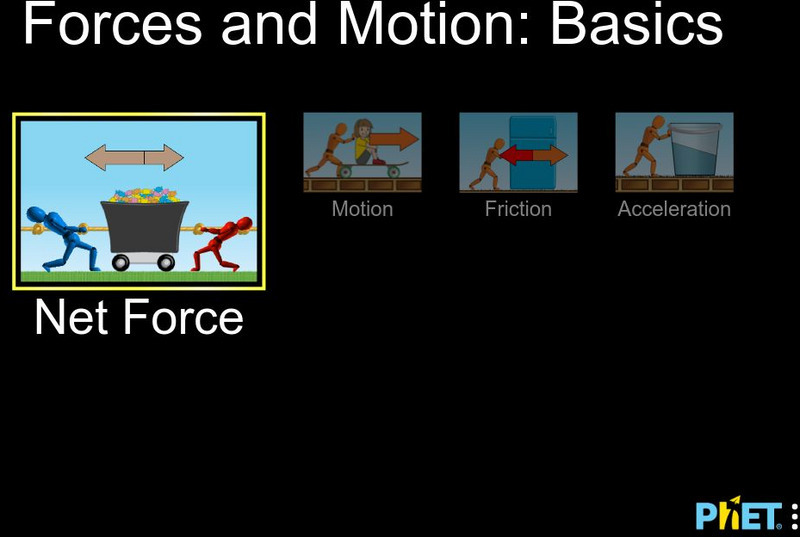
University of Colorado: Ph Et Interactive Simulations: Forces and Motion: Basics
Explore the forces at work when pulling against a cart, and pushing a refrigerator, crate, or person. Create an applied force and see how it makes objects move. Change friction and see how it affects the motion of objects.
University of Colorado
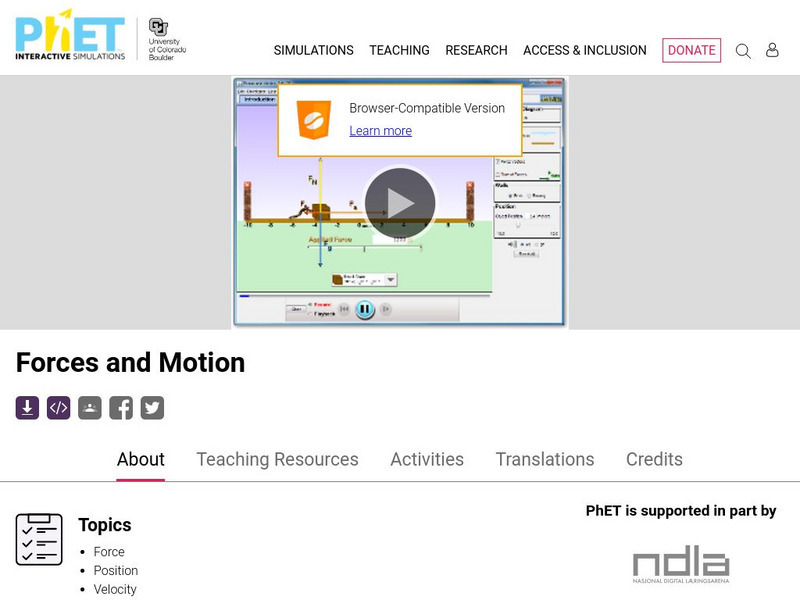
University of Colorado: Ph Et Interactive Simulations: Forces and Motion
Explore the forces at work when you try to push a filing cabinet. Create an applied force and see the resulting friction force and total force acting on the cabinet. Charts show the forces, position, velocity, and acceleration vs. time.