Hi, what do you want to do?






PreKinders
Rainforest Word Cards
Great for a science lesson or language arts activity, these picture word cards feature animals and plants that live in rainforest habitats. It includes pictures and names of rainforest residents like lemurs, monkeys, and parrots.

Lerner Publishing
Teaching Habitats
What makes up a habitat? Use this resource to engage first graders in the exploration of desert, wetland, forest, and ocean habitats. Youngsters classify plants and animals into the four distinct habitats through drawings and cutting and...

Curated OER
The Chesapeake Bay in Captain John Smith's Time
When Captain John Smith visited the Chesapeake Bay in the summer of 1608, what types of animals and habitats did he encounter? Your young historians will analyze primary source documents to answer this question, as well as compare...

Wildwood Trust
Habitats
The circle of life is all around us, from the black bears in the nearby mountains to the pile of dead leaves in the backyard. Encourage young scientists to take a critical look at the world around them with a set of lessons...

PreKinders
Colors of Nature
The colors of nature are the most beautiful and vivid colors in the world. Show kids the ways that colors are striking and changing throughout different habitats with a set of images that feature two animals or plants for each color.

Rainforest Alliance
Protecting the Critical Habitat of the Manatee and Loggerhead Turtle
Explore ocean habitats with a lesson that showcases the home of manatees and loggerhead turtles in Belize. Here, pupils compare and contrast the homes of ocean animals to those of humans, listen to an original short story about...

DePaul University
Contrast and Evaluate Fact and Opinion
How can you tell when an author is expression an opinion or stating a fact? Use two short reading selections to emphasize the difference between a statement that you can prove and one that you can't. The first passage explains food...

Columbus City Schools
Get Your Organisms Organized
From large to small, show your class how to organize them all! Included within the guide is everything you need to take their knowledge of classification from the cellular to the species level. The worksheets focus on...

K12 Reader
Competing for Resources
Young biologists examine the concept of scarce resources with a reading comprehension passage. After finishing the paragraphs, learners turn to the questions to demonstrate what they have learned about what is beneficial and what is...

New York State Department of Environmental Conservation
Adaptations – Designs for Survival
What's the difference between behavioral adaptations and physical adaptations? Learn about the various ways that organisms adapt to their environment with a worksheet about the creatures of the Hudson River.

Living Rainforest
Finding the Rainforests
From Brazil to Indonesia, young scientists investigate the geography and climate of the world's tropical rain forests with this collection of worksheets.

K12 Reader
Adapting to Survive
Life science and language arts come together in a passage about animal adaptation. After kids learn about how organisms adapt to conditions in their environments, they complete five reading comprehension questions based on context clues...

K5 Learning
All About Bears
Want to know all about bears? Read a passage about the way they look, how they live, and their lifestyles. The reading passage is followed by questions that ask what baby bears are called and in what ways some bears are different,...

National Park Service
Living & Non-Living Interactions
What better way to learn about ecosystems than by getting outside and observing them first hand? Accompanying a field trip to a local park or outdoor space, this series of collaborative activities engages children in...

K12 Reader
Habitat Destruction
What happens when an animal becomes endangered or extinct? Explore the ways that human influence throughout the environment has threatened the existence of other species with a reading passage. After reading the paragraphs, kids answer...

University of South Carolina
Home Sweet Home
Fifth graders will research a biome (land or aquatic) and create a project (diorama, model or another idea of the student's choosing) which includes the geographic features of that biome as well as plants and animals found there and...
BioEd Online
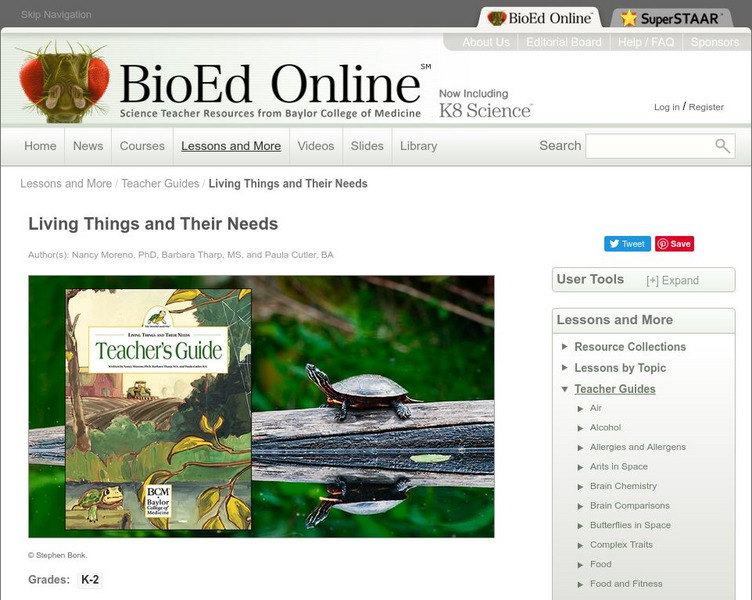
Bio Ed Online: Living Things and Their Needs Teacher's Guide
This is a free downloadable teacher's guide (PDF) to teach young children (grades K-2) about living things and their needs.
E-learning for Kids
E Learning for Kids: Science: Hawaii: What Can We Find in a Garden?
Daisy is learning all about the animals and plants that live in her beautiful garden. Join her and learn about habitats, too.
E-learning for Kids
E Learning for Kids: Science: Pacific Ocean: What Can We Find on a Beach?
Josephine lives on the Marshall Islands. Follow her to the beach and find out what kinds of plants and animals live there.