Hi, what do you want to do?






Edmond Public Schools
8th Grade Science Resource Book: Unit 2 - Physics
Get things moving with this extensive collection of physical science resources. Covering the fundamentals of measurement, graphing, lab safety, and experimental design as well as the specific scientific concepts...

CK-12 Foundation
Cliff Diver
Cliff diving is more than an adrenaline rush ... it's a lesson in physics! Scholars adjust the height of a cliff and plot the resulting velocity and position over time on graphs. They also can incorporate air resistance to monitor the...

Mr. E. Science
Motion
An informative presentation covers motion, metric system, conversions, graphing of coordinates and lines, speed, velocity, and acceleration problems, as well as mean calculations. This is the first lesson in a 26-part series.

CK-12 Foundation
Newton's Cannon
Gravity does more than keep our feet on the ground — it holds a satellite in orbit, too. Help learners understand the effects of gravity on an orbiting object through a simulation activity. Individuals adjust a launch speed and watch as...

Corbett Maths
Average Rate of Change
Simply find the slope to find the average rate of change. A short video provides the definition of the average rate of change. Using the definition, pupils calculate the average rate of change to solve problems that cover finding average...

Evergreen State College
Physics: Motion
My acceleration is downward at 9.8 meters per second squared. That means I'm falling for this physics of motion worksheet. Once motion has been covered in class, give a worksheet that offers multiple choice and short answer...

Flipped Math
Calculus AB/BC - Connecting a Function, Its First Derivative, and Its Second Derivative
Uncover what the first and second derivatives reveal about the function. Pupils move beyond sketching graphs to determine what derivatives tell about the function itself. The video reminds learners about particle motion and how to...

National Council of Teachers of Mathematics
Varying Motion
For this secondary mathematics learning exercise, high schoolers collect data based on a person’s motion. From this data, students create graphs comparing displacement, velocity, and acceleration to time. The five-page learning exercise...

EZ Task
Forces
Investigate force, acceleration, Newtons, and vectors with this worksheet packet that starts with an overview fact sheet for reference. Learners label images as either push or pull forces, indicating if the force causes a change in...

CPO Science
Physics Skill and Practice Worksheets
Stop wasting energy searching for physics resources, this comprehensive collection of worksheets has you covered. Starting with introductions to the scientific method, dimensional analysis, and graphing data, these skills practice...

Concord Consortium
Keeping Pace
What came first, pedestrian one or pedestrian two? Scholars consider a problem scenario in which two people walk at different rates at different times. They must decide who reaches a checkpoint first. Their answers are likely to surprise...

Rice University
College Physics for AP® Courses
Take a look at an organized physics course. The 34-section electronic textbook covers material in AP® Physics 1 and 2. Teachers use the text to supplement lectures and have the class work through the labs. Each section contains...

College Board
2008 AP® Calculus BC Free-Response Questions Form B
This is integral to the test. Pupils realize that every question in the released free-response items from the 2008 AP® Calculus exam Form B requires integration. By reviewing the additional resources, scholars learn how important it is...

College Board
2004 AP® Calculus BC Free-Response Questions Form B
Take another look at the exam. A set of questions is a different form for the 2004 AP® Calculus BC free-response question section. The questions are evenly split into calculator and non-calculator sections. Pupils use their knowledge of...

Texas Education Agency
Texas Gateway: Speed, Velocity, and Acceleration
Given descriptions, illustrations, graphs, charts, or equations, students will differentiate between speed, velocity, and acceleration.

PBS
Pbs Learning Media: Virtual Car: Velocity and Acceleration
Take control of a virtual car and learn how vectors are used to represent velocity and acceleration in this interactive activity developed for Teachers' Domain.

Khan Academy
Khan Academy: What Is Acceleration?
Provides definitions, examples, and formulas for acceleration.

Khan Academy
Khan Academy: Acceleration and Velocity
This site includes practice using the acceleration equation to solve for acceleration, time, and initial or final velocity.
CK-12 Foundation
Ck 12: Displacement During Constant Acceleration
[Free Registration/Login may be required to access all resource tools.] Students solve problems involving displacement, distance, velocity, speed, and acceleration, and then explore problems and graphs involving one-dimensional motion.
Physics Aviary
Physics Aviary: Acceleration Challenge
Challenges students to get as many vehicle accelerations as possible in a 3 minute time frame. Students must push on the gas to accelerate their vehicle and then use the change in velocity and the change in time to get the acceleration...

Khan Academy
Khan Academy: Position, Velocity and Acceleration
This 9-problem quiz/practice helps students understand how position, velocity and acceleration are related.
CK-12 Foundation
Ck 12 Exploration Series: Simulations: Physics: Model Rocket
[Free Registration/Login Required] Learn about the relationship between position and velocity for a model rocket during launch and in free-fall. Experiment with rocket mass, rocket thrust, and rocket burn time to understand the...
University of Colorado
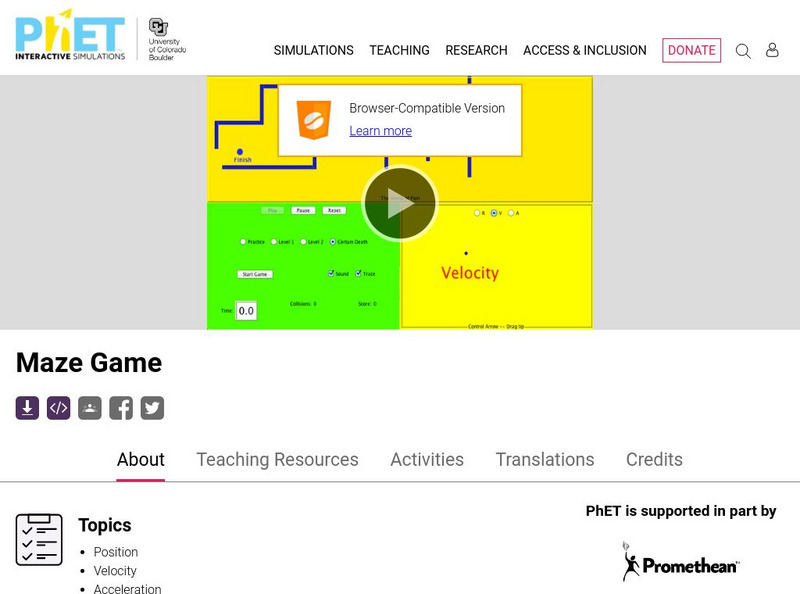
University of Colorado: Ph Et Interactive Simulations: Maze Game
Learn about position, velocity, and acceleration in the "Arena of Pain." Use the green arrow to move the ball. Add more walls to the arena to make the game more difficult. Try to make a goal as fast as you can.

Texas Education Agency
Texas Gateway: Objects in Motion
This resource provides flexible alternate or additional learning activities for students learning about the concepts of distance, speed, and acceleration.