Hi, what do you want to do?






EngageNY
Mid-Unit Assessment Part 2: Beginning the Writer’s Workshop
Writers learn about using sensory details as they revise bland sentences with more vivid language. Next, they begin writing the first drafts of their children's books, completing storyboards to effectively plan their writing.

Poetry4kids
Five Ways to Overcome Writer’s Block
Every writer knows how terrible writer's block can feel. Use these five writer's block-busting techniques to help young writers get out of their rut and into a better state of mind.

Baruch College Writing Center
Summarizing, Paraphrasing, and Quoting Workshop
What's the difference between summarizing and paraphrasing? Show class members how to find the main ideas from informational text and condense it, restate it, or quote it directly with a series of educational activities based...

Apple State University
Friendly Letter Mini-Lesson
This mini-lesson about informal letter writing is packed with a lot of information about writing a friendly letter. Class members begin by working in pairs to answer questions after reviewing letter models. Then, take part in a grand...

Curated OER
Writer's Craft: Foreshadowing
Track instances of foreshadowing in any text with a straightforward graphic organizer. In one column, learners note down the events that happened, and in the other they list the clues that indicated that those events would happen. Some...

Curated OER
Nonfiction Genre Mini-Unit: Persuasive Writing
Should primary graders have their own computers? Should animals be kept in captivity? Young writers learn how to develop and support a claim in this short unit on persuasive writing.

MENSA Education & Research Foundation
The Writer’s Toolbox: What You Need to Master the Craft
Strengthen your high schoolers' writing with a series of steps for writing successfully. With sections on organizing an essay, choosing a topic, crafting a thesis statement, and revising a draft, the lesson encourages your class to...

J. Hines, Ed Prgms Intern
Comma Usage
Sometimes it feels like young writers just place commas as they please! Ensure that your pupils uses these important punctuation marks properly by requiring them to study the information here and complete the grammar exercise....

Model Citizen Publications
How To Write a Paragraph
Instructing learners on how to craft a good paragraph, a skill required of all writers, is the focus of a 23-page packet that includes directions, graphic organizers, exercises, and worksheets for guided practice.

EngageNY
Writing the Children’s Book: Day Two
Following a brief mini-lesson on using dialogue in fiction, young writers continue day two of their writing workshop. They work on the second half of their Children's Book Storyboards, and then they turn and talk with partners to reflect...

City College of San Francisco
Making Inferences: Reading Between the Lines
Have you ever read part of a story and had to figure out what the rest was about? Practice making inferences with several short passages and multiple choice questions.

Turabian Teacher Collaborative
Parts of Argument II: Article Critique
Break down the parts of argumentative writing with a critical thinking activity. High schoolers read an article of your (or their choice), and use a graphic organizer to delineate the ways the author structures his or her arguments.
Scholastic
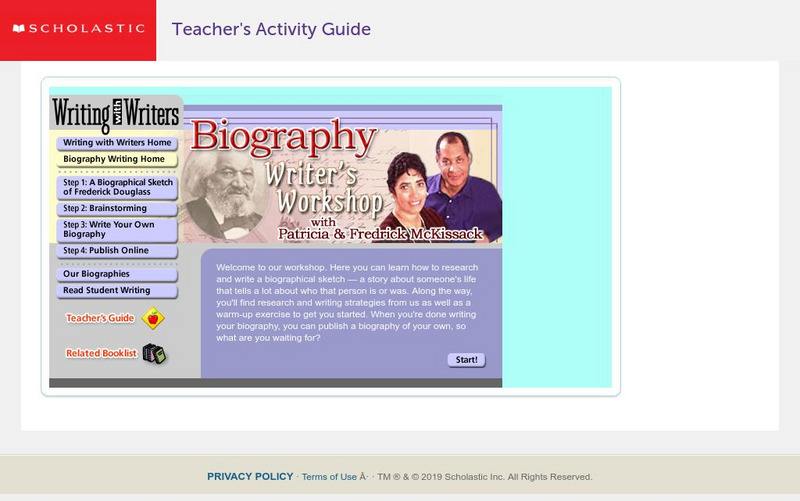
Scholastic: Biography Writer's Workshop
This tutorial has students follow a step-by-step guide to write their very own biography using that of Frederick Douglass as a model.
Scholastic
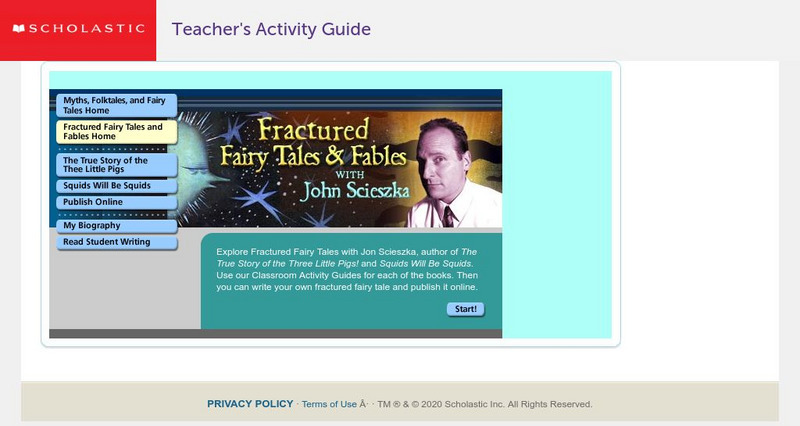
Scholastic: Fractured Fairy Tales and Fables With Jon Scieszka
In this resource students will have an opportunity to learn about fractured fairy tales and fables with the help of Jon Scieszka. This site also features a writer's workshop where students can write their own fractured tale and publish...
![Holt, Rinehart and Winston: Writer's Workshop: Analyzing a Character [Pdf] Unknown Type](https://statictemp.lp.lexp.cloud/images/attachment_defaults/resource/large/FPO-knovation.png "Holt, Rinehart and Winston: Writer's Workshop: Analyzing a Character [Pdf] Unknown Type")
Houghton Mifflin Harcourt
Holt, Rinehart and Winston: Writer's Workshop: Analyzing a Character [Pdf]
Organize your thoughts about two different characters using this printable activity. Five elements of character are covered. RL.9-10.3 Analyzing Characters
Other
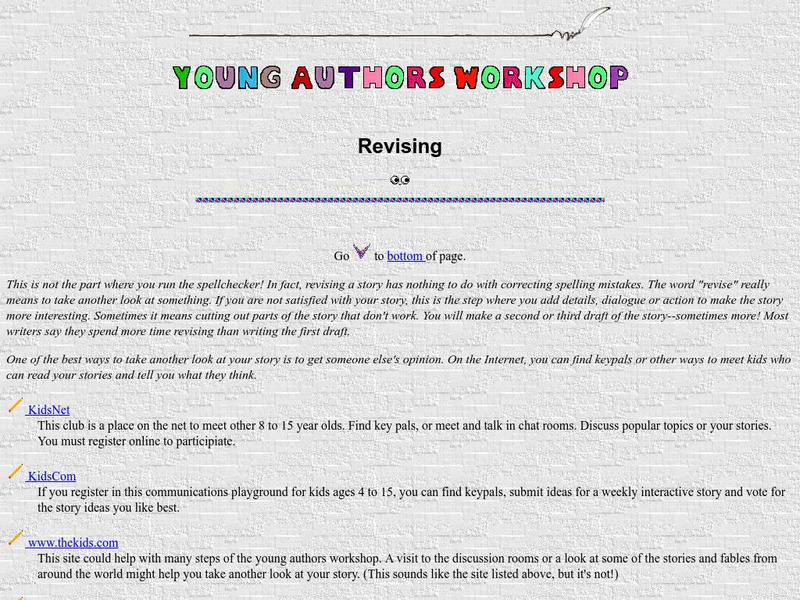
Young Author's Workshop: Revising
Revise means to take another look at something. If you are not satisfied with your story, this is the step where you add details, dialog, and action to make the story more interesting.
Other
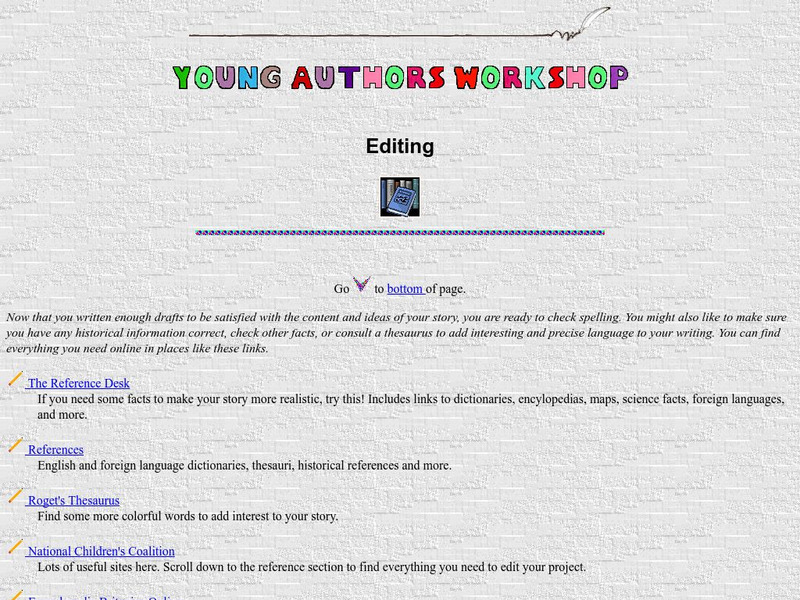
Young Author's Workshop: Editing
Now that you written enough drafts to be satisfied with the content and ideas of your story, you are ready to check spelling. You might also like to make sure you have any historical information correct, check other facts, or consult a...
Other popular searches
- First Grade Writers Workshop
- Minilesson Writers Workshop
- Mini Lesson Writers Workshop
- Writers Workshop Publish
- Writers Workshop Lessons
- Readers and Writers Workshop
- Setting Up Writers Workshop
- Writers Workshop Mini
- Writers Workshop Focus
- Writers Workshop the Cocoon
- Launching Writer's Workshop
- Writer's Workshop Steps