Hi, what do you want to do?






Curated OER
Denser Sensor
Fourth graders calculate density, compare densities of solids and liquids, measure liquids using a balance, and investigate the significance of density. They conduct an experiment to determine an order of densities, and complete a...

Curated OER
Flat Earth Society
Pupils explore map distortion. In this geography lesson, students compare Mercator projection maps to globes in order to understand the strengths and weaknesses of projection maps.

Curated OER
Any Nook or Cranny
Students create a reading nook. In this measurement lesson, students find a spot in the classroom to turn into a reading nook. They need to measure how much space they need to fit students and supplies into their nook.

Curated OER
Architecture And Math
Students investigate the ties that architecture and math have in common. They focus on works of architecture in the world that is considered of great significance. Students use the internet to find building images from around the world....

Curated OER
Make Your Own Trashasaurus Rex Sculpture
Students explore environmental awareness through reusing materials. In this environmental awareness lesson, students use trash to create a "trashasaurus," a large dinosaur sculpture made from waste. Detailed structure and papier-mâché...

Curated OER
Fractals
Young scholars explore the concept of fractals. In this fractal lesson plan, students use applets to explore Koch's Snowflake, Sierpinski's Triangle, and other fractals. Young scholars develop these concepts through exploration and...

Curated OER
Equilateral Triangles
Students examine the attribute of equilateral triangles. In this equilateral triangle lesson, students examine a number of paper triangles to determine how they are classified. They determine how triangles are depicted in Navajo rugs.

Curated OER
Tiling the Plane
Pupils use pattern blocks and triangular grid paper to review shape names, be introduced to the concept of a tiling of the plane, and determine which pattern blocks tile the plane. They are asked: "Have you ever seen a floor or a wall...

Curated OER
Geo-Folder
Second graders create a Geo-Folder based on geometric terms and concepts. They make a Table of Contents that guides them through the process of assembling a folder of completed activities.

Curated OER
Area Pre- Test
In this area worksheet, 6th graders take a pre-test about what they may already know pertaining to geometric area. Students respond to 10 multiple choice questions.

Curated OER
Geometric Glances
Second graders locate, comprehend, interpret, evaluate, maintain, and apply information, concepts, and ideas found in literature, the arts, symbols, recordings, video and other graphic displays, and computer files in order to perform...

Curated OER
Listen to a Shape
First graders identify basic shapes (circle, square, rectangle, triangle) and describes the attributes of each. They use magazines to find examples of each shape, and then make a collage.

Curated OER
Introduction to Plates, Axles, and Gears
Students are introduced to the function and design of the following Lego pieces: beams, bricks, plates, axles, tires, hubs and bushings. They then work with a partner to build something using only these pieces.

Curated OER
Pasta Research
Third graders read the story STREGA NONA together as a class and discuss what they know about pasta. They each receive pieces of pasta to glue down on construction paper and write beneath each one what they think it looks like.

Curated OER
Symmetry
Students examine the concept of symmetry. They use photographs in front of a mirror to see symmetry. They write an explanation or drawing of how a mirror always produces a line of symmetry.

Curated OER
Drawing On Gray Toned Paper
Students create an artwork that uses organizational principles and functions to solve a visual arts problem. The piece creates the illusion of transparency used to unify a work of art that demonstrates that light advances and darks recede.

Curated OER
Angles: Angles, Angles, Everywhere
Students estimate and accurately measure the size of angles communicate with the appropriate geometric terms and symbols to describe and name angles, lines, line segments, rays

Curated OER
Shape Makes a Difference!
Students learn the difference between perimeter and area by watching a video and a hands on activity.

Curated OER
Heat Transfer and Pollution
Students perform computer simulations on air dispersion. In this chemistry instructional activity, students calculate energy transfer based on specific heat and temperature change. They explain the causes of smog.

McGraw Hill
Glencoe: Self Check Quizzes 1 Two Dimensional Figures Polygons
Use Glencoe's randomly generated self-checking quiz to test your knowledge of two-dimensional figure-polygons. Each question has a "Hint" link to help. Choose the correct answer for each problem. At the bottom of the page click the...

Texas Instruments
Texas Instruments: Dimensional Figures
Students use the Explorer Draw application to draw two-dimensional figures. They understand how to write commands to draw squares and hexagons. They also calculate the perimeter of the figures drawn. [Requires Adobe Reader.]
Texas Education Agency
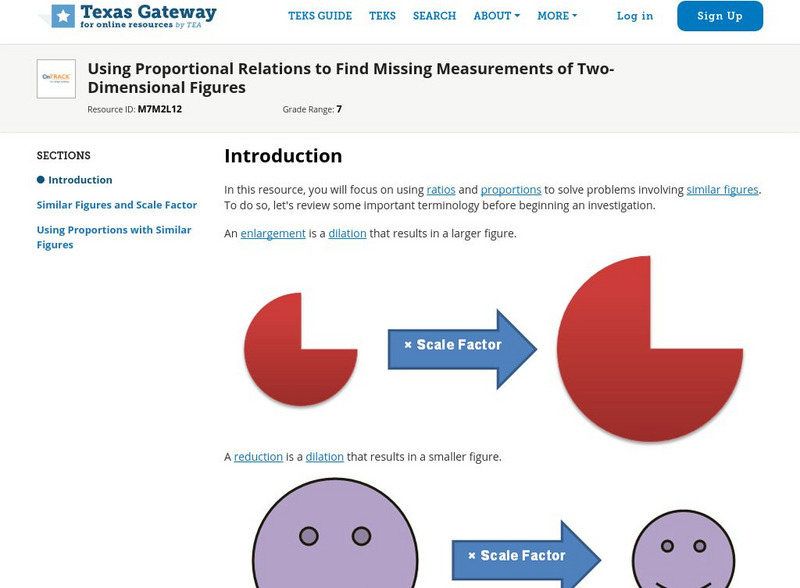
Texas Gateway:use Proportional Relations to Find Missing Measurements 2 D Figures
Given pictorial representations and problem situations of 2-dimensional figures or 3-dimensional figures, the student will use proportional reasoning to find a missing measurement.

GeoGebra
Geogebra: Copy of Classify Two Dimensional Figures
User will drag the vertices of the quadrilaterals to decide on the best possible classification.
Better Lesson
Better Lesson: Spotting Two Dimensional Shapes
Second graders will be able to identify 2-dimensional shapes and tell the number of vertices and sides.
Other popular searches
- Two Dimensional Figures
- Two Dimensional Figures
- 2 Dimensional Figures Change
- 2 Dimensional Figures Lessons