Hi, what do you want to do?






Curated OER
Marshmallow Figures
Students enjoy making 3-D figures while learning about rectangular prisms, pyramids, vertices, edges, and faces. After a lecture/demo, students use marshmallows, toothpicks and a worksheet imbedded in this lesson to create 3 dimensional...

Curated OER
Introducing Powers and Models
Students construct two dimensional models to illustrate squared numbers. In this geometry lesson, students use graph paper and an x/y axis to build squares exponentially. Students identify powers and relationships between various figures...

Annenberg Foundation
Geometry 3D Shapes: Surface Area and Volume
Whether you wrap it or fill it, you're using geometric concepts. Classmates use an interactive approach to learn how to find volume and surface area of cylinders and prisms in the second lesson in a five-part series. The online lesson...

Curated OER
Three Dimensional Figures
For this geometry worksheet, learners study diagrams with labels of common geometric figures. Students then answer 24 questions. Then they draw and label their own figures.

Mathematics Vision Project
Module 5: Modeling with Geometry
Solids come in many shapes and sizes. Using geometry, scholars create two-dimensional cross-sections of various three-dimensional objects. They develop the lesson further by finding the volume of solids. The module then shifts...

Curated OER
Spotting Polygons
See all sides of the story with a worksheet on geometric shapes! After studying the example at the top, which matches polygons with solid figures, second graders circle shapes that are named in the directions. Next, they match polygons...

Curated OER
Marshmallow Geometry
In this three-dimensional shapes geometry lesson, learners identify geometric solids and name their properties. They define "face," "edge," and "vertex," and construct geometric solids using marshmallows as vertices and toothpicks as edges.

Curated OER
Guess My Shape
Learners play a game with shapes. They work in groups to identify the names and characteristics of various shapes. They give each other clues to see if others can identify the shape being described. This is a great hands on activity.

Annenberg Foundation
Geometry 3D Shapes: Euler's Theorem
How do you get a theorem named after you? Euler knows what it takes! The third lesson of five asks pupils to use an interactive activity to compare the faces, vertices, and edges of seven different three-dimensional solids. They use...

Curated OER
How many edges do I need to cut in order to open a cube?
Learners problem solve to open a cube to create different shapes. For this problem solving lesson plan, students are given a cube and the shapes to open it up to, and they have to cut the cube open to make certain shapes. This gives them...

Curated OER
2: Isle of Shapes - Based on the Puerto Rico Quarter Reverse
Students identify both two and three-dimensional shapes. In this geometric shapes lesson, students listen to a teacher led lesson about the island of Puerto Rico. They look at the symbols and shapes on "Puerto Rico Quarter Reverse" on a...

Curated OER
Math Who Am I? Worksheet 3
In this math who am I worksheet, students read geometric shapes and math terms clues, fill in the blanks, and check their answers by circling each third letter in boxes with answers. Students write eight answers.

EngageNY
Surface Area
Explore finding the surface area of composite figures. Building on the previous lessons in the 29-part series, the 24th installment examines the surface area of three-dimensional solids. The focus is on decomposing composite figures and...

Curated OER
Space Geometry
Students explore points, lines and planes as it relates to geometry. In this geometry instructional activity, students analyze space and explain wy it is 3-D and not flat or 2-D. They solve problems involving volume and 3-D shapes.

Curated OER
Nature's Polyhedrons
Students discover the characteristics of polyhedra. Through hands-on activities and interactive videos, students investigate and retrieve information on polyhedra and crystal structures. Students study angles and symmetry. They...

Curated OER
Where has Polly Gone?
Learners explore polygons and their uses in careers. They also discover polygons shapes in manmade objects and nature. They use their acquired knowledge to construct a strong structure using polygon shapes.

EngageNY
Average Rate of Change
Learners consider the rate of filling a cone in the 23rd installment of this lesson series. They analyze the volume of the cone at various heights and discover the rate of filling is not constant. The lesson ends with a...

Curated OER
Basic Shapes
Learners create books about shapes. In this shape lesson, students select a topic such as points, lines, angles, planes, polygons, quadrilaterals, triangles, circles, and polyhedra. In groups, they create an illustrated...

Curated OER
A World of Symmetry
Students identify lines of symmetry. In this symmetry lesson, students create objects and identify their lines of symmetry. They answer questions about lines of symmetry. Students cut shapes out of cookie dough and...

Illustrative Mathematics
Box of Clay
What happens to a volume when you scale the dimensions of a rectangular prism? In this problem, a box of clay is increased in each dimension, with the intent to see if learners can generalize the result. The addition of...

Pennsylvania Department of Education
Volume of Regular and Irregular Objects
Fifth graders examine patterns and relate to equations to solve math problems. In this patterns lesson, 5th graders diagram, graph, use models and use tables to solve equations for real world problems.

Pennsylvania Department of Education
Volume of Compound Figures
Fifth graders use patterns, models and relationships to solve equations. In this equations lesson, 5th graders define vocabulary for equations and complete worksheets explaining variables and solving problems.
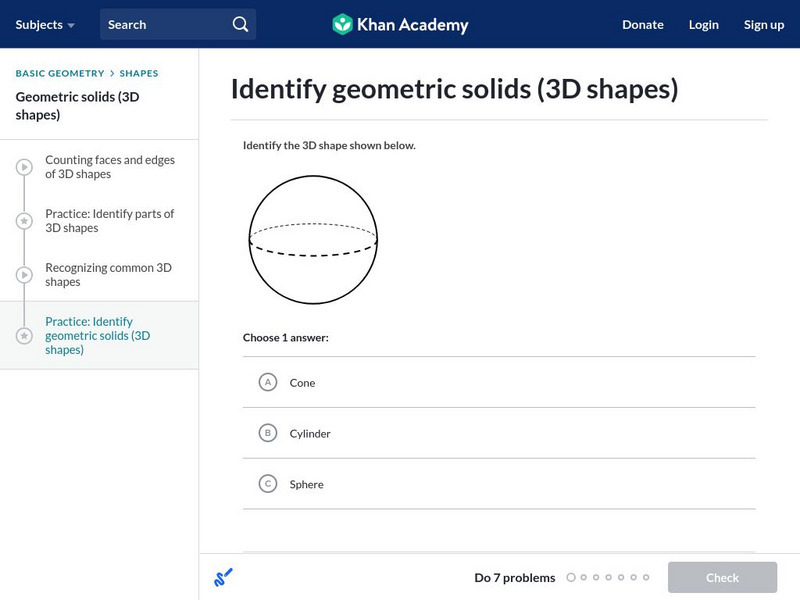
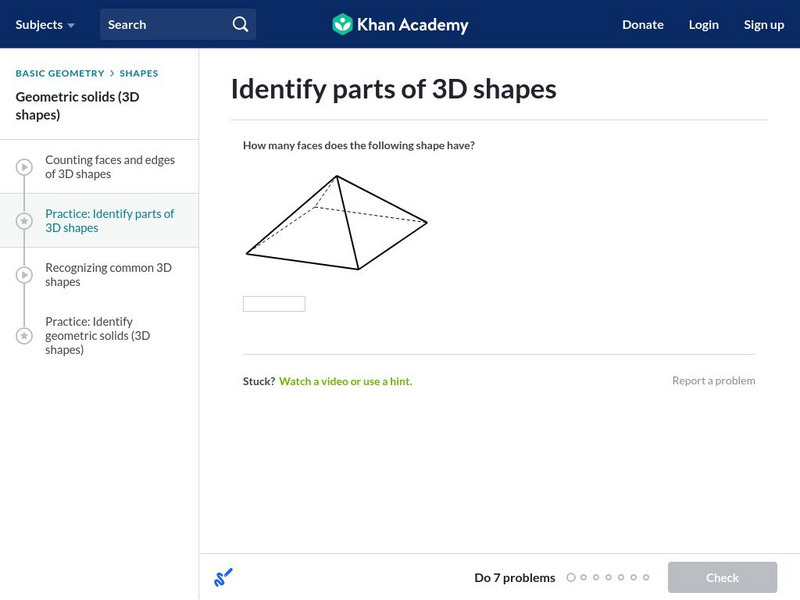
Khan Academy
Khan Academy: Identify Parts of 3 D Shapes
Identify the parts of 3D shapes in this assessment.