Hi, what do you want to do?






Curated OER
Exploring Graphs
Students are introduced to connecting graphing in a coordinate plane to making scatterplots on a graphing calculator. Working in pairs, they connect points plotted to make a sailboat and complete questions on a worksheet as well as plot...

Curated OER
Polydron Fun
Students investigate nets as they relate to volume and area. In this geometry lesson plan, students use nets as a visual to deepen their understanding of surface area and volume of objects. They make conjectures about different objects...

Curated OER
Lesson 10: Graphs
Students explore graph theory. In this geometry lesson, graphs are used to solve problems in a variety of domains. In this lesson the term graph refers to a collection of vertices and edges used to depict...

Curated OER
Grade 1: More Land or Water?
First graders listen as the teacher reads a story involving cross-continent traveling. Students collect a random sample by tossing an inflatable globe and recording whether they touch land or water each time they catch the globe in order...

Curated OER
Euler Characteristic
Learners identify the different properties of Euler's Characteristics. In this geometry lesson plan, students identify the shape and surface a polygon. They relate the concept of Euler to solving real world problems.

Curated OER
Drawing Figures
Third graders draw shapes that are congruent. In this congruency lesson, 3rd graders use grid paper to draw letters and figures and their congruent partners. They complete a worksheet while working in a whole class setting with the...

Curated OER
Teaching Rhythm and Pitch Reading
Young scholars practice correct rhythms and pitches during this short instructional activity for the middle school instrumental class. Objectives vary depending on music used for the instructional activity. Students assessed through...

Curated OER
Fractions and Halves
Fourth graders examine halves of a whole and discover through activities that they must be exactly equal in size. Working with Geoboards and Dot-Paper Squares, the class practices finding halves that are both congruent and incongruent.

Curated OER
M&M's Game
Students connect a number to an appropriate quantity of M&M candies. They identify and use whole numbers.

Curated OER
Track's Slippery Slope
Middle schoolers graph data of sports figure running time using x-axis y-axis to find slope of trend line, mathematically find the interpolated and extrapolated values for data points. Using the information they make predictions.

Curated OER
Lu-Lu
First graders practice their counting skills while playing a Hawaiian game called Lu-Lu. Lu-Lu is a Hawaiian counting game. It is played with four stones. Each stone is divided into four equal sections and dots are placed in the...

Curated OER
Modular Houses
Students, working in pairs, are presented with the problem. They are asked to design modular houses using four cubic modules, all the same size, which touch each other on complete faces. They must draw each of their houses on isometric...

Curated OER
Illustrate Inequalities
Sixth graders participate in a lesson that involves the concept of inequalities. They translate the words of problems and put them into a visual illustration. The illustration should include a number line for assessment.

Curated OER
Exploring Arrangements of 2, 3, 4, and 5 Cubes
Pupils construct models of various tricubes, tetracubes, and pentacubes that are possible, classify n-cubes into different groupings, and draw these figures on isometric dot paper giving true perspective to what they visualize.

Curated OER
Polyominoes
In this dominoes worksheet, students solve a word problem involving different ways to put dominoes together. Students complete 1 complicated higher order thinking problem.
Illustrative Mathematics
Illustrative Mathematics: A Sse Seeing Dots
The purpose of this task is to identify the structure in the two algebraic expressions by interpreting them in terms of a geometric context, a series of squares filled with dot arrangements. Students are asked to notice a pattern and...

Illustrative Mathematics
Illustrative Mathematics: 4.g What's the Point?
The purpose of this task is to use what students intuitively understand about connecting points or dots with lines to generate a discussion about what points are and how they should be represented. Aligns with 4.G.A.1.
National Institute of Educational Technologies and Teacher Training (Spain)
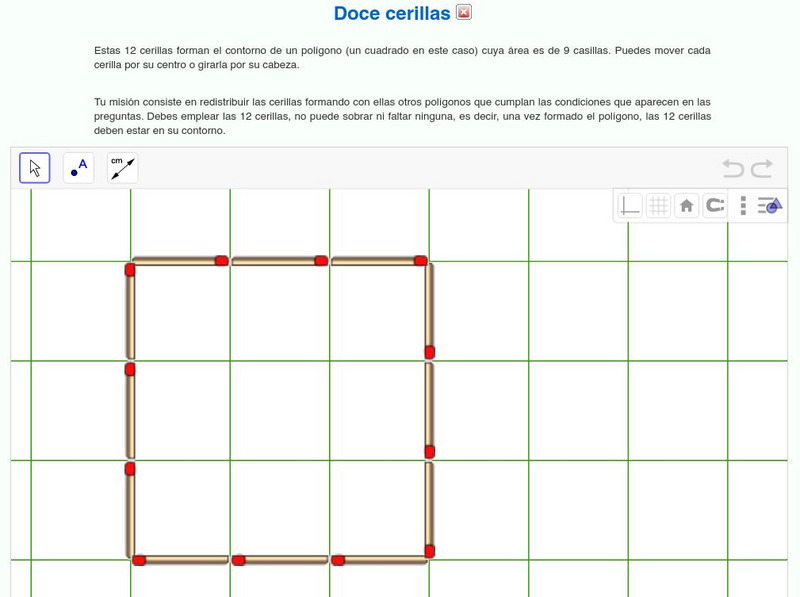
Ministerio De Educacion: Doce Cerillas
See if you can connect the dots of the same color with horizontal and vertical segments without leaving the grid and without intersecting the lines or crossing the colored dots.