Hi, what do you want to do?






Ocean Explorer
The Volcano Factory
The tectonic processes that have resulted in the formation of the Marianas Arc, and the Marianas Trench are explored. Groups of pupils access websites that give them a wealth of information about these formations. Each group must prepare...

NOAA
The Biggest Plates on Earth
The deepest part of the ocean is the Marianas trench where two tectonic plates meet. Scholars explore plate tectonics and their boundary types by completing hands-on activities throughout the instructional activity. Specific areas, such...

NOAA
Subduction Zones
Sink into an interactive learning experience about subduction zones! Junior oceanographers examine the earth-shaking and earth-making effects of subduction in the fourth installment in a 13-part series. Hands-on activities include...

Curated OER
Earths Waters
Middle schoolers research Everglades National Park, Three Gorges Dam, Hoover Dam, Roaring 40s, and Mariana Trench. After reviewing the sites, they choose one to illustrate a postcard with an image on one side and a description of the...

Curated OER
Ocean Planet: Sea Secrets
Students identify ocean features and draw a profile using data points on a map. Through discussion and research, they discover the importance of oceanography and plot a profile of the ocean floor in search for a vessel full of precious...

Curated OER
2005 Submarine Ring of Fire Expedition: What's for Dinner?
Students compare and contrast photosynthesis and chemosynthesis as sources of primary production for biological communities, and describe sources of primary production observed in biological communities associated with volcanoes of the...

Curated OER
The Volcano Factory
Learners examine the process of tectonic plates and why the Mariana Arc is active with volcanoes. They create a model of the Mariana Arc out of clay.

Wilderness Classroom
Ocean Life
Our oceans are composed of many complex relationships. Young oceanographers explore relationships between organisms, understand the world ocean's currents, and discover the effects of water pollution and how it behaves. There are...

Curated OER
The Ocean Floor
Practice reading comprehension by approaching oceanography through 2 pages of informational text. The text compares the ocean floor to the Grand Canyon to gives students perspective, and gives a brief coverage of the earth's crust and...

Curated OER
Earth: The Water Planet
Students elicit data on the water cycle, ocean topography, and island formation in this six lesson unit. The ocean floor and the properties of water are examined through a variety of discussions and hands-on experiments.

Curated OER
Breaking News: Virgin Voyage to the Bottom of the Ocean (7th April, 2011)
Students explore current events by reading about a trip to the bottom of the ocean. In this modern day explorer lesson plan, students read about Virgin CEO Richard Branson and his adventure to the bottom of the ocean. Students complete...

Curated OER
The Vast Ocean
Students explore oceans, and demonstrate reading comprehension skills, including reading strategies, inference, literal meaning, and critical analysis.

Curated OER
Science Quiz: Earth Quiz
In this earth science quiz worksheet, students respond to 20 short answer and true or false questions regarding earth science topics.

Curated OER
Friendly Volcanoes
Learners discuss the benefits of volcanic activity on marine life. They explain the process of tectonic plates.

Curated OER
2005 Submarine Ring of Fire Expedition: Unexplored
Students compare and contrast submarine volcanoes at convergent and divergent plate boundaries, infer kinds of living organisms that may be found around hydrothermal vents, and describe ways in which scientists may prepare to explore...

National Geographic
National Geographic: Encyclopedia: Ocean Trench
Comprehensive information about deep-ocean trenches. Includes maps, a video [1:29], and a vocabulary list.
Encyclopedia Britannica
Encyclopedia Britannica: Geology: Deep Sea Trench
Detailed information about oceanic trenches, their structure, and how they are formed. Discusses the twenty trenches that exist around the world. Includes several labeled illustrations.
NOAA
Noaa: Ngdc: Images, Visualizing Data
The National Geophysical Data Center has transformed extensive ocean research into colorful video, 3D maps, charts posters and more! This site starts off with a film clip of a dive into the Marianas trench and then lead you to other...

Science Struck
Science Struck: What Are Ocean Trenches and How Are They Formed?
Around 72 percent of the Earth's surface is found under the oceans. It has always been contributing to the dynamically changing face of the Earth through the tectonic phenomenon occurring at its depths. Such a naturally occurring...
Wikimedia
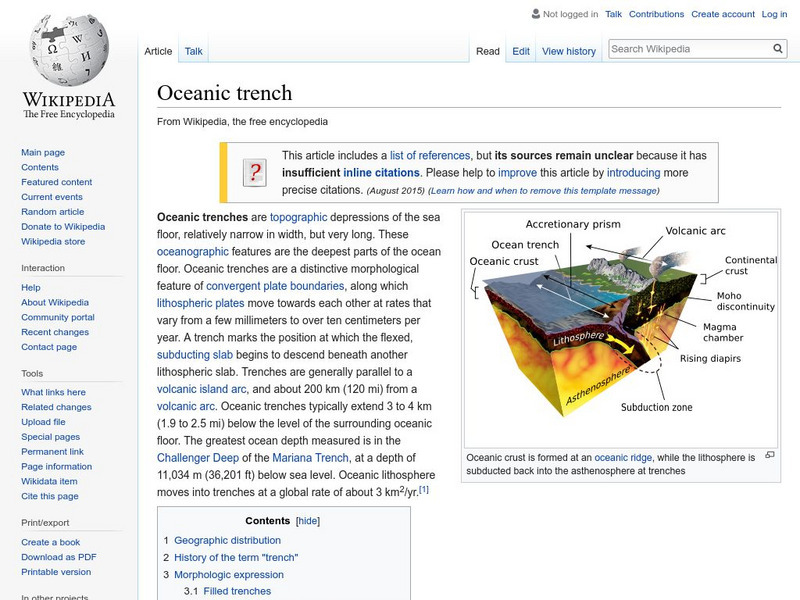
Wikipedia: Oceanic Trench
Wikipedia provides brief information on oceanic trenches, and has a hyperlinked list of major world trenches.
Smithsonian Institution
National Museum of Natural History: Ocean Planet
Detailed website that was a companion to a 1995 traveling exhibit of the Smithsonian. Links to lesson plans and other educational materials are at the bottom of the page. Enter the exhibition to explore the world of the ocean.
Extreme Science
Extreme Science: Challenger Deep
A short description of the world's deepest ocean trench. Includes diagram and map.
Science Struck
Science Struck: Facts About the Aphotic (Midnight) Zone of the Ocean
The aphotic zone of the ocean receives less than one percent of sunlight penetration. It extends from between 200 to 1,000 m, or 660 to 3,300 ft, down to the seafloor. Learn about the characteristics of this zone and the adaptations the...

National Geographic
National Geographic: Adapting Under Pressure
Students learn about James Cameron's Challenger Deep dive and about the marine animals that live in different layers of the ocean. They then study the characteristics of the hadalpelagic zone at the bottom of the ocean, and imagine and...