Hi, what do you want to do?






CK-12 Foundation
Numbers in Expanded Form: Pennies Expanded Form
Beginning with a word problem that poses the question of making groups of 10 pennies to translate into a single dime, pupils are challenged to make sense of the amount of dollars 33 cents is in expanded form.

CK-12 Foundation
Sum Notation and Properties of Sigma: Cracking the Code
Help your class develop an understanding of sigma notation. Pupils match the sigma notation with the sums. Using the expanded sums, learners evaluate the summations. The scholars move on to prove a property of sums.

CK-12 Foundation
Scientific Notation: Matching Numbers to Notation
Explore the conversion of numbers to scientific notation and back again. Learners begin with a matching activity to identify equivalent expressions. Then guiding questions test and extend their understanding.

CK-12 Foundation
Scientific Notation: Light Years to Centaurus Constellation
Connect scientific notation to a real-life situation. Measuring distances in our solar system require large numbers. As pupils make conversions using these large numbers, they begin to see the necessity of scientific notation. They...

CK-12 Foundation
Scientific Notation Values
Scientific notation is the focus of a five-question interactive. A model with movable points offers a visual reference to help solve true or false, multiple-choice, and fill in the blank questions. A discussion question challenges...

CK-12 Foundation
One-Sided Limit Type: Limit Notation and Graphs
A one-sided limit is no less important than a two-sided limit. Young mathematicians use an interactive to match limit notation to graphs. The exercise requires interpreting how one-sided limits connect to features of graphs.

CK-12 Foundation
Concept of Limit: Limit Notation
Limits to infinity are simple to find if you can compare numerators and denominators. Users of the interactive drag expressions to match with their limit as x approaches infinity. A set of challenge questions assesses their groupings.

CK-12 Foundation
Two-Dimensional Vectors: River Ferry and Current Vectors
Fight against the current. Pupils explore the resulting path when they are crossing a river while being pushed downstream by the current. Using vector notation, learners express the speed and direction of a ferry. They finish by...

CK-12 Foundation
Higher Order Derivatives—Acceleration and Jerk
Accelerate your class through finding the second derivative. Using a bank of equations, pupils determine the equations for distance, velocity, and acceleration and their associated function notations. With the equations, learners answer...

CK-12 Foundation
Unit Vectors and Components: Bow and Arrow
Aim for a better understanding of vector components. Scholars adjust the angle of release on a bow and determine the horizontal and vertical components of the velocity vector. The pupils finish by determining how the angle affects...

CK-12 Foundation
Angle Measurement: Fuel Gauge Angles
Once you start looking, angles appear everywhere in our daily lives. A creative lesson has learners use the angles created by a fuel gauge to practice the Angle Addition Postulate. They see how changing the angle parts does not...

Curated OER
Passive Integrator and Differentiator Circuits
In this circuits worksheet, students answer 25 questions about passive integrator circuits and passive differentiator circuits given schematics showing voltage. Students use calculus to solve the problems.
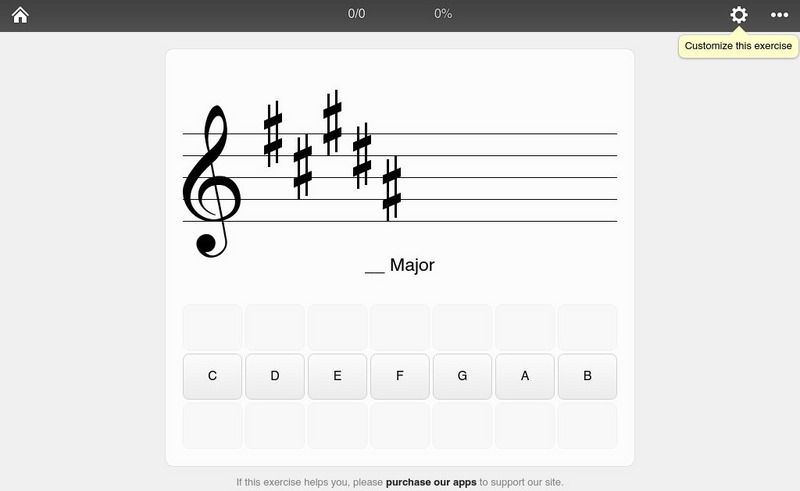
Music Theory
Music theory.net: Key Trainer
A terrific tool for music teachers and students! Test students' knowledge of key signatures with this online quiz. Click "toggle" to check answers along the way, or click "setting" to customize the quiz.
Other popular searches
- Set Notation Venn Diagram
- Set Notation and Math
- Set Notation and Probability
- Set Notation Work Sheets
- Mathematical Set Notation
- Decimal Set Builder Notation
- Identifying Set Notations
- Set Notation Lesson Plans