Hi, what do you want to do?






Curated OER
American Foreign Policy: 1920 - 1941
Take your class through the period between World War I and World War II. Covering various treaties and pacts between America and its neighbors - namely, Japan, Germany, and the Soviet Union- these slides could inspire some political...

Curated OER
American Isolationism and Entrance into World War I
In this 20th century U.S. history worksheet, students read articles about American Isolationism and entrance into World War I. Students then respond to 15 short answer questions.

Annenberg Foundation
A Growing Global Power
How does a nation turn into a global superpower? The 16th installment of the 22-part series on American history investigates the rise of the United States to global importance in the late nineteenth and early twentieth centuries. Groups...

Curated OER
Lost Peace
High schoolers view a television program that chronicles the failure of the League of Nations as a deterrent to further war. They create a timeline of events that led from WWI to WWII and hold a mock town meeting in which they discuss...

Curated OER
World War II: Internment in Hawaii
Students examine world history by writing an essay in class. In this World War II lesson, students identify the attack on Pearl Harbor, the response from the U.S and the effect it had on Japanese-Americans. Students define Japanese...

Curated OER
Breathing New Life into Old Traditions
Students investigate the role of ceremonies and other traditions of Native American cultures. They research various Native American nations and create posters that visually depict their research.

Curated OER
"The Island of Plenty": Reading Guide
Johnson C. Montgomery’s controversial plea for American social isolationism, “The Island of Plenty,” launches an in-depth study of the structure and logic of the essay. After responding to a series of questions, individuals craft a...

Curated OER
America's Wars, 1898-1945
High schoolers examine the wars the United States was involved in between 1898 and 1945. In groups, they determine the causes and effects of each war and how each war changed the way the United States handled their foreign affairs. As a...

Curated OER
Imperialism
Students explore the concept of Imperialism. In this foreign policy lesson, students examine the policies of the US and other countries through time. Students then create a political cartoon of their own and create a timeline that...

Curated OER
President Wilson and the League of Nations
Students examine Wilson's ideals of world peace and world order and the conflict between these ideals and the U.S. Senate's policy of isolationism. Wilson's visionary stance and its significance in forming the policies of our government...

Curated OER
Animation
Students describe what ways did the motion picture industry influence American lifestyle in the 1920's? They evaluate the role of motion pictures in people's lives leading up to the Great Depression.

Curated OER
To War or Not To War!
Ninth graders examine the various types of propaganda used during World War II. In groups, they make notes on each example and determine why they believe the opinion of the United States involvement in the war changed. They share their...

Curated OER
Broadcasting World War II
Third graders listen to several broadcasts from the WWII era. They research, write and perform simulated radio broadcasts concerning topics related to American society in World War II.

Curated OER
Why do wars occur?
Understanding the causes of war is one way (possibly) to prevent it. World War II is used as a case study to facilitate an understanding of reasons why wars start. Topics covered included Totalitarianism, scarcity of resources, need for...

Curated OER
Cartoons for the Classroom: The Political Dr. Seuss
In this historical events worksheet, students analyze political cartoons by Theodor Geisel. Students respond to 2 talking point questions.

Curated OER
Franklin D. Roosevelt
In this presidential history worksheet, students respond to 9 essay and short answer questions about the presidency of Franklin D. Roosevelt.

Curated OER
It's Time to Put Our Money Where Our Mouths Are
Eighth graders choose a person who should be honored on our currency. They write a letter outlining the reasons for their choice.
OpenStax
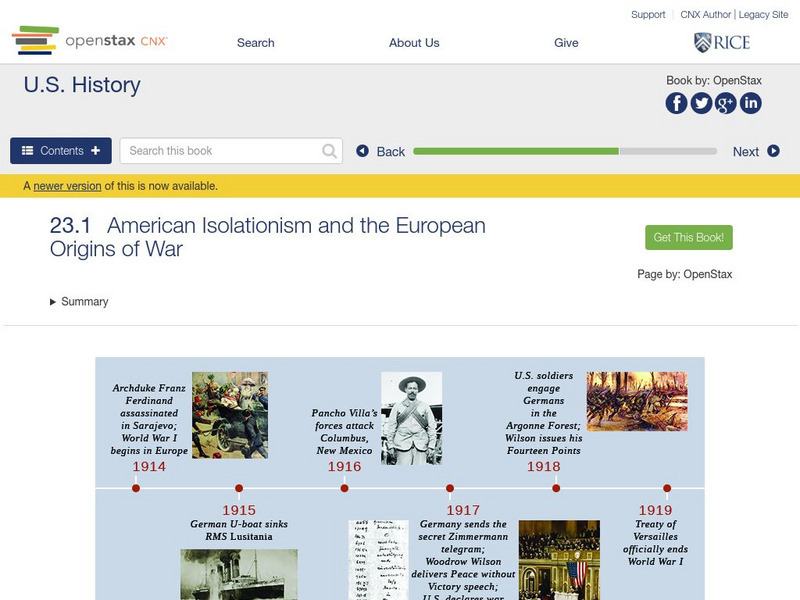
Open Stax: Great War 1914 1919: American Isolationism and European Origins of War
The foreign policy of Woodrow Wilson is explained, and how he tried to keep America neutral at the start of World War I yet intervened in international affairs in the Western Hemisphere. The reasons America declared war on Germany in...
Siteseen
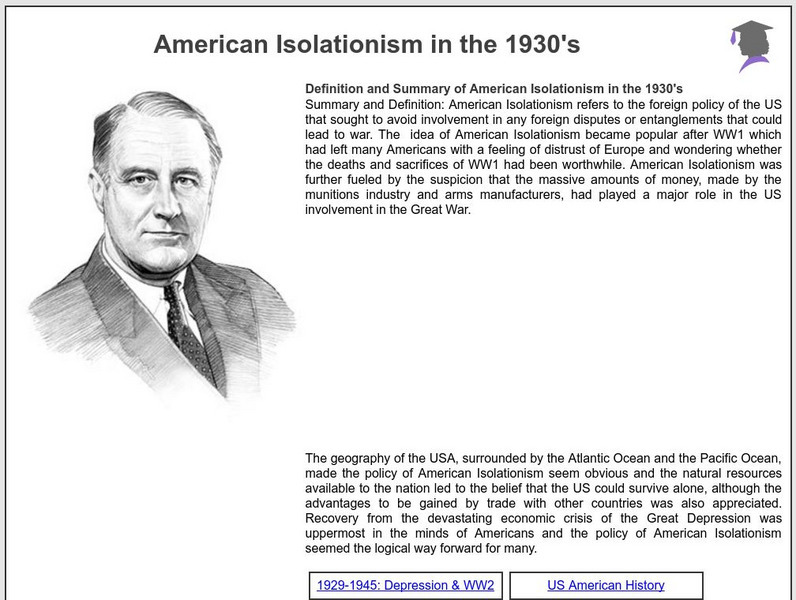
Siteseen: American Historama: American Isolationism in the 1930's
Interesting facts on the reasons and effects of American Isolationism policy in the 1930s.
Independence Hall Association
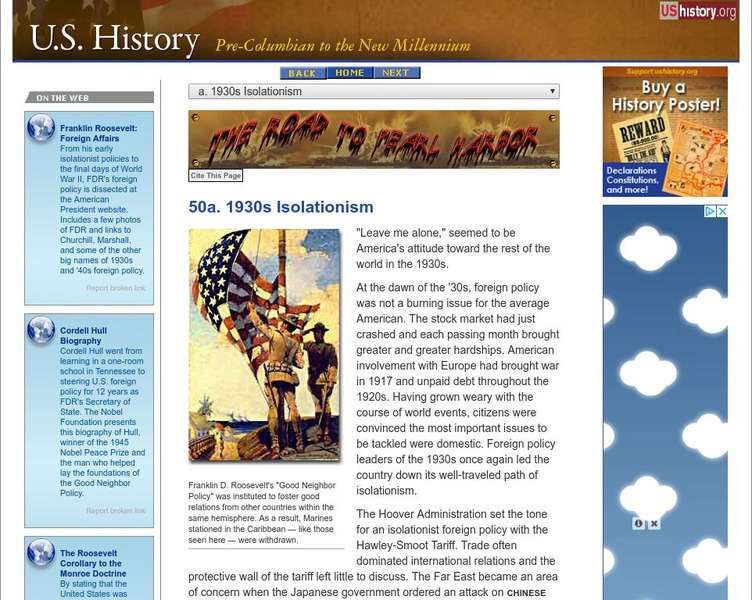
U.s. History: 1930s Isolationism
Read about the ways the American government and people looked inward during the 1930s, isolating themselves from actions taking place in Europe and Asia.
US Senate
Historical Minutes: Merchants of Death
A review of the Senate hearings held by Senator Gerald Nye investigating the possibility that munitions manufacturers had forced the United States into World War I in order to increase their profits. Read how the course of these hearings...
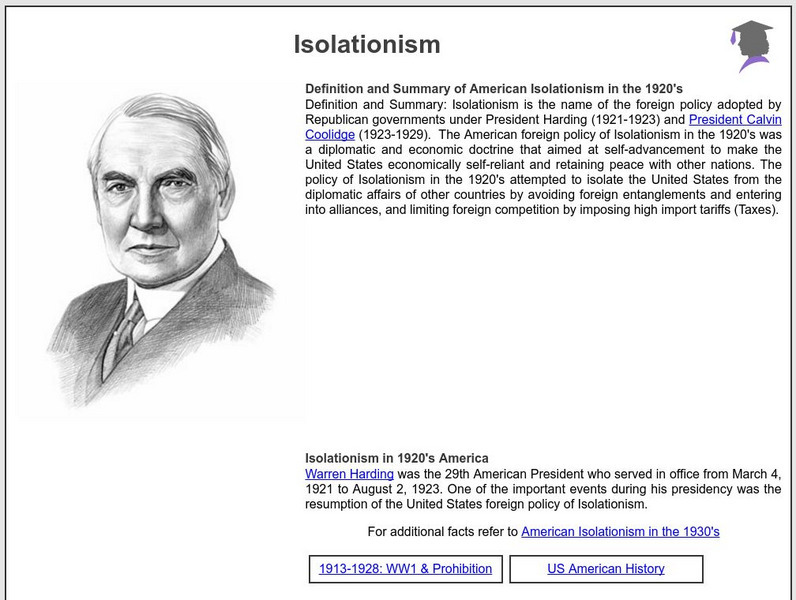
Siteseen
Siteseen: American Historama: Isolationism
Facts, definitions, and the reasons for the resumption of Isolationism, the foreign policy adopted by Republican governments in the 1920s.

Siteseen
Siteseen: American Historama: Neutrality Acts
Discover the terms of the Neutrality Acts banning arms and war materials to countries at war. These laws were designed to prevent the United States of America from being entangled in a possible foreign war.

Khan Academy
Khan Academy: Ap Us History Unit: Period 7: 1890 1945: Intro.: Age of Empire
The study resource from Khan Academy provides an overview of Period 7: 1890-1945 in American History. The Age of Empire is discussed in this lesson. This resource is designed as a review for the AP US History Test.
Other popular searches
- Wwii American Isolationism
- Wwi American Isolationism
- American Isolationism 1800
- \"Wwii American Isolationism\