Hi, what do you want to do?





Other
New American Nation: Internationalism and Interwar Isolationism
This essay by two foreign policy scholars gives background to the concept that the United States did not really become isolationist after World War I.
University of Virginia
Miller Center at Uva: u.s. Presidents: Franklin Delano Roosevelt: Foreign Affairs
Scroll through this discussion of Franklin Roosevelt's attention to foreign policy during his several terms in office to "Confronting Germany and Japan" and "Descent into War." Here you will find out about the United States' position of...
Department of Defense
Do Dea: Ap Us History: Unit 3: The Growing Republic
This extensive learning module examines how the United States' efforts to increase foreign trade, add new territory, and isolate itself from Europe affected its foreign policy and other initiatives. It investigates how advances in...
US Department of State
Office of the Historian: Washington's Farewell Address
President Washington's departing remarks set foreign policy practices for the next century and a half. He warned against foreign alliances and argued for isolationism. Read a brief summary of his remarks.
Library of Congress
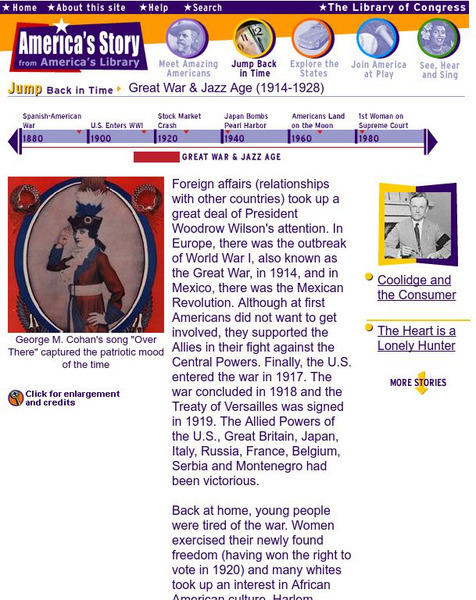
Loc: America's Story: Great War & Jazz Age (1914 1928)
This Library of Congress time-line series surveys World War I and the Jazz Age. When World War I broke out in Europe, many changes were going on in the United States. Women were voting for the first time and African-American culture was...
ibiblio
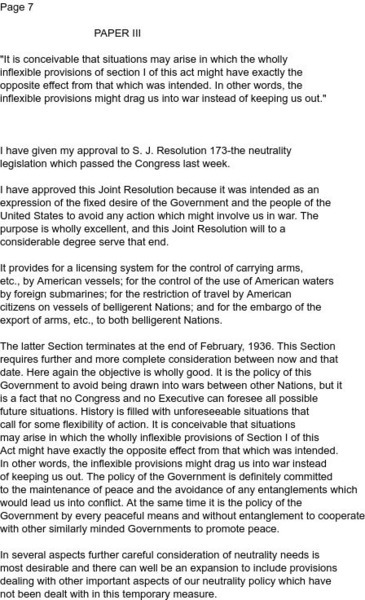
Ibiblio: World War Ii Resources: 1935 Neutrality Act
Text of Franklin Roosevelt's approval of the Neutrality Act of 1935, passed by the Congress in August, 1935. Read why Roosevelt thinks this act is a reasonable reflection of American foreign policy in the mid-1930s.
OpenStax
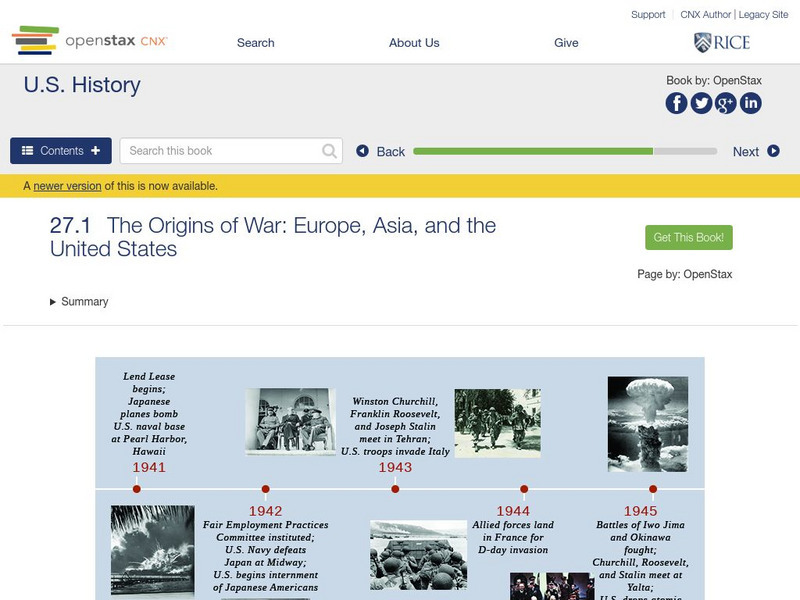
Open Stax: World War Ii 1941 1945: Origins of War: Europe, Asia and United States
Examines the conditions that fostered the rise of Fascism and Nazism, the events during the lead-up to the outbreak of war, and what Roosevelt did to help affected nations yet still keep the United States neutral.
Independence Hall Association
U.s. History: America in the First World War
A brief overview of the United States in the World War I era. Read about initial American neutrality, American entrance into the war, and the American homefront.

Khan Academy
Khan Academy: Start of Cold War, Part 2: Truman Doctrine and Marshall Plan
Explains President Truman's plan to contain communism, which signaled the end of American isolationism. Also discusses America's pledge of financial aid to rebuild Europe with the Marshall Plan.
US Army Center
U.s. Army Center of Military History: Peace Becomes Cold War, 1945 1950
A discussion of historical events that led to the Cold War from the perspective of the U.S. Army. Particular emphasis is placed on military leadership and policy.
Other
Economic History Services: The Fordney Mc Cumber Tariff of 1922
A lengthy explanation of the Fordney-McCumber Tariff of 1922 and its precursor. Find out about the disagreements between Democrats and Republicans about the necessity of the tariff, how it affected international relations, and how it...
The Newberry Library
Newberry Library: Anti Statism in u.s. History
Newberry Library digital collections presents a lesson using primary sources from which students explore the concept of "anti-state" sentiment and examine the reasons writers and politicians protest the authority of the federal...
Library of Congress
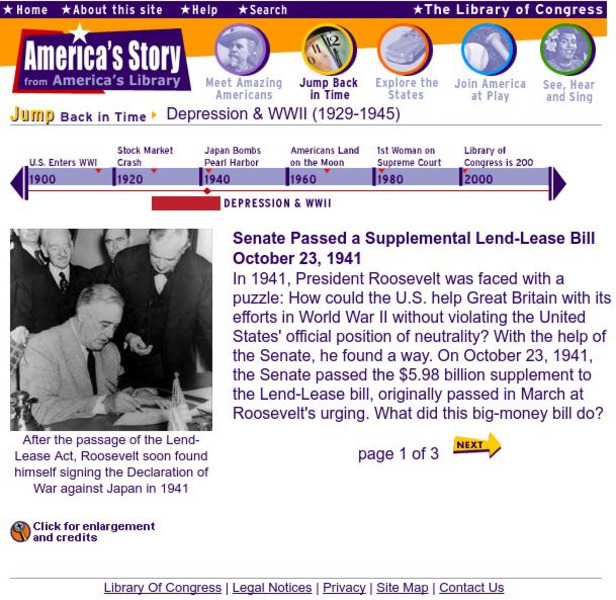
Loc: America's Story: Senate Passed Lend Lease Bill
How did the U.S. give aid to European countries fighting World War II when we were not supposed to be getting involved. See how President Roosevelt got around this by visiting this Library of Congress site.
Yale University
Yale New Haven Teachers Institute: The Foreign Policy of Franklin D. Roosevelt
Describes Roosevelt's policies towards Pan-America, involvement in the global conflict, and entry into World War II. Included are sample lessons and a bibliography. (Published in 1978)

Library of Congress
Loc: Today in History: July 17: The Spanish Civil War
The Spanish Civil War was a precursor of the tumult of World War II. Read a brief description of those involved in this civil war and see posters supporting each side.
University of Pennsylvania
University of Pennsylvania: The Abraham Lincoln Brigade of the Spanish Civil War
An interesting look at the Lincoln Brigade and those who served in it fighting in Spain against the fascists in the Spanish Civil War.
US Department of State
Office of the Historian: The Neutrality Acts, 1930s
You can see by reading the descriptions of these three neutrality acts how determined some in Congress were to isolate the United States and keep it out of World War II.

Khan Academy
Khan Academy: Fdr and World War Ii
Discusses how Franklin D. Roosevelt guided the United States through World War II and laid the groundwork for Harry Truman to assume the role after his death.
Independence Hall Association
U.s. History: Reactions to a Troubled World
Read about the rising militarism and fascism in Europe and Asia as dictators expanded their territories. See how the United States reacted with its series of three neutrality acts.
Oregon Secretary of State
Oregon at War: Before the War America's Strained Neutrality
Read about the attempts of the United States to remain neutral during World War I raging in Europe. Find out what finally made U.S. entrance into the war inevitable.

Khan Academy
Khan Academy: Ap Us History: 1890 1945: Introduction to the Age of Empire
Discusses the transition of the United States in the late 19th century from an isolationist country into an imperial power with colonies of its own and the reasons for this abrupt change in foreign policy. Includes questions for students...
Other popular searches
- Wwii American Isolationism
- Wwi American Isolationism
- American Isolationism 1800
- \"Wwii American Isolationism\