Hi, what do you want to do?






Curated OER
Muscular System
In this health worksheet, high schoolers find the words that describe the aspects of the muscular system. The answers are found at the bottom of the page.

Curated OER
Understanding the Body, Day 1: Anatomy
Intended for moderate to severely disabled students, this lesson focuses on building an understanding of human anatomy. A secondary special education class reviews, identifies, and labels parts of the body. Including the internal and...

Curated OER
Human Anatomy- How Do We Move?
Students explore the human anatomy. In this respiratory system lesson, students conduct an experiment to simulate the capacity of human lungs.

Curated OER
The Nervous System
Learners investigate the nervous system. In this anatomy lesson, students identify and define vocabulary related to the nervous system. Learners role play the parts of a nervous system and perform an experiment measuring and...

Curated OER
Human Anatomy - How Do We Move?
Fifth graders discover how blood moves around the body. In this circulatory system lesson, 5th graders feel their pulse before and after exercise. Students count their heart rate. Students use the scientific method to record...

Curated OER
Systems of the Human Body
Learners inquire about human anatomy by completing a worksheet. In this body systems lesson, students discuss the importance of a self-regulating body and how the skeletal, muscular, respiratory and digestive system all take care of...

Curated OER
Head, Shoulders, Knees and Toes
Students gain a greater comprehension of the anatomy and physiology of the muscular system, the skeletal system and connective tissue by researching joints in the body. They also reflect on the effects of injuries on their joints and...

Curated OER
Anatomy and Physiology of the Human Knee Joint
Students examine human anatomy with a focus on the knee joint. In groups, they research the chemical makeup of human bones and explain the different types of joints found in the body. To end the lesson plan, they identify the other...

Curated OER
Understanding the Body, Day 1: Anatomy
Students review gender identification and label themselves female or male. They identify the parts of the human body and practice using appropriate vocabulary. They complete a worksheet to complete the lesson.

Curated OER
Beef (Advanced)
In this beef worksheet, students participate in a variety of activities including completing a digestion dilemma, identifying best meat cuts and selecting a service project to complete.

National Cancer Institute at the National Institutes of Health
Seer Training Modules: Introduction to the Muscular System
Self-guided learning activity where students learn about the structure and function of the human muscular system. There is a short quiz at the end of the lesson to check for understanding.
BBC
Bbc: Applied Anatomy and Physiology: Muscles and Movement
Learn what muscles are, how they are classified, and how they are attached to the body's skeletal system. This site contains several definitions, illustrations showing the parts of muscles, and a quiz to test your knowledge of muscles...
Curated OER
Kids Health: Bones, Muscles, and Joints
This article from Family Doctor.org provides in depth terminology and helpful diagrams. This site has links to related articles to learn more about the musculoskeletal system.

Curated OER
Kids Health: Bones, Muscles and Joints
The anatomy of the musculoskeletal system and what the bones, muscles and joints do in our bodies are explained. Interactive diagrams show the internal structure of a bone, and how muscles and joints work together. Major disorders of the...
Other
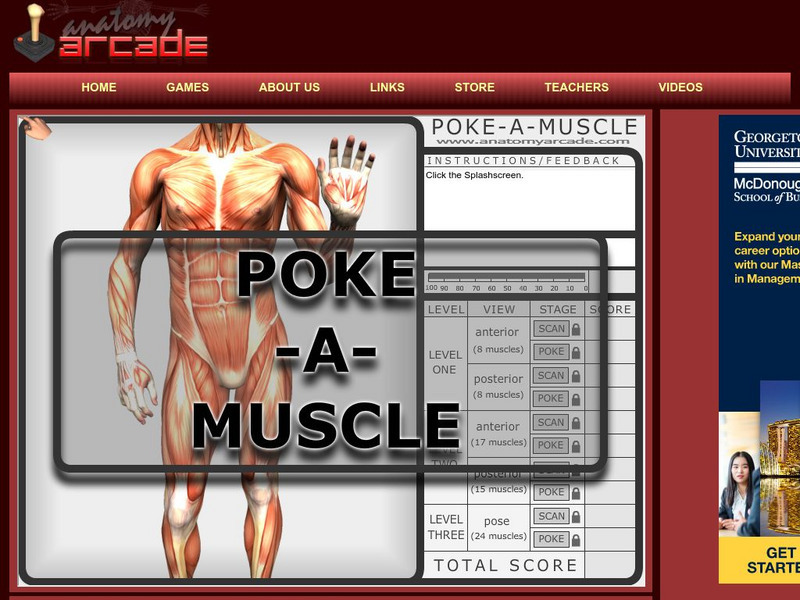
Anatomy Arcade: Poke a Muscle
Work your way through the muscles as you play this game. Click on the muscle that is named to earn points. You must get all correct in order to proceed to the next level, which ensures repeated practice if you make errors. There are ten...
OpenStax
Open Stax: Naming Muscles
This site helps you understand where muscles get their names. When you understand the names of muscles it will help you remember where the muscles are located and what they do