Hi, what do you want to do?






Curated OER
Circulatory Systems
A slideshow that covers the all-important details related to basic human circulation. The reasoning for exchange of material methods is presented and then labeled diagrams of the main human transfer systems are shown, along with...

Curated OER
Coqui Frog Camouflage
Young scholars investigate the concept of the coqui frog of Puerto Rico. They conduct research using a variety of resources. Students explain in oral or written form some of the characteristics to that identify the frog. The lesson...

Curated OER
Invertebrates
Students identify the characteristics common to all animals. In groups, they compare the characteristics between the animals and how they are divided. To end the lesson, they compare the eight phyla of invertebrates and review the...

Curated OER
Dive In: Biology At The Beach
Continue the spirit of summer by studying marine life in your classrooms.

Curated OER
Wildlife Habitat
Students explain what a habitat is and describe its four elements. They see how an area's habitat suitability varies with different species of wildlife. They name factors that affect habitat suitability.
SMART Technologies
Smart: Animal Ecosystems, Adaptations and Food Chains
This unit contains interactive lessons on animal ecosystems, animal classification, adaptations, and food chains.
National Institute of Educational Technologies and Teacher Training (Spain)
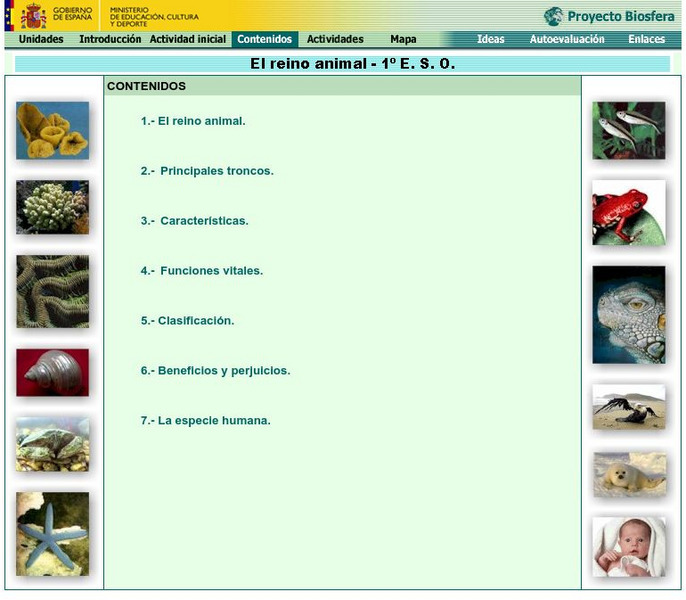
Ministerio De Educacion: El Reino Animal
Learn about the animal kingdom including an in-depth look at body characteristics, reproduction, types of cells, ways they obtain food, and evolutionary relationships. Many illustrations and nine interactive activities are included.

PBS
Pbs Learning Media: Animal Mouths
This collection of images of six different creatures, including insects and carnivorous vertebrates, illustrates the wide range of mouth types that exist within the animal kingdom. It also discusses the environment and its impact on the...
Globio
Glossopedia: Animals
The animal kingdom and its classification are explained and broken down into vertebrates and invertebrates in this resource. "Best-of" the animal kingdom list given - fastest, smallest, largest, strongest and more.

ClassFlow
Class Flow: Animal Kingdom
[Free Registration/Login Required] This flipchart introduces students to the animal kingdom, differentiating between vertebrates and invertebrates.

ClassFlow
Class Flow: Animal Classification
[Free Registration/Login Required] Students will classify organisms into groups and relate how they determined the groups with how and why scientists use classification. They will also demonstrate how animals are sorted into groups...

Quia
Quia: Animal Classifications
An interactive matching game from Quia dealing with animal classifications.
Saint Louis Zoo
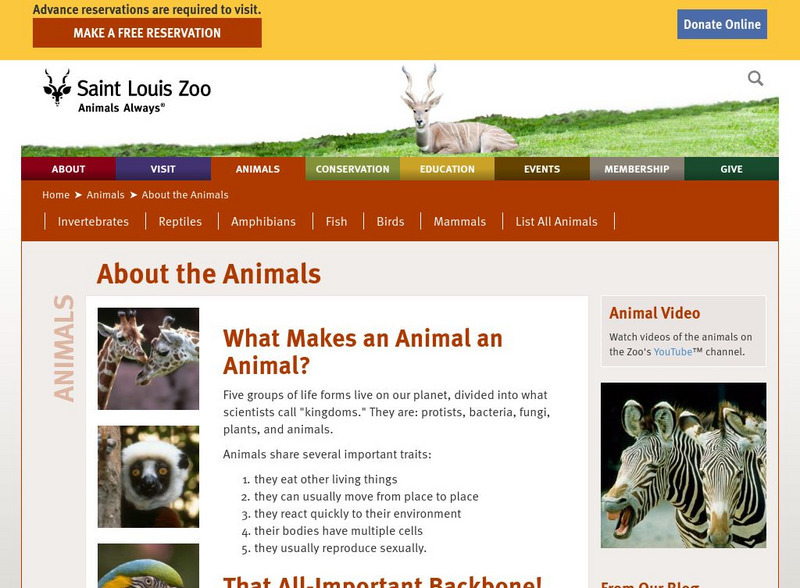
Saint Louis Zoo: About the Animals: What Makes an Animal an Animal?
Short introduction to animals explains the important traits that all animals share and the differences between vertebrates and invertebrates.
CK-12 Foundation
Ck 12: Third Grade Science: Life Sci: Animal Characteristics and Classification
[Free Registration/Login may be required to access all resource tools.] Presents an overview of the major animals groups (mammals, birds, reptiles, amphibians, fish, arthropods, vertebrates, invertebrates, those having live births and...
My Science Site
Middle School Science: Shoe Classification Lab [Pdf]
This concise worksheet site will enable students to learn how to create a classification system and to understand the reasons for classification in science. Requires Adobe Reader.
Other
University of Aberdeen: The Phyla of Kingdom Animalia
Very systematic breakdown of the animal kingdom starting with the simplest type the sponge, all the way to the chordate or vertebrate. Each phylum has a link with information.

Alabama Learning Exchange
Alex: Classification
This lesson will explain the reasons that society groups and classifies. The lesson has a hands-on component that helps students connect everyday grouping with the way that scientists group and classify all living organisms.

ClassFlow
Class Flow: What Are Vertebrates?
[Free Registration/Login Required] This flipchart discussed the characteristics of vertebrates. Using Activotes, students are asked to classify characteristics and deduce the common features and determine the defining characteristic. Web...
Palomar Community College District
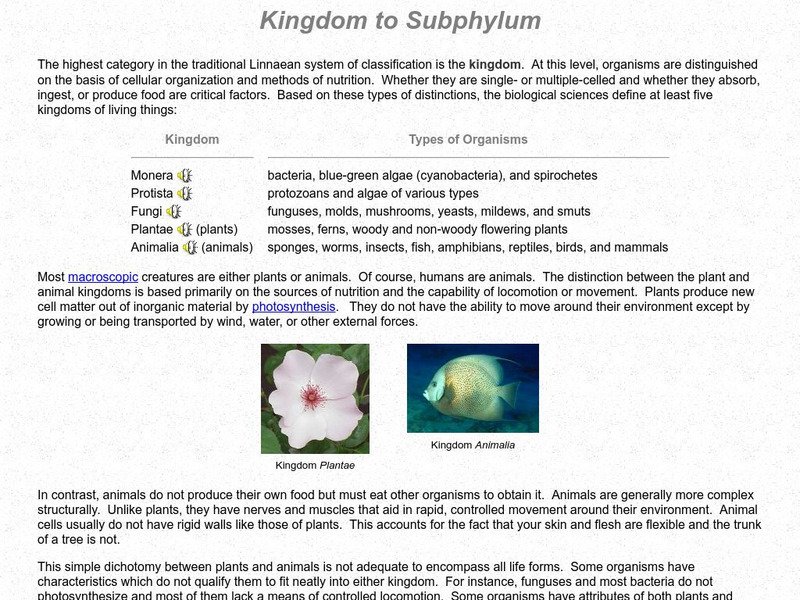
Palomar College: Kingdom to Subphylum
The highest category of taxonomic classification is the kingdom. This website from Palomar College presents the five kingdoms in an easy-to-read chart and discusses the Animalia and Plantae kingdoms in depth. After reading through the...
The Franklin Institute
The Franklin Institute: Living Things Families
What do centipedes and crabs have in common? What's so special about a backbone? Check this site out from The Franklin Institute if you are interested in biology and classification.

ClassFlow
Class Flow: Vertebrates and Invertebrates
[Free Registration/Login Required] Using this lesson the students will review the 2 groups of animals - vertebrates and invertebrates. They will be actively involved in classifying animals. An Activote assessment is also included.

University of Southern California
Structure of Matter: Animals
A slide show that demonstrates the development of physical structure in the animal world, moving from sponges through mammals.

Georgia Department of Education
Ga Virtual Learning: Ap Biology: Animals
This unit focuses on the unique structure and function of both invertebrate and vertebrate animals. Students review their understanding of animal diversity, and take a closer look at the various organ systems found in the animal kingdom.
ArtsNow
Arts Now Learning: What Class Are You In? [Pdf]
Drawing evidence from informational text and using it to compose text for ABA form in music, 5th graders will add onto a poem about vertebrates and how they are classified.