Hi, what do you want to do?






Curated OER
Hunt the Fact Monster
In this Fact Monster search engine worksheet, students access the Internet to one specific website to find the answers to five questions with multiple choice answers.

Curated OER
Hunt the Fact Monster October #1
In this internet research worksheet, students search for the answers to five multiple choice questions. They are directed to use the Fact Monster search engine.

Curated OER
Test Your General Knowledge
In this ESL worksheet, students answer 10 multiple-choice questions about a variety of topics. For example, "What is the highest mountain in the world?"

Curated OER
El Niño
In this weather instructional activity students complete an interactive activity on El Ninos then answer a series of short answer questions on how they occur.

Curated OER
Climate Change in Canada
In this Canada worksheet, students read a 6 page detailed informational text about climate change in Canada. Students then complete 10 essay/short answer questions.

Curated OER
Canada Crossword
In this Canada crossword puzzle worksheet, students read 13 clues pertaining to Canada. Students fit their answers in a crossword puzzle, which has no word bank.

Curated OER
Describe That State
Students broaden knowledge about all the 50 states. They combine their knowledge about states with their knowledge about parts of speech to create grammatically correct sentences that describe the characteristics of the states.

Curated OER
Vocabulary Practice: Complete the Sentences With Words From the Word Pool
In this vocabulary worksheet, students analyze ten sentences that have missing words. Students complete the sentences with the correct words from the word list.

Curated OER
North America Knowledge
Second graders move around a large map of the North America drawn on the playground. They follow the directions called out by the teacher. They may also develop their own tasks for other students to follow.

Curated OER
Hurricane Tracking
Students recognize that hurricanes are tropical storms that have a sustained wind speed greater than 74 miles per hour. In this science lesson plan, students plot data they observe on the National Hurricane Center Website in order to...

Smithsonian Institution
National Museum of Natural History: Ocean Planet
Detailed website that was a companion to a 1995 traveling exhibit of the Smithsonian. Links to lesson plans and other educational materials are at the bottom of the page. Enter the exhibition to explore the world of the ocean.
Missouri Botanical Garden
Missouri Botanical Garden: Temperate Oceans
How are the Atlantic and Pacific oceans different? At this site from the Missouri Botanical Garden you can click on the "Atlantic and Pacific Oceans," link to learn all about this topic. Study the two animated illustrations given to...
Science Buddies
Science Buddies: Hurricanes and Climate
The past few years have histories of extremely powerful and dangerous storms. These storms have also increased in frequency. To investigate potential effects of climate on hurricane number and strength, this project will focus on the...
NOAA
Noaa: Ocean and Coasts
This website highlights the oceans of the world. Even though June is World Ocean Month, learning about oceans never ends! There are links here to many resources and lesson plans regarding the Arctic, Atlantic, Indian, Pacific, and...

Princeton University
Mammals of North America: Dolphins and Porpoises
From the pages of "Mammals of North America," a field guide published by Princeton University Press, this website offers general descriptions of striped, blunt-nosed dolphins and porpoises. Detailed pictures and maps of habitat range are...
The Franklin Institute
Missouri Botanical Garden: Ocean Facts
Click on all the links to find out many interesting facts about the ocean. Why is the ocean blue? Why is it salty? Where do most of the animals and plants live? Which ocean is the biggest? The deepest? How much of the Earth is covered by...
Missouri Botanical Garden
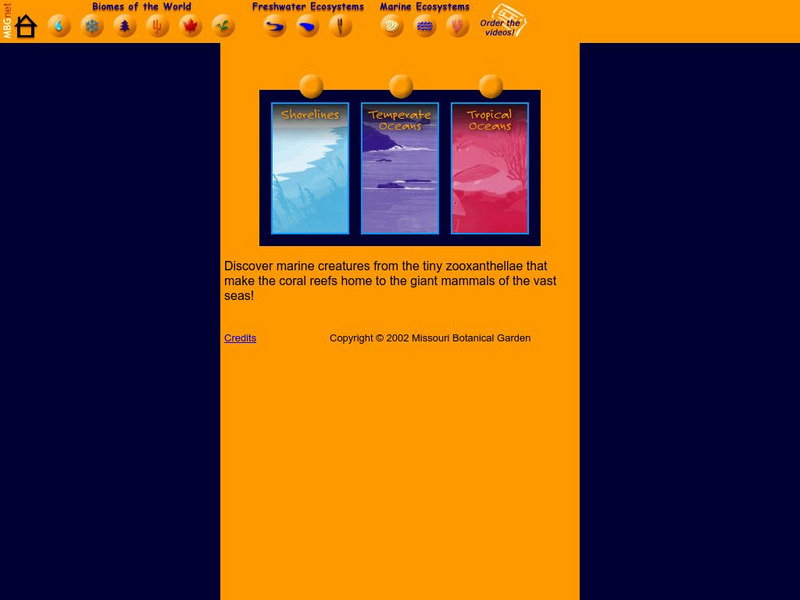
Missouri Botanical Garden: What's It Like Where You Live? (Oceans)
This site contains a wealth of information. You can click on shorelines, temperate oceans and tropical oceans. Each page contains links to even more information.
Missouri Botanical Garden
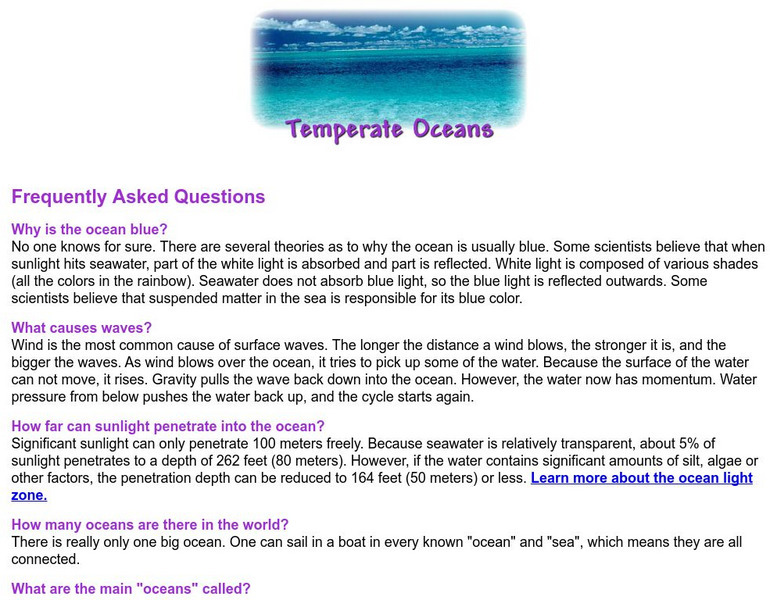
Missouri Botanical Garden: Fa Qs About Temperate Oceans
Learn why the ocean is blue. Learn the names of the oceans and how they received their names. Learn how the ocean forms waves.
Missouri Botanical Garden
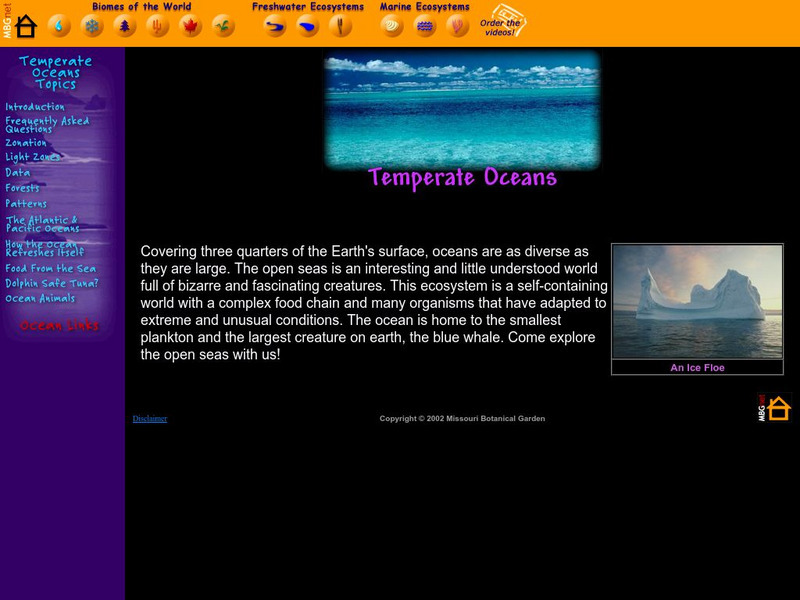
Missouri Botanical Garden: Temperate Oceans
This site from the Missouri Botanical Garden is a comprehensive site covering various topics related to temperate oceans. Be sure to check out the ocean animals link on the left side to learn more about the invertebrates that live in the...
Missouri Botanical Garden
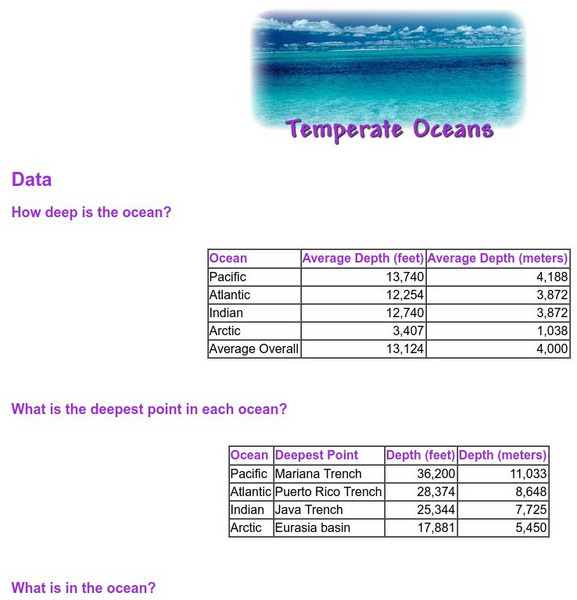
Missouri Botanical Garden: Temperate Oceans
Easy data tables compare the ocean depth of the four oceans, list the deepest point in each ocean, and list how much of different elements are contained in the oceans.
Science4Fun
Science4 Fun: Oceans
Learn about the five oceans of the Earth, life in the oceans, and why oceans are salty.
Curated OER
Educational Technology Clearinghouse: Maps Etc: South America (Physical), 1901
A map from 1901 of South America showing the physical features of the region. This map is color-coded to show general elevations from sea level to over 6,500 feet, mountain systems, drainage divides, lakes, rivers, coastal features, and...

Ducksters
Ducksters: Geography for Kids: Oceans
Learn about the world's five great oceans: Pacific, Atlantic, Indian, Southern, and Arctic on this site.