Hi, what do you want to do?






Curated OER
It's A Gas!
Fifth graders complete a activity which has them place a list of gases in order from the least to the most dense. The density in grams is given for each. There's a good paragraph which provides background knowledge about the volatility...

Curated OER
Buoyancy-Why Things Float
In this buoyancy worksheet, students read about the principles behind objects floating including density, buoyancy and Archimedes' Principle. Students complete a buoyancy lab where they use a balloon and water and a film canister and...

Curated OER
Sink or Float: Exploring the Laws of Buoyancy
Middle schoolers explore the relationship between density and buoyancy. After watching a video explaining buoyancy, students discuss displacement and floating. Middle schoolers have a raft building competition. Afterward, they conduct...

Curated OER
Graphical Determination of Density
Students determine the density of metal shot by a graphical method using significant digits in making measurements and calculations. Students graph a seris of laboratory measurements and determine density from a mass verses volume graph.

Curated OER
Why Could the Hindenburg Float?
Tenth graders experiment with floating and sinking objects and heavy and light liquids, using correct terms, like density, to explain what happens. In this Hindenburg instructional activity, 10th graders watch a demonstration...

Curated OER
Helium Balloon Race
Students determine the force of a helium balloon that allows it to rise a specific distance. In this helium lesson students calculate the amount of paper needed to construct a weight and determine the density of a piece of...

Curated OER
Gases Worksheet
In this gases worksheet, students solve twenty problems using the gas laws and their understanding of the relationship between energy and temperature and energy and velocity.

Curated OER
Buoyancy
In this buoyancy worksheet, students read about why objects float or sink. Students apply the Archimedes' Principle in a buoyancy lab. Students complete 1 graphic organizer.

Curated OER
Name That Gas!
Young scientists discover that air is a mixture of different gases - mainly nitrogen and oxygen. The properties of some of the other gases found in oxygen are listed in a table, then learners must decide which one of those gases is...

Curated OER
Convection Activities
Students conduct a series of hands-on activities to demonstrate that heated air expands and that warm air rises because it is less dense.

Teach Engineering
Rock and Boat
Present the class with a question on whether the water level of a pond will rise they take a large rock out of a boat and drop it into the pond. Groups come down on all sides of the question and try to justify their answers. The activity...

Curated OER
What is a Gas?
Students develop a scientific model of gas behavior. In this gas lesson plan, students observe different balloons filled with different densities of gases. They complete an activity where they model the behavior of gases using marbles, a...

Curated OER
Characteristics of Matter
Students study matter. For this science lesson plan, students examine the relationships among gravity, weight, and mass, the metric measurement of distance and volume, and density and its application to physical properties.

Curated OER
WHY DO SOME THINGS FLOAT WHILE OTHERS SINK
Young scholars explore how density can cause things to sink or float by experimenting with a jar, oil and corn syrup.

Colorado State University
How Far Away Is Space?
Outer space may be a lot closer than you think! Science scholars model the layers of the atmosphere using transparencies to gain insight into the scale of space. The resource includes ideas to tailor the activity to the skill level of...

Curated OER
WS 1.2 Metric Units I/ Physical vs. Chemical
In this metric units and properties worksheet, students determine the proper metric unit given a variety of measurements for specific items. They also identify chemical and physical properties and chemical and physical changes.
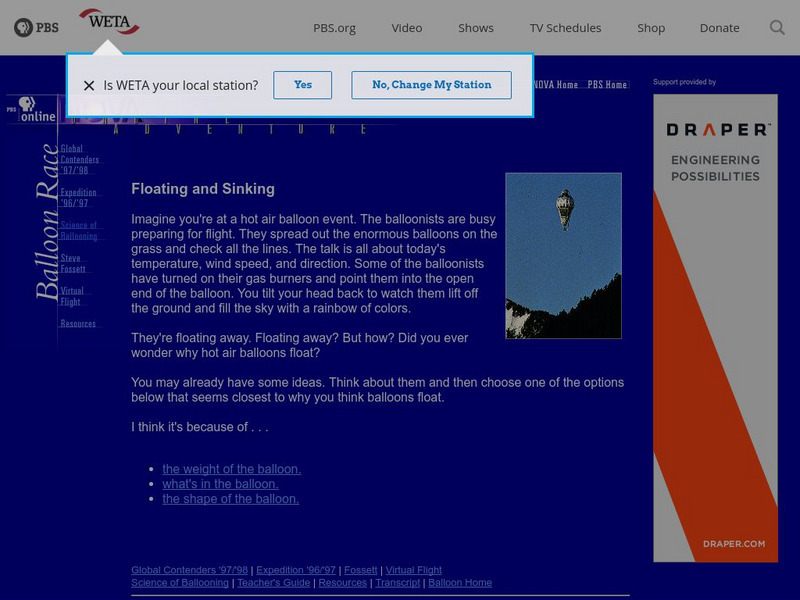
PBS
Pbs Learning Media: Floating and Sinking: Hot Air Balloons
Why do hot air balloons float? This resource from the NOVA Web site offers a series of interactive activities that illustrates the physics of hot air balloons.
Science Buddies
Science Buddies: Up, Up, and Away in Your Own Hot Air Balloon!
In this science fair project, students will make hot-air balloons using a toaster and dry-cleaning bags, and see how the size of the balloon affects its flight. The Science Buddies project ideas are set up consistently beginning with an...
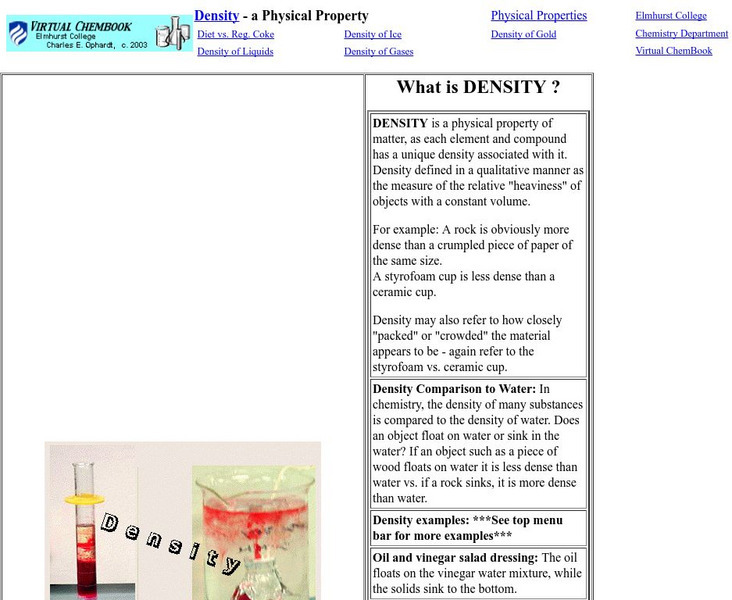
Other
Virtual Chembook: Density Applications With Gases
DENSITY is a physical property of matter, as each element and compound has a unique density associated with it. Density defined in a qualitative manner as the measure of the relative "heaviness" of objects with a constant volume. For...
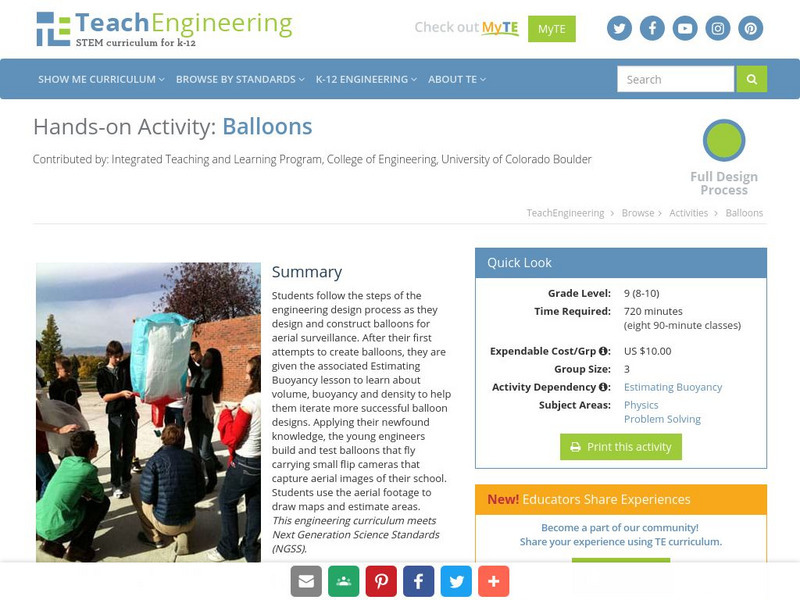
TeachEngineering
Teach Engineering: Balloons
Students follow the steps of the engineering design process as they design and construct balloons for aerial surveillance. After their first attempts to create balloons, they are given the associated Estimating Buoyancy lesson to learn...
Scholastic
Scholastic: Dirtmeister's Science Lab: The Air Is There
An experiment to see how the temperature of an object affects how high it bounces. This site contains web links and notes for the teacher.

PBS
Pbs Teachers: Hot Air Balloon Experiment
Explore how heat affects the density of air by building and flying a hot air balloon using large plastic bags and the hot air from an electric hairdryer.

Science Buddies
Science Buddies: Measure the Pressure
Scientists have developed an instrument called a barometer that can measure atmospheric pressure. In this activity, you will find out how a barometer works by building one yourself.