Hi, what do you want to do?






Teach Engineering
Clay Boats
Clay itself sinks, but clay boats float. Why? Young engineers build clay boats to learn about buoyancy. They test the weight the boats can hold using washers and then tweak their designs to make improvements, following the engineering...

Teach Engineering
Buoyant Boats
Eureka! Using the clay boats made in the previous lesson, learners investigate the idea of buoyancy and water displacement to finish the last installment of five in a Floaters and Sinkers unit. Their observations during the activity...

Museum of Science
Design a Submarine
Don't just sink the boat. Using a closed container as a submarine, pupils experiment to see what to add to the container to make it float, sink to the bottom, and hover in the middle. After finding one option, learners see if they can...
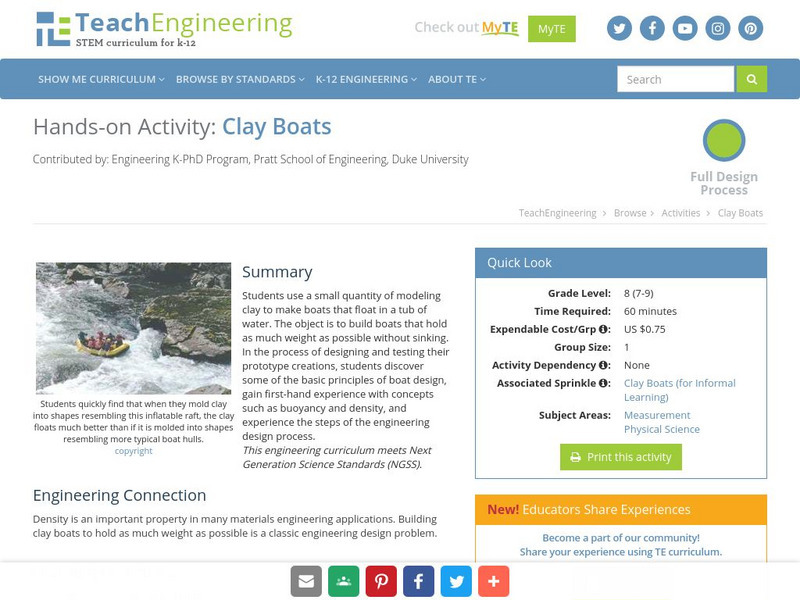
TeachEngineering
Teach Engineering: Clay Boats
Each student uses a small quantity of modeling clay to make a boat that will float in a tub of water. The object is to build a boat that will hold as much weight as possible without sinking. In the process of designing and testing their...
TeachEngineering
Teach Engineering: Taking the Boat to Manaus
In this activity, the students will apply the concepts they learned regarding mass, volume and density in the previous activities to design a boat.
TeachEngineering
Teach Engineering: Eureka! Or Buoyancy and Archimedes' Principle
Students explore material properties in hands-on and visually evident ways via the Archimedes' principle. First, they design and conduct an experiment to calculate densities of various materials and present their findings to the class....