Hi, what do you want to do?






Curated OER
Transportation with Lewis and Clark
Students listen to a PowerPoint presentation and complete a Venn diagram comparing the methods of transportation in the early 1800s with today's transportation. They experiment with the buoyancy of keelboats.

Curated OER
Sink or Float?
Students make and test predictions about sinking and floating, and classify objects according to whether they sink or float.

Curated OER
Archimedes' Principle
For this Archimedes' principle worksheet, students answer 13 questions about the concepts of Archimedes' principle such as water displacement, buoyancy and force. The answer questions from a lab they did in class to simulate Archimedes'...

Curated OER
Build Your Own Submarine
Students construct their own submarine following a certain procedure. In this physics lesson, students calculate the density of objects using a mathematical formula. They explain why some object floats in water while some do not.

Curated OER
Inventions 2: The Impact
Students research inventors and inventions and their impacts. In this invention lesson plan, students research inventions and their affects in good and bad ways.

Curated OER
The Impact of Invention
Students explore the impact of invention. In this invention lesson plan, students examine how inventions are on going and affect all aspects of life in both good and bad ways. Students will research the history of invention, become an...

Curated OER
Sink or Float?
Students will determine whether various objects sink or float in water. They do not need to explain why objects sink or float. They are rather to be encouraged to observe that the same objects will sink or float every time, i.e., that...

Curated OER
Ship Building Trip
Students travel to a ship building plant to see how they are built. They enter into discussion and writing about the task of the building. This lesson is multiple intelligence in design and valuable because of the real life exposure.
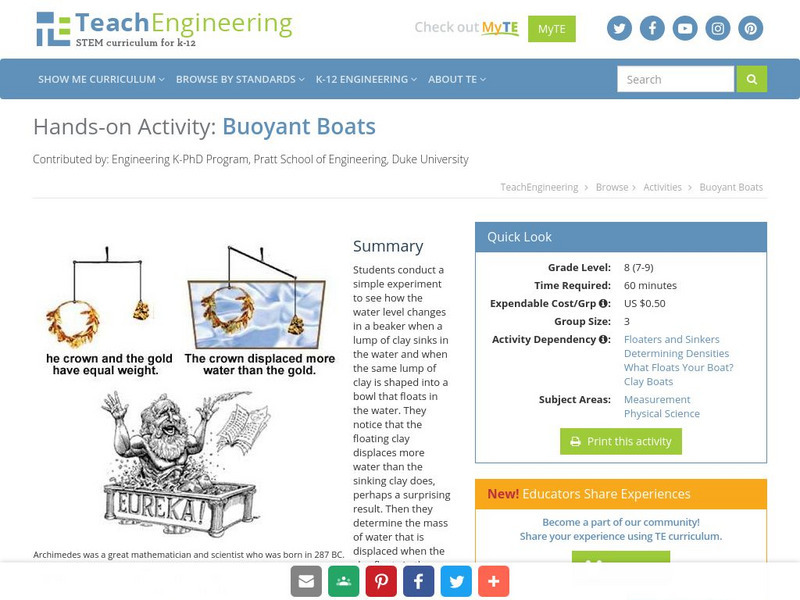
TeachEngineering
Teach Engineering: Buoyant Boats
Students learn about displacement, density and buoyancy then apply their knowledge to build a floating object.
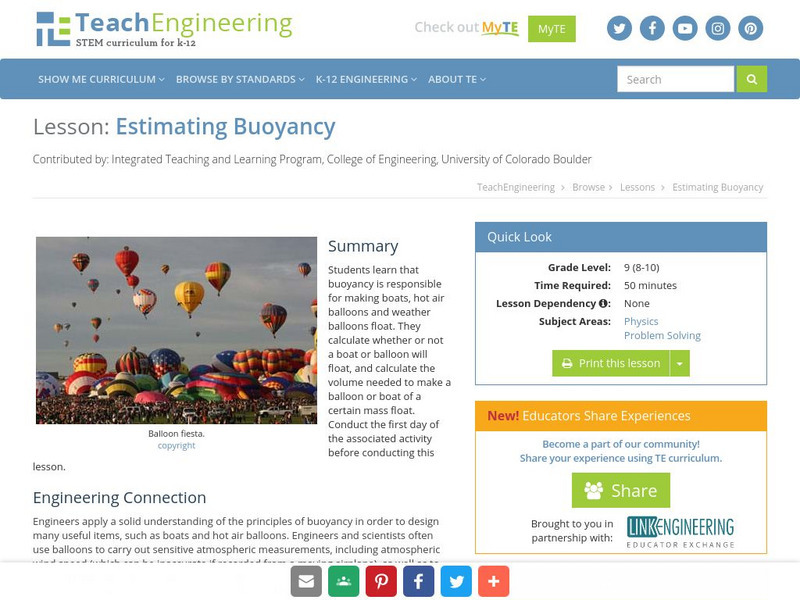
TeachEngineering
Teach Engineering: Estimating Buoyancy
Students learn that buoyancy is responsible for making boats, hot air balloons and weather balloons float. They calculate whether or not a boat or balloon will float, and calculate the volume needed to make a balloon or boat of a certain...

TeachEngineering
Teach Engineering: What Floats Your Boat?
Young scholars use modeling clay, a material that is denser than water and thus ordinarily sinks in water, to discover the principle of buoyancy. They begin by designing and building boats out of clay that will float in water, and then...
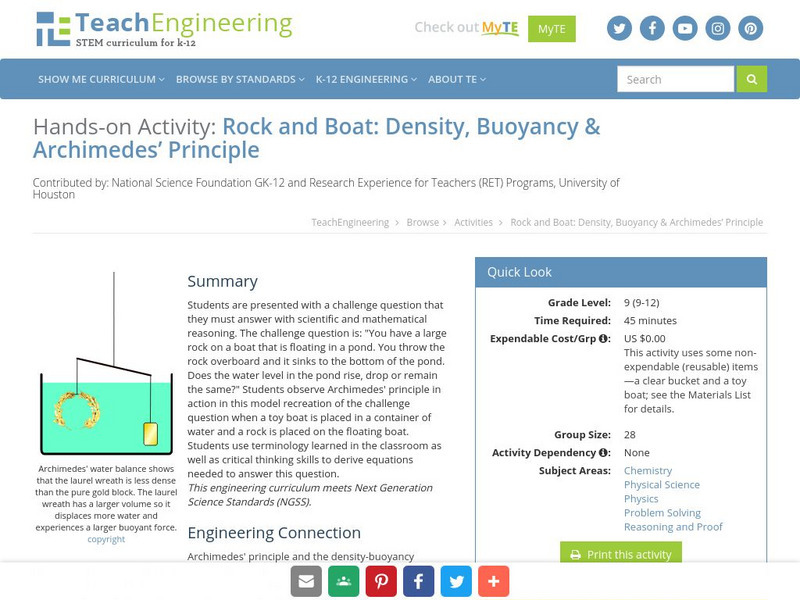
TeachEngineering
Teach Engineering: Rock and Boat
Students observe Archimedes' principle in action in this challenge where a toy boat is placed in a container of water and a rock is placed on the floating boat. Students must explain why the water level rises/falls/stays the same based...
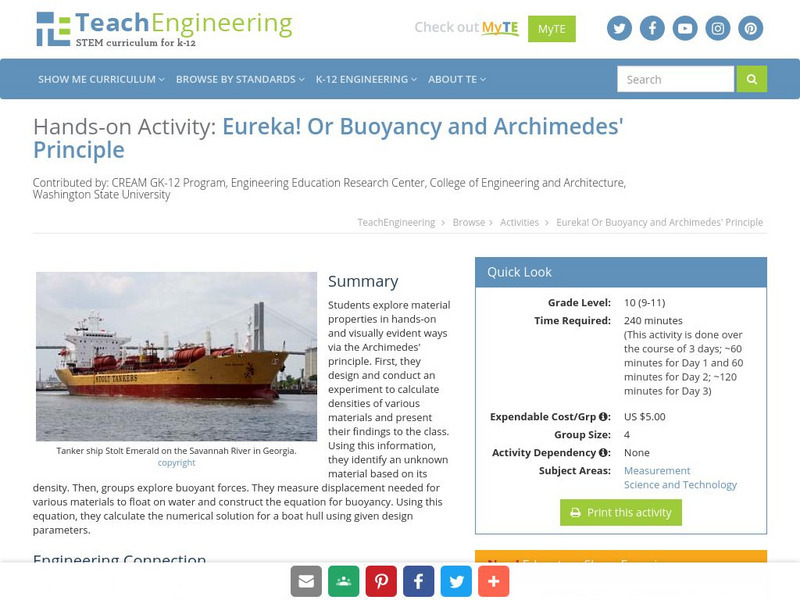
TeachEngineering
Teach Engineering: Eureka! Or Buoyancy and Archimedes' Principle
Students explore material properties in hands-on and visually evident ways via the Archimedes' principle. First, they design and conduct an experiment to calculate densities of various materials and present their findings to the class....

PBS
Pbs Learning Media: Buoyancy Brainteasers: Boat in Pool Puzzler
This interactive brainteaser from the NOVA: "Voyage of Doom" Web site challenges you to figure out what happens to the water level when a rock is resting in a boat and when it is submerged in water.

Alabama Learning Exchange
Alex: Who Sank the Boat?
This lesson teaches the concept of measurement using grams and ounces through a student-created experiment. The students will get to test their own scientific predictions by constructing a boat and trying to sink it. This lesson provides...
TeachEngineering
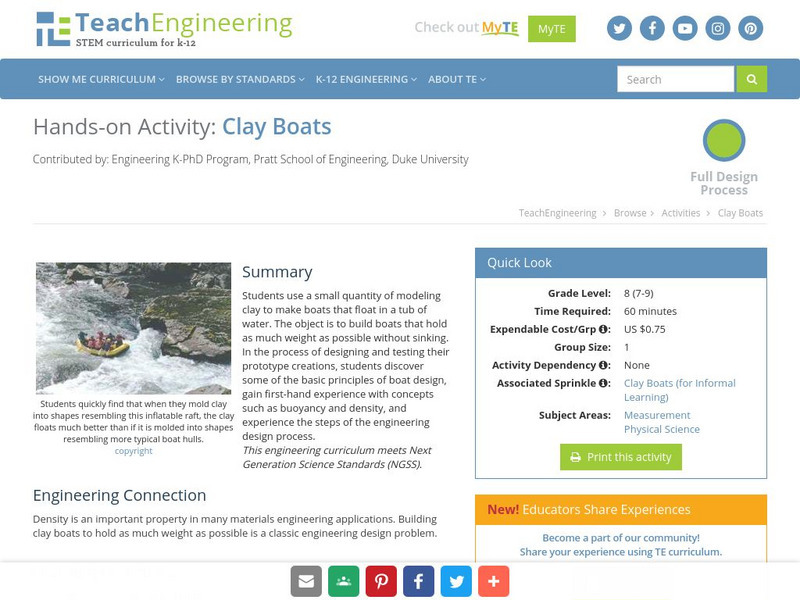
Teach Engineering: Clay Boats
Each student uses a small quantity of modeling clay to make a boat that will float in a tub of water. The object is to build a boat that will hold as much weight as possible without sinking. In the process of designing and testing their...

Alabama Learning Exchange
Alex: Teaching Measurement: Literature and Manipulatives
The tradebook, Who Sank the Boat? by Pamela Allen, is an excellent tool in teaching measurement. Young scholars will engage in activities involving different types of measurement. In the story, five animal friends decide to take a boat...
![Pbs Kids: Design Squad Challenge: Watercraft (Pdf) [Pdf] Handout](https://content.lessonplanet.com/knovation/original/39865-57ea89204034120cacf80bcffffff89c.jpg?1661243863 "Pbs Kids: Design Squad Challenge: Watercraft (Pdf) [Pdf] Handout")
PBS
Pbs Kids: Design Squad Challenge: Watercraft (Pdf) [Pdf]
Hands-on challenge to build an unsinkable boat out of straws and plastic wrap that can hold twenty five pennies. Provides full list of materials with ideas on how to build, test, evaluate, and redesign it if necessary. Also, includes...
Scholastic
Scholastic Instructor: Seashore Science
Come and learn with this incredible seashore science resource. The content includes fun facts, experiments, reproducible activities, resources and more.