Hi, what do you want to do?






Kenan Fellows
Unit 4: The Brain
Drugs interact with the brain to alter moods, emotions, and behaviors by changing the brain's chemistry, perceptions, and interactions. The final lesson in the Pharmacology unit shows scholars experiments, has them complete four labs,...
OpenStax
Open Stax: Anatomy & Physiology: The Cranial Nerve Exam
Students learn about the functional grouping of cranial nerves and match the regions of the forebrain and brain stem that are connected to each cranial nerve.
University of Washington
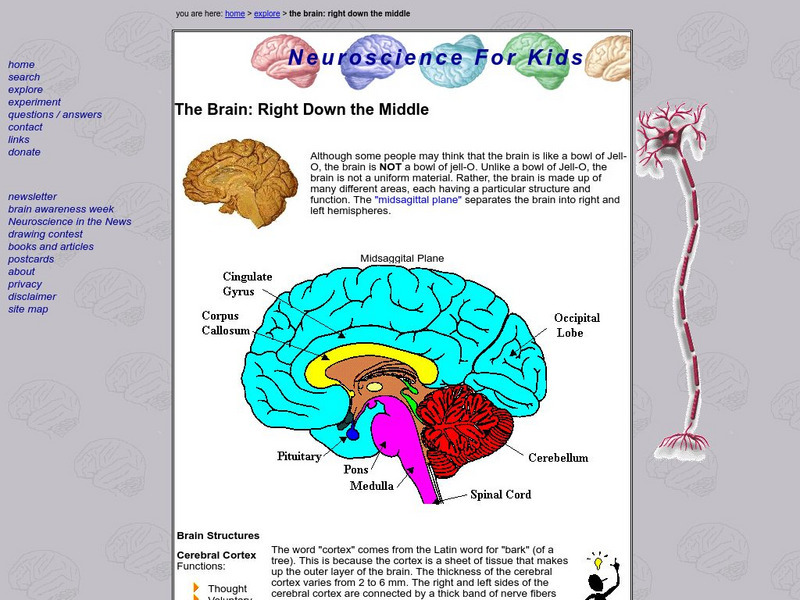
Univ. Of Washington: The Brain Right Down the Middle
From the University of Washington, this site goes into great detail in describing the brain.
OpenStax
Open Stax: Anatomy & Physiology: The Central Nervous System
Students study the adult brain, and learn the connections between the cerebrum and brain stem through the diencephalon, and from those regions into the spinal cord.
CK-12 Foundation
Ck 12: Life Science: Central Nervous System
[Free Registration/Login may be required to access all resource tools.] The central nervous system (CNS) is the largest part of the nervous system. It includes the brain and the spinal cord. The bony skull protects the brain. The spinal...

BBC
Bbc: Gcse Bitesize: How Does the Nervous System Help Us Respond? Ocr 21 C
This lesson focuses on the areas of the brain and the functions of each area. It includes a diagram of the brain with areas labeled, a table of the functions of the areas, and a link to a test.
OpenStax
Open Stax: Anatomy & Physiology: Central Processing
Students learn the pathways that sensory systems follow into the central nervous system, and understand the difference between the two major ascending pathways in the spinal cord.
TeachEngineering
Teach Engineering: It's a Connected World: The Beauty of Network Science
Students learn about complex networks and how to use graphs to represent them. They also learn that graph theory is a useful part of mathematics for studying complex networks in diverse applications of science and engineering, including...
TeachEngineering
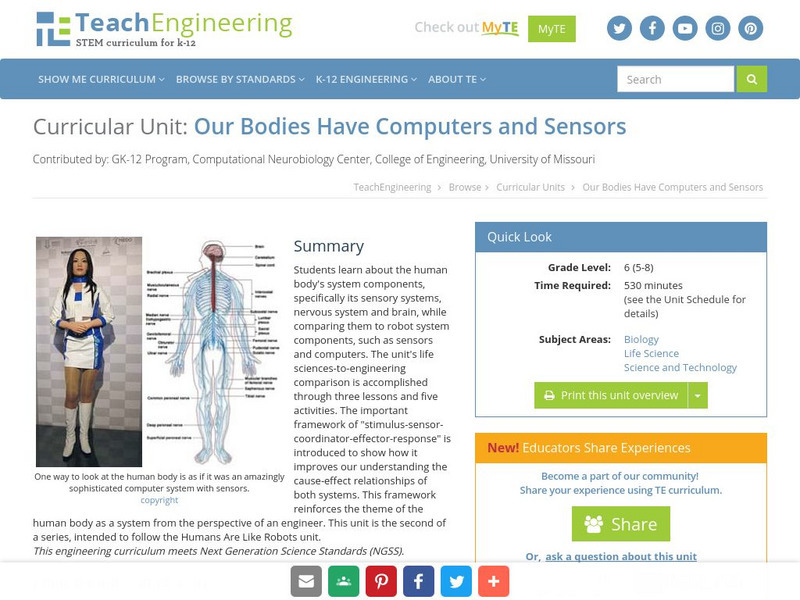
Teach Engineering: Our Bodies Have Computers and Sensors
Students learn about the human body's system components, specifically its sensory systems, nervous system and brain, while comparing them to robot system components, such as sensors and computers. The unit's life sciences-to-engineering...
TeachEngineering
Teach Engineering: Humans Are Like Robots
Four lessons related to robots and people present students with life sciences concepts related to the human body (including brain, nervous systems and muscles), introduced through engineering devices and subjects (including computers,...
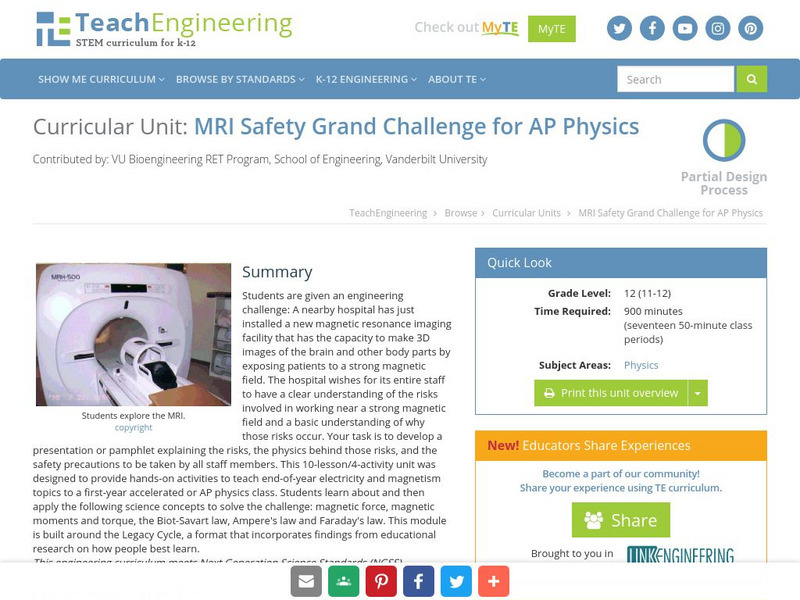
TeachEngineering
Teach Engineering: Mri Safety Grand Challenge
This module was written for a first year accelerated or AP physics class. It is intended to provide hands on activities to teach end of the year electricity and magnetism topics including the magnetic force, magnetic moments and torque,...

PBS
Pbs Learning Media: Pbs Kids: Cyberchase: Collection
Cyberchase is the Emmy-winning animated series full of math and environmental adventures. It features three diverse kids, known as The CyberSquad, who use brain power and problem solving skills to outwit and outsmart the villain Hacker...

Scholastic
Scholastic: Study Jams! Science: The Human Body: The Nervous System
A video and a short quiz on the central and peripheral nervous systems.