Hi, what do you want to do?






Curated OER
Science: Mirrored Movements
This activity provides students with a lab experience during which students construct a basic electric circuit and use it to explore dexterity skills. A chance to construct and operate a tool that extends a person's grasping ability and...

Curated OER
Candy DNA Model Lesson
Students explore DNA structure using materials such as Twizzlers, small colored gumdrops and/or toothpicks.

Curated OER
Do You Know the Master Programmer?
Fourth graders, using candy, build models of DNA replication, RNA transcription, and tRNA translation.

Curated OER
18th Century Microscope
Students examine a microscope from the 18th century. For this microscope lesson, students investigate how it works, what it was used for and how the tool has evolved through the years. Students also build knowledge on how compound...

Curated OER
Basic Introduction to Foundation of Life: Genes, Genetics and Genetic Diseases
Learners are introduced to genetics along with genetic diseases and heredity. In groups, they complete a Punnett Square to determine the dominant and recessive genes. After viewing diagrams, they identify the characteristics of DNA and...

Curated OER
Technology of Colonial America
By learning about the technology of Colonial America, students can gain a greater appreciation of history.

Curated OER
Circulatory System Design
Pupils identify the different parts of the circulatory system and their function. They work together to create their own model of the system and use it to determine the rate of blood flow. They answer questions related to their model.

Curated OER
Systems of Word Problems
Ninth graders investigate systems of linear equations. In this Algebra I lesson, 9th graders explore word problems that can be solved by using a system of equations. The problems involve such topics as cell phone usage,...

Curated OER
Edible DNA
Students use multicolored soft candies (gumdrops and candy orange slices) and toothpicks to create models of DNA structures. They discuss the fact that DNA must copy itself before splitting into two cells. Students demonstrate this by...

Curated OER
Neuron Anatomy Comparison
Students create a scale model of a motor neuron that is two hundred times larger than the actual neuron. They identify the structures of a neuron and observe neurons under the microscope then use a worksheet to convert actual sizes into...

Curated OER
The Honey Bee's Home
Students are introduced to the members and workings of a honey bee colony. They describe the structure of a comb, the day-to-day activities of honey bees, and name the four stages of bee development. They construct a honeycomb model.

Curated OER
Molecular Recognition and the Immune Response
Students explore the importance of molecular shape and charge in molecular-recognition. They examine the interaction between antigens and antibodies. Students design and build 3-D visual models to represent molecular-recognition...

Curated OER
Best Practices of Technology Integration
Learners participate in a lesson in order to practice using systems of equations in order to graph them. A cumulative project in the form of a brochure, web page, or interactive kiosk make this lesson more engaging.

Curated OER
Feedback and Flowcharts
Sixth graders explain what a negative feedback system is and they distinguish it from a positive feedback system. They describe examples of how negative feedback is used in both nature and technology. , Students define homeostasis, and...

Curated OER
Monastic Settlements
In this monastic settlements worksheet, students read facts, draw a monastic plan, complete 2 creative writing assignments and short answer questions. Page references chapters, but no text is mentioned.

Curated OER
Solar Arrays for the Space Station
Students explore the challenges that are faced when transporting materials into space. They review the various forms of energy, including solar arrays, that are used on the International Space Station and how generating this energy calls...

Curated OER
The Structure of DNA
Students describe the structure of the double helix, explain how DNA copies itself, and recognize that the sequence of DNA is what makes each individual unique.

Curated OER
Remember This?
Students investigate the mechanics of an fMRI and the properties of neurons. In this biology instructional activity, students analyze the way the brain works by performing tests in the neurons in the brain. This is all done theoretically.

Curated OER
How To Make an Artificial Organ
Students examine the advances made in technology with regard to prosthetics and replacement organs and limbs. They describe the anatomy and functions of different organs and create their own artificial organ. They defend and present...

Curated OER
From Sunlight to Electric Current
Students explore concept of current in electrical circuits. They examine how energy from the sun can be used to power everyday items, including vehicles.

BiologyWise
Biology Wise: Simple Steps on How to Build a Plant Cell Model
Describes the steps in how to make a model of a plant cell using simple materials and sweet foods like jello and candy.
TeachEngineering
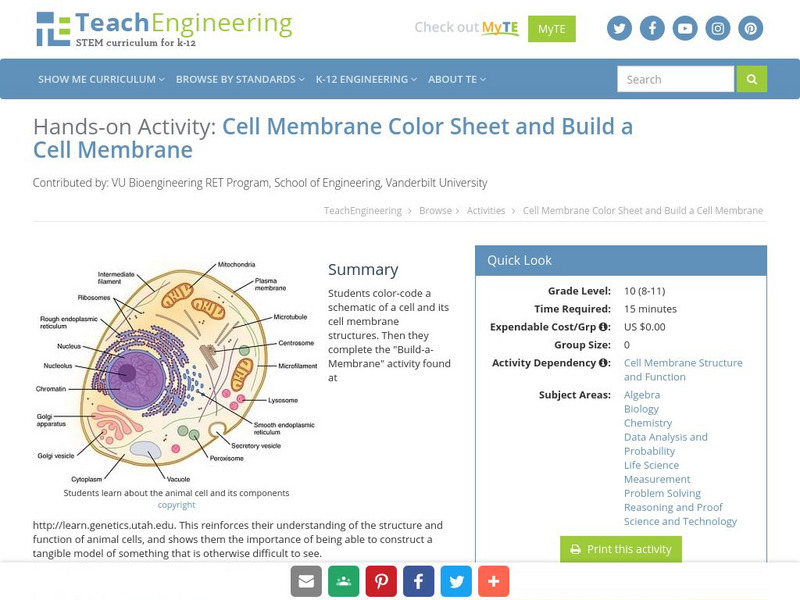
Teach Engineering: Cell Membrane Color Sheet and Build a Cell Membrane
Students color-code a schematic of a cell and its cell membrane structures. Then they complete the "Build-a-Membrane" activity found at http://learn.genetics.utah.edu. This reinforces their understanding of the structure and function of...
Science Education Resource Center at Carleton College
Serc: Best Edible Model of a Cell Contest
Students build a model of a cell using all edible materials. Students must do an oral presentation of the model.
BioEd Online
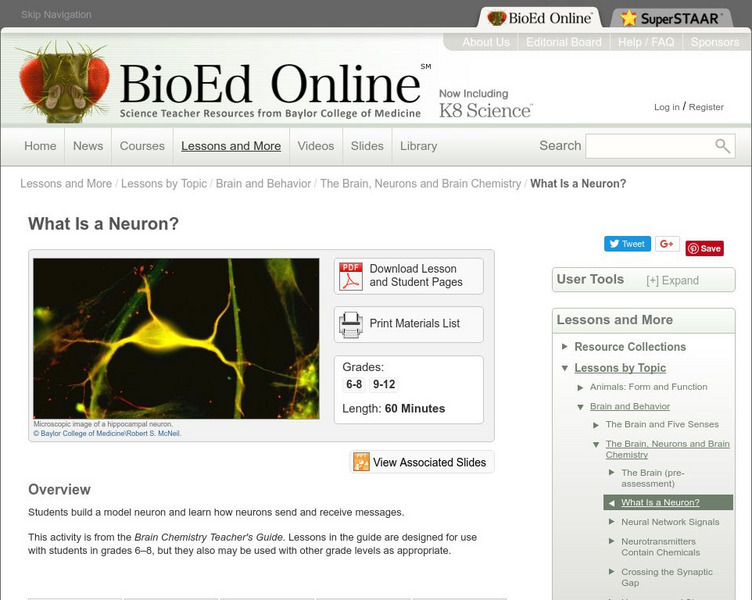
Bio Ed Online: What Is a Neuron?
Messages within the brain and the rest of the nervous system are sent very rapidly. These messages are conducted by cells called neurons. Neurons are specialized to receive and transmit message and neurons are connected in networks. In...