Hi, what do you want to do?






Curated OER
School Rules Scroll
Students, after creating a list of suggested classroom rules, work together to agree on a set of rules for the classroom, school cafeteria and playground. They write and illustrate the rules they agree on to make a school rules scroll.

Curated OER
School Manners and Student Behavior
Students write rules for good manners. In this character building lesson, students discuss and record showing respect in the classroom, playground, and cafeteria. They role play these behaviors in front of the class.

Curated OER
Getting Out of the Box
Students define stereotype, discrimination and prejudice. They brainstorm a social action plan to heal racism.

Scholastic
Make a Mini Mayflower
Students discover the importance and history behind the Thanksgiving feast. Using walnut shells and toothpicks, they construct models of the Mayflower and simulate giving them to the Native Americans for helping the Pilgrims survive.

Curated OER
Sensory Details
Students observe their environment and write detailed, sensory-specific sentences about that environment. This lesson can be extended to include the creation of a personalized story or movie of the experience (student examples are...

Teaching Tolerance
Consuming and Creating Political Art
A picture is worth a thousand words, but political art may be worth even more! After examining examples of political cartoons, murals, and other forms of public art, class members create their own pieces to reflect their ideals and...

Curated OER
A World of Taste--Louisiana Gumbo
Students discover the multicultural contributions to New Orleans gumbo through participation in cross curriculum activities. In this multicultural diversity and New Orleans history lesson plan, students shade regions of a map according...

Curated OER
History in the Making: The Tortilla
Fourth graders examine the history of the tortilla and extend the study across the curriculum. In this history of the tortilla lesson, 4th graders research the background of the tortilla, determine the ingredients, and work with the...

Curated OER
Look Before You Think: How To Appreciate a Painting
Learners develop an elementary understanding of the history of art. They study the basic elements of a painting including perspective, composition, color, light and symbolism. They look at each selected painting and analyze it, moving...

Curated OER
What I Like About My School
Young scholars create a picture montage about the qualities they like about their school. In this photography lesson plan, students use a digital camera to take photos of their school's locations, people, etc. Young scholars construct a...

Curated OER
Teaching Students To Follow Directions
Students practice following directions. In this listening activity, students play a game of "Follow the Leader" while coloring in an activity page. They must color their page according to the directions given by the teacher or leader.

Curated OER
Giving Cheer
Students explore kind behavior. In this values development and literacy lesson, students listen to The Giving Tree by Shel Silverstein, then generate a class list of ways the tree helped the boy and ways in which the boy helped the tree....

Curated OER
Germs and the Body
Students explore biology by completing an illness worksheet. In this human germs lesson, students identify how germs are transferred from one body to another and the prevention methods that can be taken. Students complete a worksheet...

Curated OER
Eating to Win
Students examine human health by completing a sports nutrition worksheet. In this eating habits lesson, students discuss the importance of a balanced diet and proper feeding times when competing in physical activities. Students complete...

Curated OER
Music
Third graders incorporate two formal music lessons into the core curriculum. They study whole notes and rests, syllables of the musical scale and practice singing.
Yale University
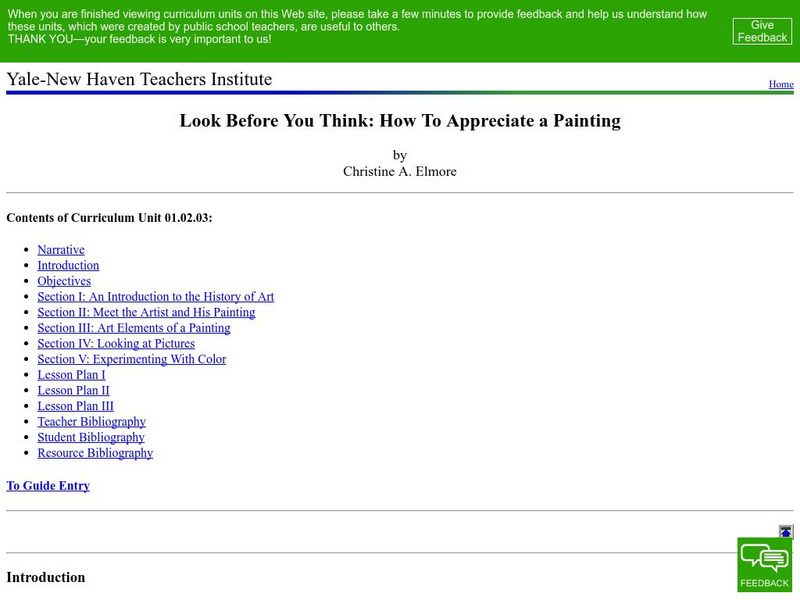
Yale New Haven Teachers Institute: How to Appreciate a Painting
Christine A. Elmore's curriculum unit designed "to facilitate her third-graders' enjoyment of and response to fine art." This unit can be applied to all age groups and provides an extensive background on art in general.