Hi, what do you want to do?






Texas State Energy Conservation Office
Investigation: Conservation of Energy
By rolling marbles down a six-foot length of track, physical scientists determine how much energy is lost to heat. It is recommended that you opt for the foam pipe insulation track because more friction slows the marble, allowing...

Teach Engineering
Energy and the Pogo Stick
Let your class bounce to examine the concept elastic potential energy. Individuals bounce on a pogo stick in order to calculate its elastic potential energy. Groups then compare the elastic potential energy to the gravitational...

Anchorage School District
Roller Coaster Project
Emerging engineers work in teams to design pipe insulation roller coasters for marbles that meet specific parameters. They are required to label along the track the areas where kinetic and potential energy are highest and lowest, where...

Teach Engineering
Energy on a Roller Coaster
Roll with your class into the idea of conservation of energy. Pupils use a roller coaster track to collect data to reinforce the concept of conservation of energy and the influence of friction. Class members then create a graph from...

Teach Engineering
Swinging Pendulum
Get into the swing of things. Pupils use a pendulum to demonstrate the conversion of potential energy to kinetic energy and back. After measuring the speed of a pendulum and compare it to the calculated theoretical speed, they...

MENSA Education & Research Foundation
Roller Coaster Mania!
Raise the energy level of your physical science class with this exciting hands-on activity. Applying their knowledge of kinetic and potential energy and Newton's laws of motion, young engineers use foam tubing and marbles to create...

Teach Engineering
Bouncing Balls
How high will it bounce? Groups determine the height different balls bounce off of different surfaces. By performing the necessary calculations, they determine the initial and final momentum of the balls. The included worksheet provides...

It's About Time
Defy Gravity
Test the limits of gravity while encouraging full class participation with this thrilling lesson. Pupils investigate the meaning of work and how it is equivalent to energy. They explore the joule and apply it as a unit of work. They...

Teach Engineering
Ramp and Review (for High School)
Rolling for momentum. As part of a study of mechanical energy, momentum, and friction, class members experiment rolling a ball down an incline and having it collide with a cup. Groups take multiple measurements and perform...

Teach Engineering
Building a Piezoelectric Generator
In pairs, learners build a piezoelectric generator from readily available electric components in the second and final installment of the two-part series. Tapping the piezoelectric element produces enough electricity to light an LED....

Trash For Teaching
The Light-House Project
Groups work together to design a lighthouse, from designing and drawing the wiring diagram, to creating prototypes of the switch and circuit, to envisioning and building a scale model along with a blueprint. By including different...
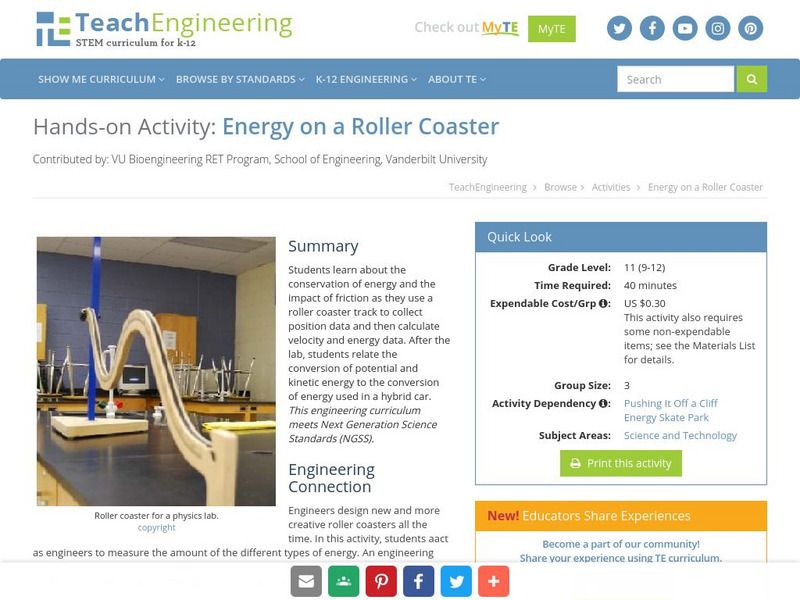
TeachEngineering
Teach Engineering: Energy on a Roller Coaster
This activity utilizes hands-on learning with the conservation of energy and the interaction of friction. Students use a roller coaster track and collect position data. The students then calculate velocity, and energy data. After the...

TeachEngineering
Teach Engineering: Falling Water
Students drop water from different heights to demonstrate the conversion of water's potential energy to kinetic energy. They see how varying the height from which water is dropped affects the splash size. They follow good experiment...
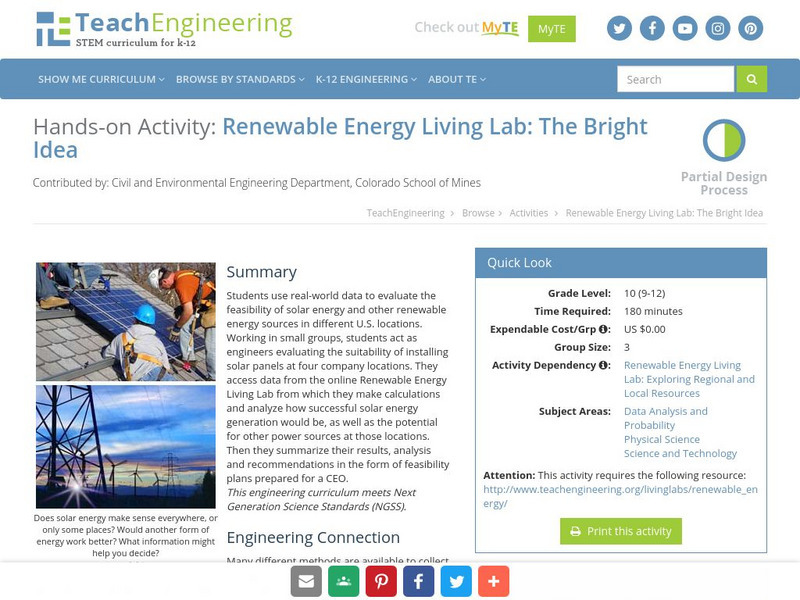
TeachEngineering
Teach Engineering: Renewable Energy Living Lab: The Bright Idea
Students use real-world data to evaluate the feasibility of solar energy and other renewable energy sources in different U.S. locations. Working in small groups, students act as engineers evaluating the suitability of installing solar...

TeachEngineering
Teach Engineering: Renewable Energy Living Lab: Power Your School
Students use real-world data to calculate the potential for solar and wind energy generation at their school location. After examining maps and analyzing data from the online Renewable Energy Living Lab, they write recommendations as to...
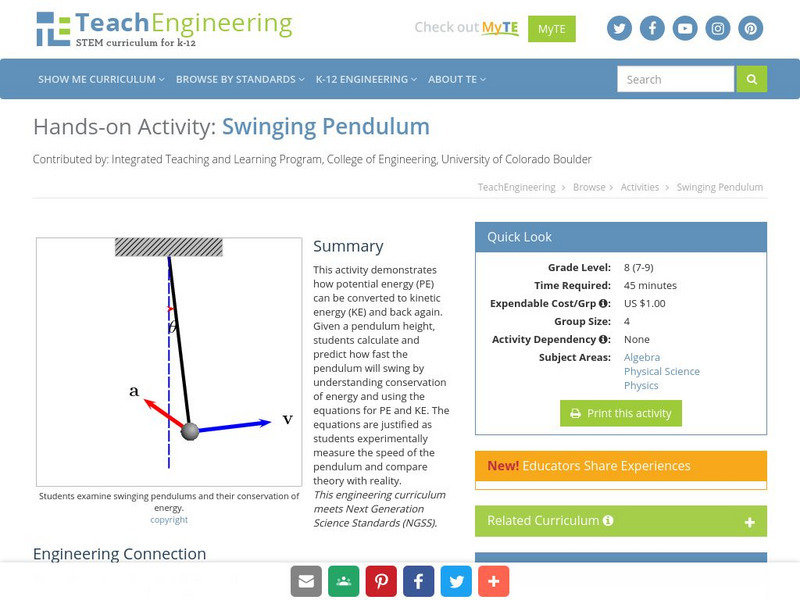
TeachEngineering
Teach Engineering: Swinging Pendulum
This activity demonstrates how potential energy (PE) can be converted to kinetic energy (KE) and back again. Given a pendulum height, students calculate and predict how fast the pendulum will swing by understanding conservation of energy...
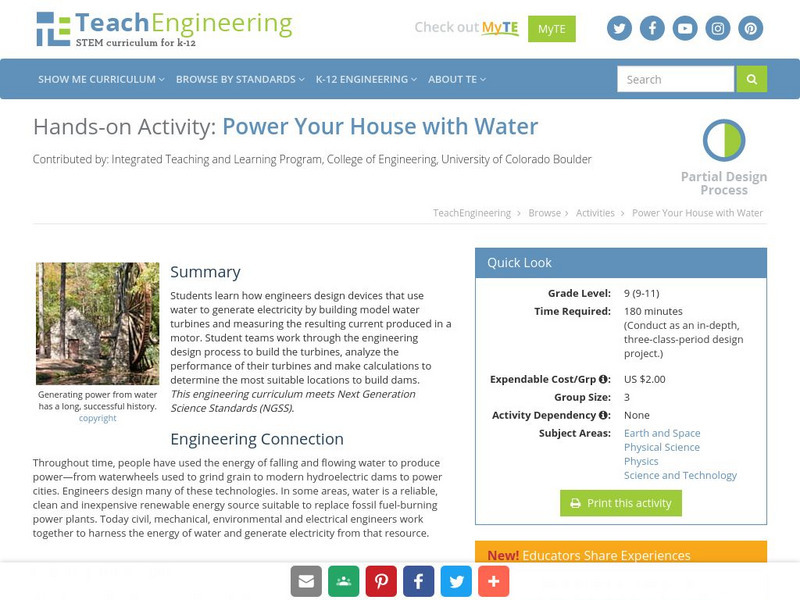
TeachEngineering
Teach Engineering: Power Your House With Water
Students learn how engineers design devices that use water to generate electricity by building model water turbines and measuring the resulting current produced in a motor. Students work through the engineering design process to build...
TeachEngineering
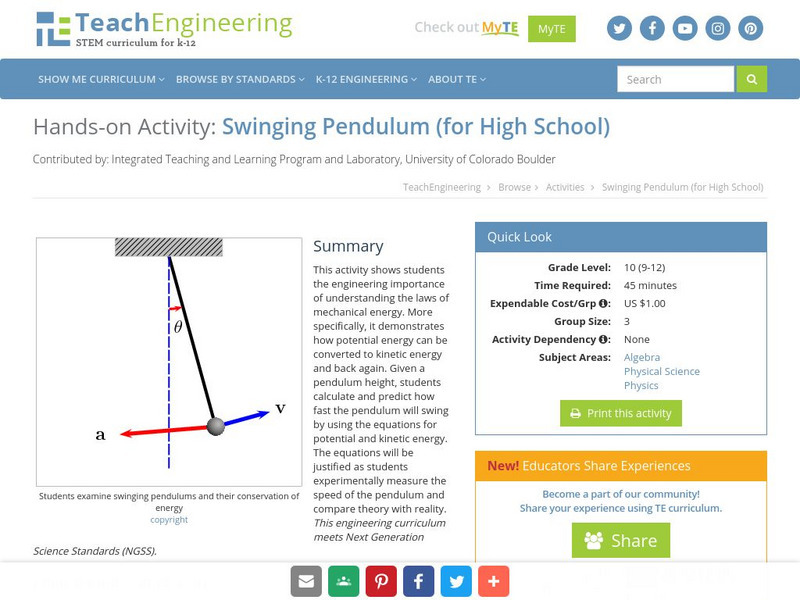
Teach Engineering: Swinging Pendulum
This activity shows students the engineering importance of understanding the laws of mechanical energy. More specifically, it demonstrates how potential energy can be converted to kinetic energy and back again. Given a pendulum height,...

TeachEngineering
Teach Engineering: Ramp and Review (For High School)
In this hands-on activity - rolling a ball down an incline and having it collide into a cup - the concepts of mechanical energy, work and power, momentum, and friction are all demonstrated. During the activity, students take measurements...
TeachEngineering
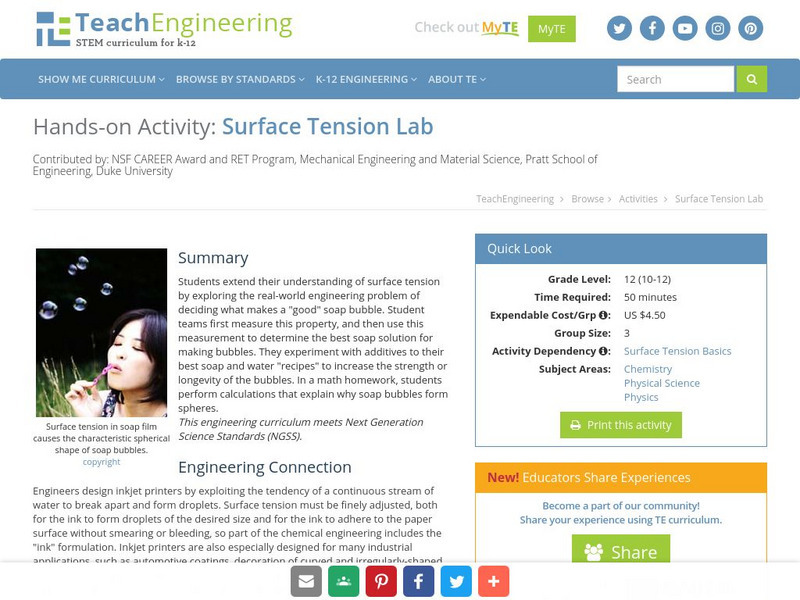
Teach Engineering: Surface Tension Lab
Students extend their understanding of surface tension by exploring the real-world engineering problem of deciding what makes a "good" soap bubble. Student teams first measure this property, and then use this measurement to determine the...
TeachEngineering
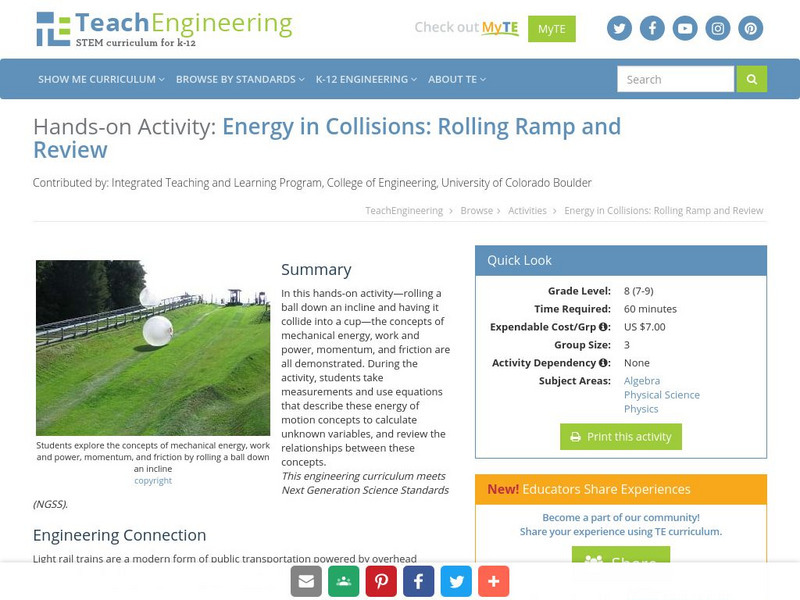
Teach Engineering: Ramp and Review
In this hands-on activity - rolling a ball down an incline and having it collide into a cup - the concepts of mechanical energy, work and power, momentum, and friction are all demonstrated. During the activity, students take measurements...