Hi, what do you want to do?






Math Open Reference
Math Open Reference: Prism
Use this interactive tool to explore prisms. Change the height and the shape of the base to see how these affect the prism. There are also several additional options, e.g., making it oblique or transparent. Properties of a prism are...
CPALMS
Cpalms: Mudslide
[Free Registration/Login Required] This is a formative assessment task where students are asked to first make a mathematical model of a mudslide given the dimensions of the area it covers. They then use an estimate of density to...
TeachEngineering
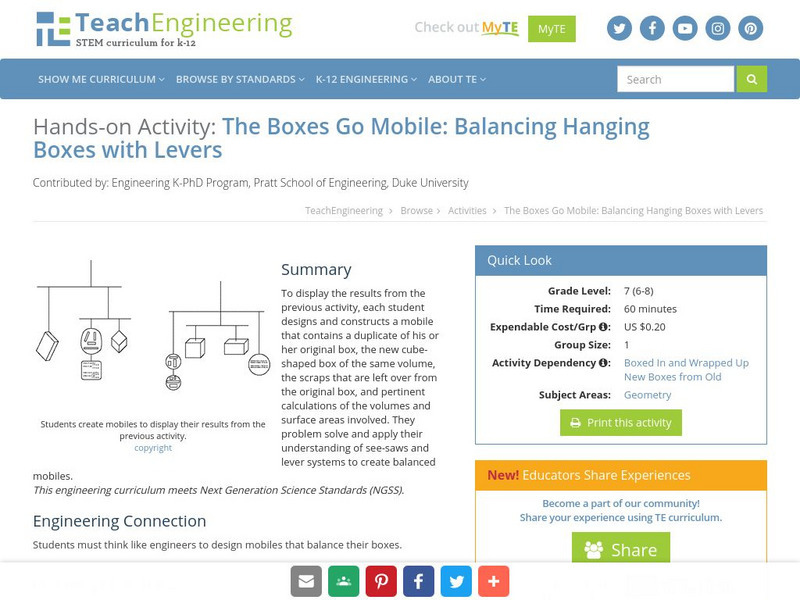
Teach Engineering: The Boxes Go Mobile
To display the results from the previous activity, each student designs and constructs a mobile that contains a duplicate of his or her original box, the new cube-shaped box of the same volume, the scraps that are left over from the...
CK-12 Foundation
Ck 12: Geometry: Spheres
[Free Registration/Login may be required to access all resource tools.] This concept teaches students how to calculate the volume and surface area of a sphere.
Illustrative Mathematics
Illustrative Mathematics: 6.g Christo's Building
This problem looks at a scale model of a project by Christo and Jeanne Claude. Students are asked to calculate its volume, how many 1/2-inch blocks would be needed to build it, and how much cloth would be required to wrap it. They then...
Texas Instruments
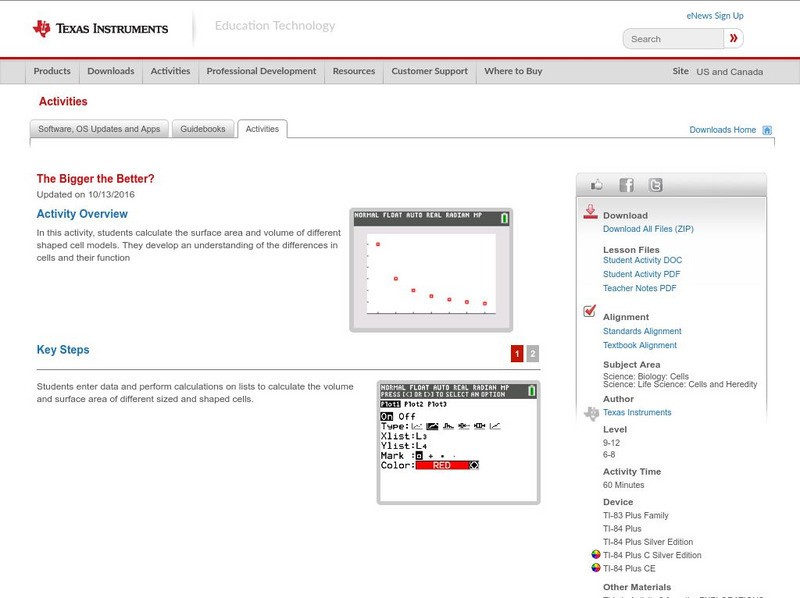
Texas Instruments: The Bigger the Better?
In this activity, students calculate the surface area and volume of different shaped cell models. They develop an understanding of the differences in cells and their function
Illustrative Mathematics
Illustrative Mathematics: 8.g Shipping Rolled Oats
For this task, 8th graders must determine the optimal dimensions of a cardboard box that will hold six cylinders of oats. To do this, they need to make surface area and volume calculations. Aligns with 8.G.C.9.
Annenberg Foundation
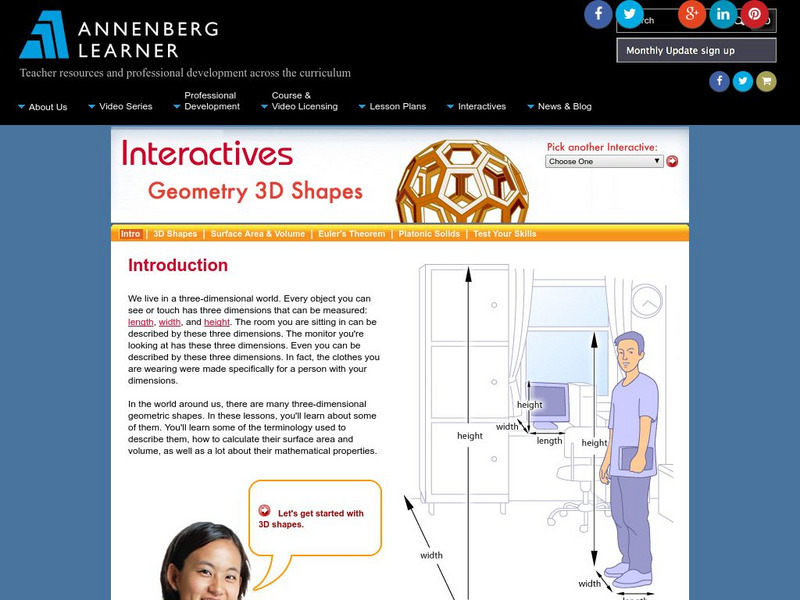
Annenberg Learner: Geometry 3 D Shapes
Learn about several three-dimensional geometric shapes and the terminology used to describe them. Learn how to calculate their surface area and volume, and explore their mathematical properties.
Other
Uss Constitution Museum: How Much Stuff Can Constitution Hold?
The lowest part of USS Constitution was called the hold and it was there that sailors stowed the many goods needed to keep the ship afloat and to feed the 480 men who served aboard for months at sea. In this lesson students use the...
TeachEngineering
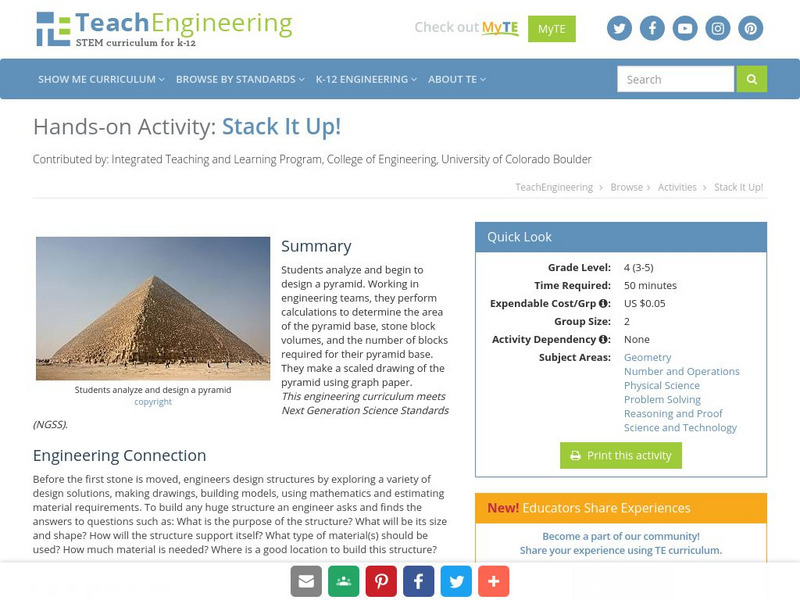
Teach Engineering: Stack It Up!
Students analyze and begin to design a pyramid. Working in engineering teams, they perform calculations to determine the area of the pyramid base, stone block volumes, and the number of blocks required for their pyramid base. They make a...