Hi, what do you want to do?






Curated OER
Throwing a Discus
Students investigate the correct technique of discus throwing through a warm up game using coits, progressing through to rolling discuss and then proper throwing. In this discus throwing lesson, students become familiar with and learn...

Curated OER
Buoyant Force
Students illustrate Archimedes' Principle of Buoyant Force. In this graphing instructional activity, students will observe that the buoyant force on an object is equal to the weight of the fluid it displaces. Students will then create a...

Curated OER
The Intertidal Zone: Tides and How Creatures Survive
Students study the properties of ocean water and tides and learn about animals that live in intertidal zones. In this intertidal zone instructional activity, students participate in classroom stations to learn about fresh water and salt...

Curated OER
Oklahoma Ag in the Classroom
Students read a recipe of beef jerky and explore the process. In this agriculture recipe lesson, students read the process and recipe for creating beef jerky. Students also read a history of the American Plains Indians and their use...

Curated OER
Backwards Watercolors
Students create a watercolor picture. In this watercolor lesson, students cover the entire page with water. They color with a marker on top of the water and watch as the colors run and blend together.

Curated OER
Laundry Basket Fun
Students entertain themselves in a laundry basket. In this performing arts lesson, students sit in a basket with small items and then throw the items out repeating the procss over an over again.

Curated OER
Mini pinatas loot bags
Students create mini pinata loot bags. In this pinata lesson, students take three balloons and cover them with flour, water, and tissue paper. They cut off the bottom to fill them and cover the opening.

Curated OER
Looking at Different Species
Pupils research a species of bug that they find in a pond. In this species lesson students work in groups and find the similarities and differences between different species of bugs.

Curated OER
Whales
Students compare and contrast the two types of whales. For this biology lesson, students research the characteristics of their assigned whale. They compile their findings in a folder.

Curated OER
Teaching about Islam
Ninth graders explore the effects of globalization on the Global South. In this World History lesson, 9th graders research a specific Islamic region. Students create a presentation that explain the effects of globalization on their...

Curated OER
Thar She Blows
Students discover the effects of El Nino on the global climate. As a class, they role play the role of a cold or warm wind and act out a skit in front of the class. They discuss the results of the role play once it is completed.

Curated OER
Afghanistan in ruins
Pupils think about and internalize how they would help to rebuild a country. They study the meaning of global interdependence and why rich countries help poor countries. They also explore different types of international aid and match...

University Corporation for Atmospheric Research
Ucar: Catching Snowflakes
Are you in a place where snow falls in winter? If so, try catching snowflakes. Then take a close look. Can you find two snowflakes that look alike?
PBS
Pbs Kids Afterschool Adventure!: Operation: Number Power Activity Plan
In this week's Afterschool Adventure, children will use number powers to solve problems and save the day! They will use grouping power to save a parade, skip counting power to catch a pie-snatching thief, and speed counting and place...

Alabama Learning Exchange
Alex: Watch Me Toss, Catch and Travel!
Week-long detailed lesson plan for early elementary physical education students focusing on walking, marching, traveling, catching, and tossing.
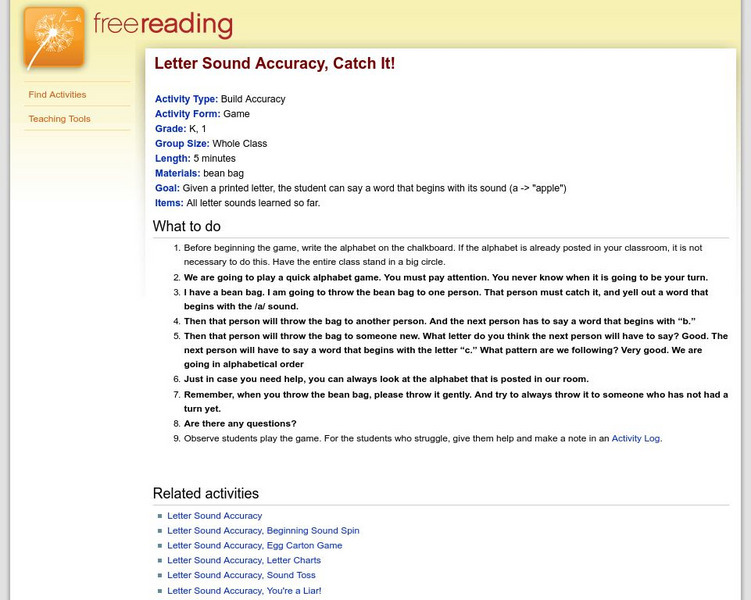
Free Reading
Free Reading: Catch a Sound: Letter Sound Accuracy Activity
A quick alphabet game for the whole class. Learners stand in a circle and throw a beanbag to each other. When they catch it, they must say a word that begins with the letter given. Continue this in alphabetical order.
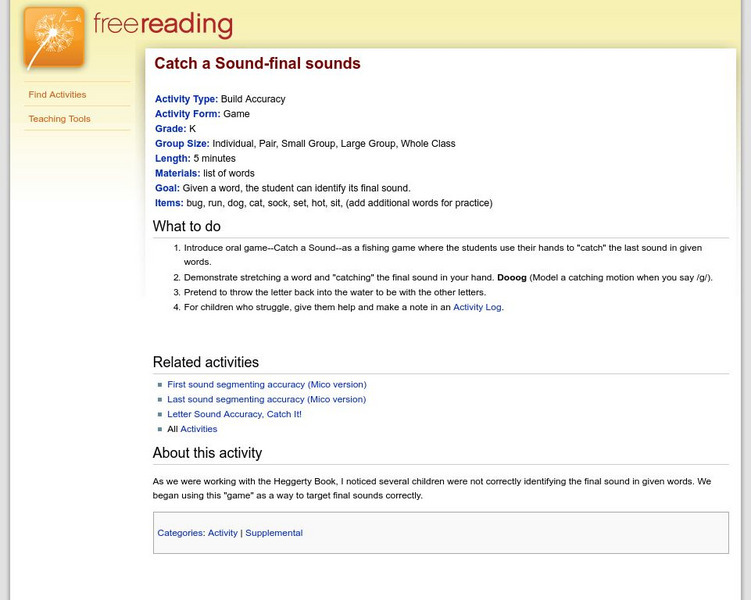
Free Reading
Free Reading: Catch a Sound: Final Sounds Game
This site contains a flexible activity that teaches students how to "catch" or identify the final sound of a word.

Discovery Education
Discovery Education: Catch 22
This lesson plan designed around Heller's novel includes a research component for collaborative work with a librarian, comprehension questions, extension activities, vocabulary, some suggested reading, a few web links, and correlation to...
Teachers TryScience
Teachers Try Science: Catch the Wave!
A resource that explores sound waves and how they work. Offers activities online and offline. Requires Adobe Flash.
Physics Classroom
The Physics Classroom: Momentum and Collisions: Fish Catch Interactive
Students explore the relative mass of two colliding objects, and determine if that can be used to quickly predict the post-collision speed of the objects? An activity sheet guides learners through the process of determining the rule for...
University of Washington
Hearing: Activities, Experiments, Models and More
Come and learn more about one of the five senses? Hearing is an integral part of our everyday life. To learn more use the activities, experiments, models and more wrapped into this hearing website.

Khan Academy
Khan Academy: Activity: Exhibit Design Challenge
From the San Francisco 49er's Museum Education Program which promotes STEAM concepts, students construct a three dimensional (3-D) artifact stand that is the exact replica of "The Catch" which is 70 inches high. Emphasis is placed on...
TeachEngineering
Teach Engineering: Can You Catch the Water?
Students construct a three-dimensional model of a water catchment basin using everyday objects to create hills, mountains, valleys and water sources. They experiment to see where rain travels and collects, and survey water pathways to...
TeachEngineering
Teach Engineering: Catching the Perfect Sar Waves!
Students learn the importance of the Pythagorean theorem as applied in radar imaging. They use a sensor unit with IRED (infrared emitting diode) to measure triangle distances and the Pythagorean theorem to calculate and verify distances....