Hi, what do you want to do?





American Chemical Society
American Chemical Society: Inquiry in Action: Teach Science Well
Online textbook reviews fundamentals of chemistry and physical science via slideshow presentations, notes, and videos. Materials for classroom activities engage students in inquiry-based, hands-on investigations covering molecular...
American Chemical Society
American Chemical Society: Inquiry in Action: Teach Science Well
Online textbook reviews fundamentals of chemistry and physical science via slideshow presentations, notes, and videos. Materials for classroom activities engage students in inquiry-based, hands-on investigations covering molecular...
American Chemical Society
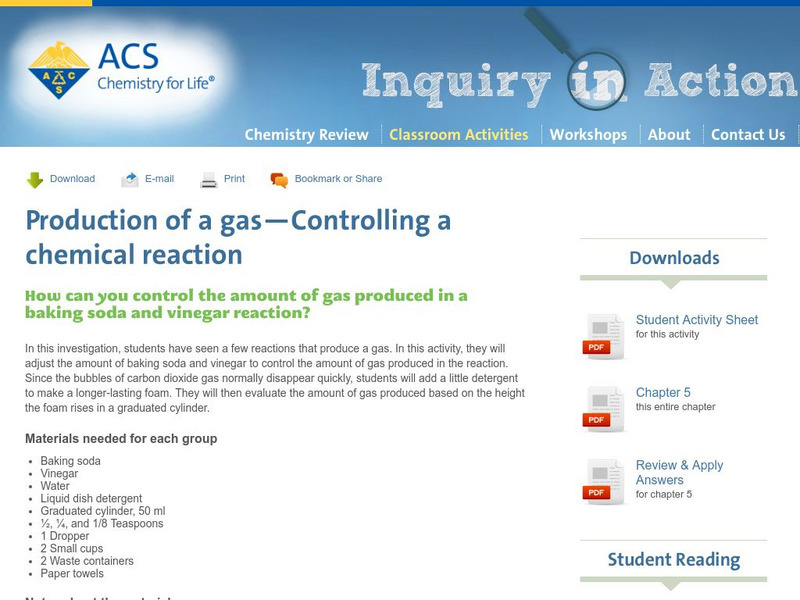
Inquiry in Action: Production of a Gas: Controlling a Chemical Reaction
Observe reactions that produce gases in this lab activity! Students observe chemical changes as they evaluate the amount of gas produced. This lab activity includes both student and teacher instruction sheets.

Utah STEM Foundation
Utah Stem Action Center: Changes in Matter
The goal of this activity is to develop and use a model to describe that matter is made of particles on a scale that is too small to be seen. You will be making observations of changes supported by a particle model of matter.
Utah State Office of Education
Utah Science: Changing Matter
Matter changes both physically and chemically on a fairly regular basis. Through these activities students will challenge their understanding of the changes that may take place with different types of matter.
American Chemical Society
Middle School Chemistry: Lesson Plans: What Is a Chemical Reaction?
After observing a demonstration of a chemical reaction between a burning candle and the oxygen in the air, students use atom model cut-outs to model the reaction and see that all the atoms in the reactants show up in the products.
American Chemical Society
Middle School Chemistry: Chapter 6: Chemical Change
Twelve interactive chemistry lessons about chemical changes complete with handouts and animations.
Science Struck
Science Struck: The Phenomena of Physical Change Explained
Explains what a physical change is and gives examples. The difference between a physical and a chemical change is also discussed.

Alabama Learning Exchange
Alex: Name That Change!
This lesson plan teaches students to distinguish between physical and chemical changes. Students will view an interactive slideshow presentation and then conduct experiments to discern physical and chemical changes.
Alabama Learning Exchange
Alex: Physical and Chemical Changes
The teacher will conduct the whoosh bottle demonstration to engage students. The class will then begin discussion of endothermic and exothermic physical and chemical changes. The students will then conduct the Science in Motion lab...
Utah Education Network
Uen: Hot and Cold
Students study the energy associated with physical and chemical changes. The activity consists of observing nine phenomena.

E-learning for Kids
E Learning for Kids: Science: Arctic Ocean: How Can We Change Materials?
Join Jacob on the Nova Zembla Expedition, and help him use suitable materials for building his house.
Utah Education Network
Uen: Physically Change Shape of Object
Science fair project tests whether students can construct a shape out of clay that will float.
Utah Education Network
Uen: Recognizing Chemical Reactions
Students will add 4 chemicals to a beaker and observe the changes that take place. They will classify them as physical or chemical changes.

Science Education Resource Center at Carleton College
Serc: Combustion or Oxidation
Students burn a magnesium strip to reinforce the concepts of chemical vs. physical changes, reaction types, conservation of mass, formulas and equations, stoichiometry, Lewis structures, and to explore the concept of oxidation/reduction...
Texas Education Agency
Texas Gateway: Matter and Energy: Chemical Reactions
Do you know the difference between a physical and a chemical change? This interactive tutorial will explore these concepts!
Science Buddies
Science Buddies: Rubber Band Elasticity and Temperature
Many materials expand when heated and contract when cooled. What do you think will happen to the elasticity (stretchiness) of a rubber band when it is heated or cooled to various temperatures?
Alabama Learning Exchange
Alex: Freezing Things: States of Matter
The class will go back over the Power Point presentation on chemical and physical properties. The teacher will then conduct numerous liquid nitrogen demos. This activity is used early in the Chemistry course. The learners love it. This...
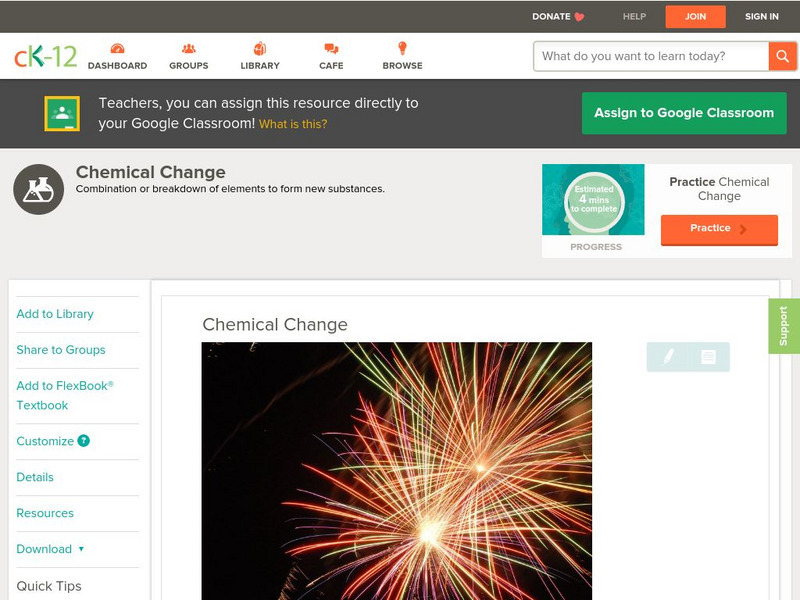
CK-12 Foundation
Ck 12: Physical Science: Chemical Change
[Free Registration/Login may be required to access all resource tools.] Definition of chemical change and examples, signs of chemical change and how it can be reversed.
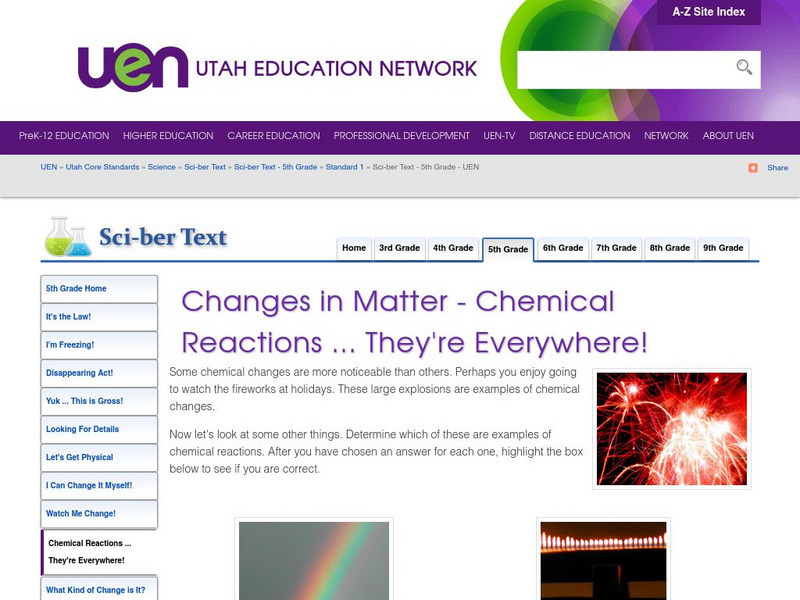
Utah Education Network
Uen: Changes in Matter Chemical Reactions They're Everywhere
Can you distinguish physical changes from chemical reactions? You'll be presented with a number of pictures and asked to identify those which are examples of chemical reactions.
American Chemical Society
Middle School Chemistry: Lesson Plans: Using Chemical Change to Identify Unknown
Young scholars observe reactions of liquids with different known powders in this lesson. Unknown powders are then identified using characteristic chemical changes.Site includes a procedure, teacher instructions, and video instruction.
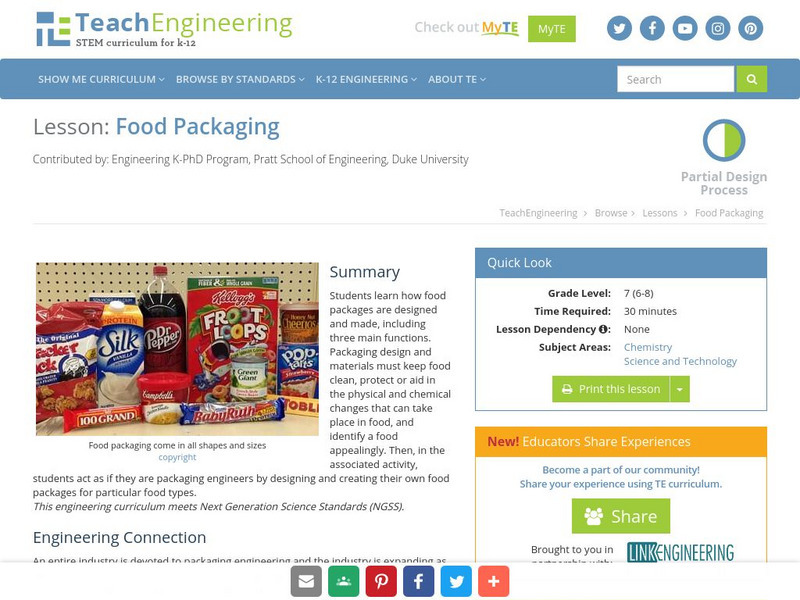
TeachEngineering
Teach Engineering: Food Packaging
This lesson focuses on how food packages are designed and made. Students will learn three of the main functions of a food package. They will learn what is necessary of the design and materials of a package to keep food clean, protect or...
American Chemical Society
Inquiry in Action: Change in Temperature: Endothermic Reaction
In this activity, students will observe another aspect of a chemical change which is a change in temperature. In this reaction, students will experiment with an endothermic reaction.

American Chemical Society
Inquiry in Action: Using Chemical Change to Identify an Unknown
This activity explores how students could use chemical changes to identify unknown substances. Lab activity includes student and teacher worksheets.