Hi, what do you want to do?






Curated OER
You say Avocado, I say Avogadro
Students convert mole to mass to particles and vice versa. In this chemistry instructional activity, students discuss the importance of Avogadro's number. They apply what they have learned in a team competition.

Curated OER
Teaching about the Chemistry of Oxygen Solubility
Young scholars explore solubility of gases in water, Henry's Law, LeChatelier's Principal, and supersaturation of gases in water.

Curated OER
Do It Yourself: Energy Transfer Lesson Plan
Fifth graders discuss the different types of energy and experiment with tesla coil to show the three types of energy transfer. They write conclusions in their science journal.

Curated OER
Transmission of Disease
Students provide names of viral diseases that they would possibly like to be infected with today; listing them on the Smart Board. They then come to an agreement about what virus to use and use beakers of fluids to simulate how viruses...

Curated OER
How Do I Get a Pure Sample of the Molecules I Make?
Students initially engage in online research and consult print materials to identify a compound to produce. Once a selection has been made, individually, students conduct lab experiments to isolate substances. The end product is a...

Curated OER
Effects of pH on Organic Molecules
Students investigate the effects of an acid and a base on the structure of milk protein. They observe the changes to droplets of milk when adding ammonia and lemon juice and relate the changes to old, curdled milk. An extension using...

Curated OER
The Reality of War
Students use research materials developed earlier. They synthesize data to formulate an argument for or against war. Students use their notes to address what the possible answers could be.

Curated OER
Carbon Dioxide: The Heat is On
Students examine the greenhouse gases affecting the atmosphere. In groups, they participate in activities in which they examine the effects of heat on the atmosphere and phytoplankton. They research how the phytoplankton differ in warm...

Curated OER
Salt & Sand
In this science worksheet, students find the terms that are related to the concept of the ocean salt and sand. The answers are found by clicking the link at the bottom of the page.

Curated OER
Ions in the Environment
Learners explain the importance of the five main biogeochemical cycles. In this chemistry lesson, students discuss how ions are transported in the environment. They design an experiment to collect data on eutrophication.

Curated OER
Flower Pigments
Young scholars experiment with Thin Layer Chromatography to separate pigments found in flower petals.

Curated OER
Separation Before Plastic Recycling
Students participate in a demonstration to test the different densities of plastics, and suggest a method that plastic waste can be separated and collected.

Curated OER
Carbon Adventures Game
Sixth graders examine the processes and transformations that occur in carbon pools. They play a game to identify paths taken by carbon through the environment.

Curated OER
Electrical Circuits And Switches
Students design and draw circuits with batteries, small light bulbs and common household conductors. They build and test the circuit then modify it so someone who couldn't use their hands could turn the circuit on and off.

Curated OER
Maintain Air Quality
Young scholars are engaged in discussing air quality through hands-on demonstrations using balloons, sealed jars, and toy cars. Students conduct a home radon test to measure their air quality.

Curated OER
Extraction of DNA from Onion
Students study DNA by isolating it from plant tissue. They determine the purpose of each step in the isolation procedure as it relates to the physical and biochemical characteristics of the genetic material

Curated OER
Determining Liquid Densities
Pupils practice determining liquid densities in a short, hands-on lab activity. Students use a graduated cylinder to measure out 100 milliliters of a liquid, find its mass using a balance, and record measurements in a data table. Pupils...

Curated OER
Activity #5 Soils-Permeability and Impurity Removal
Students predict which types of soils would work best for keeping contaminants contained. They comprehend that in the past, landfills have been one major source of groundwater contamination. Pupils comprehend that placing and building...

Curated OER
Getting the Minerals Out
Students explore the tissues of the bone. They discuss bone composition and physiology. Students perform experiments to compare and contrast the decalcifying properties of several liquids.

Curated OER
Smog Be Gone
Students begin the lesson by identifying greenhouse gases. In groups, they observe and record the effect of the gases on the atmosphere and the temperature of the Earth. They participate in activities that describe the role of...

Curated OER
Small Intestine, Pancreas, Liver, and Gall Bladder
In this small intestine, pancreas, liver, and gall bladder worksheet, students fill in the blanks with information about these structures of digestion. Students research information about organ of the digestive system given.

Curated OER
Blood, I Presume?
Students explain the value of blood in trials. In this DNA lesson students work together to collect and share information and ideas that they come up with after learning how to distinguish blood from other stains.

Open Ed
Open Ed Sci: 7.2 Chemical Reactions & Energy
In this 21-day unit, students are introduced to the anchoring phenomenon-a flameless heater in a Meal, Ready-to-Eat (MRE) that provides hot food to people by just adding water. They complete investigations to collect evidence to support...
BioEd Online
Bio Ed Online: What Is One Part Per Million Solution?
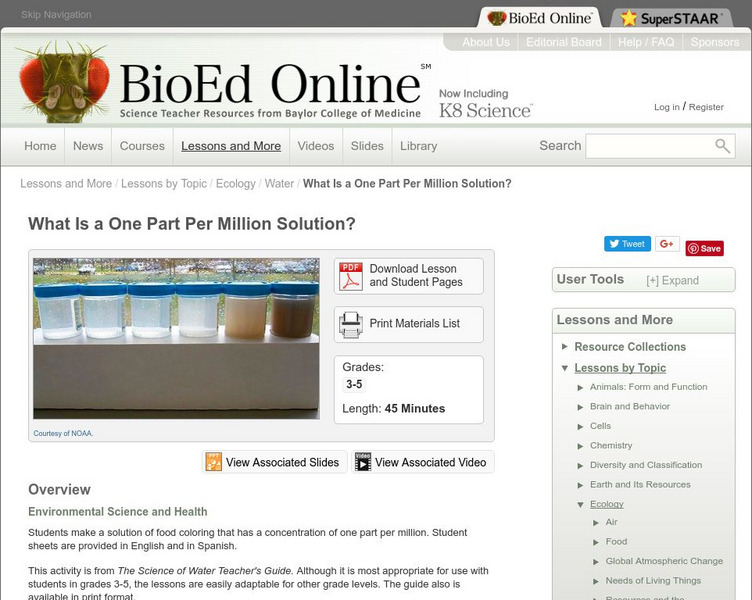
Substances dissolved in water can be present in very tiny amounts that are not visible to the eye. in this lesson students make a solution of food coloring with a concentration of one part per million.