Hi, what do you want to do?





University of North Carolina
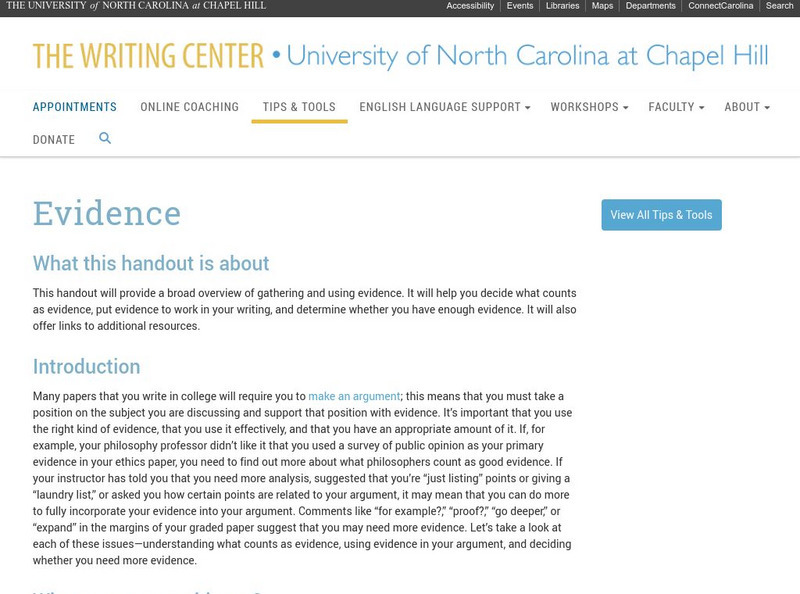
University of North Carolina: Writing Center: Handouts: Evidence
What kinds of evidence best support the points you make in a paper? Where can you find the evidence you need? This handout answers all these questions and more, including the difference between primary and secondary sources. You'll also...

Better Lesson
Better Lesson: Writing an Opinion Based on Facts From a Text
Young scholars will plan a paragraph that states their opinion and cites evidence to justify their opinion about an informational text. This lesson uses biographies since students can easily be able to write down factual information from...

CommonLit
Common Lit: Women in Ancient Rome
CommonLit.org is a wonderful resource to use in a Language Arts classroom. Each story or article is accompanied by guided reading questions, assessment questions, and discussion questions. In addition, students can click on words to see...
ReadWriteThink
Read Write Think: Text Features: Non Fiction [Pdf]
Compare the printed page to an electronic web page and use this activity to discuss the similarities and differences. A cross-curricular tie-in with ecosystems. Could easily be adapted to another subject area.

Online Writing Lab at Purdue University
Purdue University Owl: Using American Psychological Association (Apa) Format
Extensive information on how to use the American Psychological Association (APA) format for citations. Information is provided on general format, referring to other works, reference list, notes, and examples in the APA format. W.9-10.8...
Other
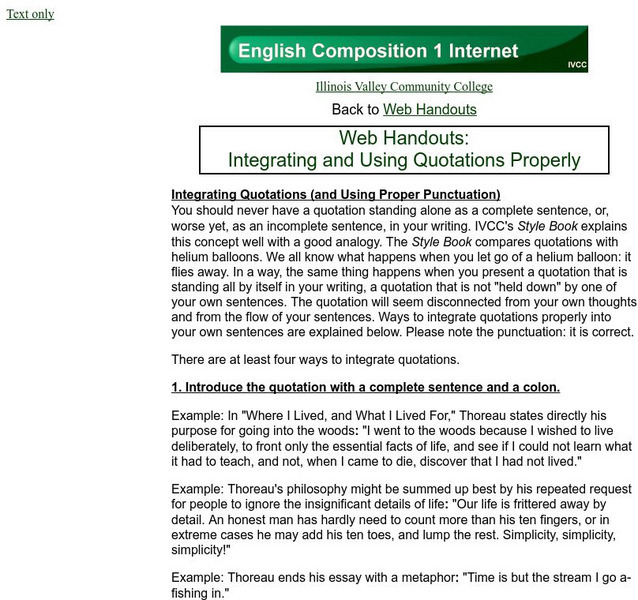
Ivcc: Integrating and Using Quotations Properly
Written for a college composition course, the ideas in this article are valid for journalists as well. The article gives examples of each of the 4 ways to use quotations in writing. W.9-10.2b Strong Support, L.9-10.2b Colons
E Reading Worksheets
E Reading Worksheets: Inferences Worksheets
In this learning module, students will learn more about making inferences. Worksheets are provided to reinforce the skill of making inferences. This module is designed to support Tier I, Tier II, and Tier III students.