Hi, what do you want to do?






Curated OER
Fish Eyes Sort
Students sort, classify and write about what characteristics they used to sort fish counters.

Curated OER
Let's Play Again
First graders use rhythm instruments to explore dynamic fluctuations in music. They experiment with clapping, body movement, recorded music and pitch instruments to explore the concept of tempo.

Curated OER
Classifying Living and Non-Living Objects
Students investigate living organisms and define the properties of a living species. In this life characteristic lesson, students examine plants in their class and discuss whether or not they are alive. Students create a...

Curated OER
Arsenic and Human Health
Ninth graders concentrate on arsenic poisoning as an example of the connections among health, geography, and geology as they develop a persuasive presentation about the dangers of arsenic in the drinking water, targeting a specific...

Curated OER
Making a Taxonomic Key
Students work as a team of abalone taxonomists who examine and classify abalones based on their shell characteristics of the four most common species. They also study the visible details of each species shell, make notes and eventually...

Curated OER
Earth Surface Socratic Questions
High schoolers explore the ways Earth's surface is shaped by hydrologic, climate and tectonic forces by participating in a whole class discussion. They respond to prompts that lead them to conclusions about the relationships between...


Curated OER
Classifying Galaxies
Students classify galaxies by their shape using the Hubble Tuning Fork Diagram.

Curated OER
Ecology and the St. Lawrence River
Ninth graders complete a unit of lessons on ecosystems, organism interactions, and energy flow. They create a key for known species of fish, diagram the movement of energy through an ecosystem, and create and present food chains and food...

Curated OER
Plate Tectonic - Volcanoes Pre Lab
Second graders draw and compare parts of volcano. They investigate parts of a volcano and distinguish between magma and lava.

Utah Education Network
Uen: Trb 4:5 Investigation 7 Classification Schemes
Activity involves placing organisms into the correct classification.

Miami University
Miami University: Nuts and Bolts of Classification
Discusses many aspects of taxonomy. Provides a lab activity where students are required to devise a classification scheme for nuts, bolts, and other hardware items.
Other
It's All About What's Inside. Classification and the Tree of Life [Pdf]
In this science lesson, young scholars look at how animals have traditionally been classified in a tree of life diagram by examining the characteristics of plastic eggs. They then analyze the genetic code assigned for each egg and look...
CPALMS
Florida State University Cpalms: Florida Students: Diagramming Diversity I
Identify how living organisms are classified according to their evolutionary history. Recognize how a hierarchical classification scheme can be used to classify living organisms based on physical characteristics.
SRI International
Performance Assessment Links in Science: Classification
This activity directs students to set up a two step classification scheme based on the physical traits of color and shape.
Utah Education Network
Uen: Wonderful World of Insects
In this lesson, students will use simple classification schemes to sort Utah's common insects.
Other
Jean Piaget Society
Learn more about Jean Piaget from this website. The site is dedicated to the study of human knowledge and development.
Shippensburg University
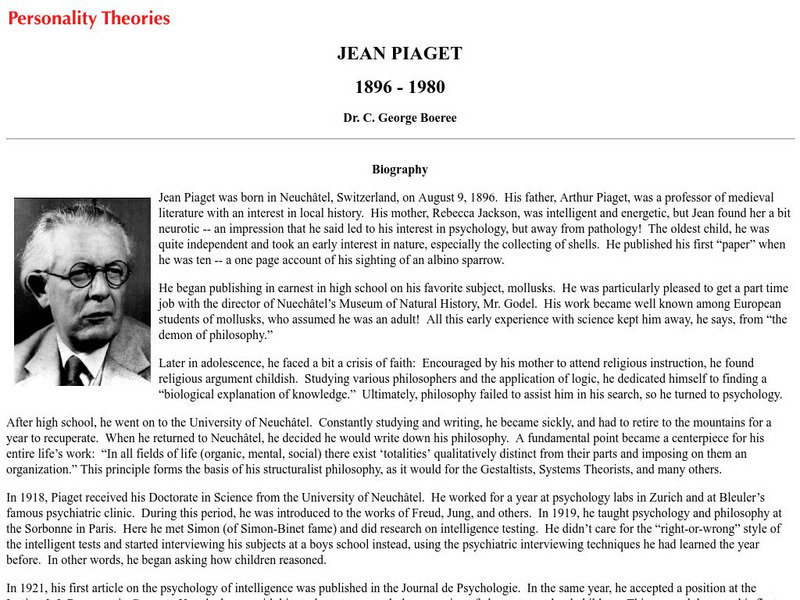
Shippensburg University: Personality Theories: Jean Piaget
This is an excellent resource on the life and work of the Swiss educational psychologist Jean Piaget (1896-1980).
Other
Oikos.org: Jean Piaget
"The basic reason for this international attention was the unquestionable fact that Piaget was the founding father of a branch of psychology that tries to unravel the mysteries of the human mind, how it grows and how it comes to know."...