Hi, what do you want to do?






Illustrative Mathematics
The Geometry of Letters
Use the alphabet as a tool for teaching your class about geometric figures. Break apart capital letters into line segments and arcs. Classify angles as right, acute, or obtuse. Identify parallel and perpendicular lines. An excellent...

Education Development Center
Finding Parallelogram Vertices
Four is the perfect number—if you're talking about parallelograms. Scholars determine a possible fourth vertex of a parallelogram in the coordinate plane given the coordinates of three vertices. They read a conversation...

Illustrative Mathematics
Lines of Symmetry for Quadrilaterals
Explore how lines of symmetry help define different categories of quadrilaterals. Looking at a square, rectangle, trapezoid, and parallelogram, young mathematicians discover that each shape has its own, unique symmetry. Encourage your...
National Council of Teachers of Mathematics
Nctm: Illuminations: Cutting Corners
Students will use their knowledge of plane figure attributes to create and view shapes by cutting and rotating shapes to stimulate discussions on names and attributes of various shapes they do not regularly encounter.
NumberNut
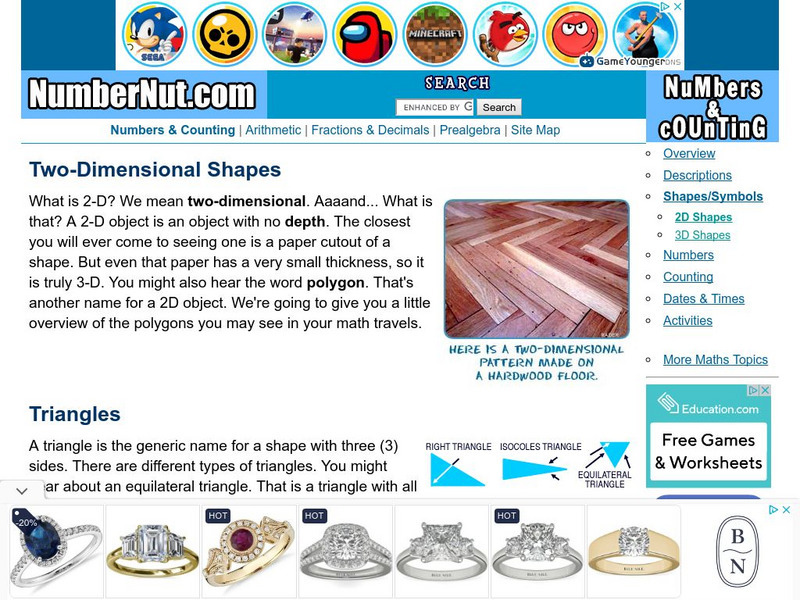
Number Nut: Shapes, Symbols and Colors: Two Dimensional Shapes
Describes, with illustrations, the basic two-dimensional shapes students will encounter in elementary Math.

NumberNut
Number Nut: Shapes, Symbols, and Colors: 2 D Shapes
Did you know that two-dimensional shapes are also called polygons? This lesson describes the various 2-D shapes and includes two interactive games to reinforce skills.