Hi, what do you want to do?






Curated OER
The Bush Doctrine
Students analyze the Bush Doctrine and its effects on foreign policy. In this foreign policy lesson, students read and discuss the Bush Doctrine. Students research and debate on whether or not the Bush Doctrine should be part of U.S....

Curated OER
Missing in MiG Alley
Students consider how technology impacted American conflicts. For this technological advances lesson, students read, "The Changing Face of War," and then describe how technology made differences in World War I, World War II, the Korean...

Curated OER
Democracy in the Middle East
Students explain that President Bush's foreign policy to promote democracy is a departure from the Cold War policy of containment, and examine the reasons this policy has been proposed at this time.

Curated OER
refugees From Vietnam and Cambodia
Tenth graders explore the massive immigration from Vietnam and Cambodia. In this World History lesson plan, 10th graders examine the crisis that led to this immigration. Students participate in a debate on whether the United...

Curated OER
Vietnam: A Divided Nation
Eleventh graders examine events leading up to and during the Vietnam War. They research assigned topics utilizing interviews, Powerpoint presentations, timelines, and collages in their presentations.

Curated OER
The Berlin Wall
Middle schoolers enter the classroom and observe a wall that is set up with desks, bookshelves, or anything else available. to create a barrier that they cannot cross during the class. The class then is divided into East and West Berlin...

North Carolina School of Science and Mathematics
Henry Kissinger and Detente
How did relations between the United States and the People's Republic of China evolve between 1950 and 1970? Your young historians will complete a timeline of events with evidence that the relationship between these two great...

Curated OER
Debating Iraq
Students analyze the main themes of President Bush's UN Speech and discussion of the NewsHour report on the Iraq Debate. In this debate activity, students answer pre-listening questions and view a transcript of the speech. In groups of...

Foreign Policy Research Institute
Understanding the Koreas
Though this resource was designed in 2005, US tension with North Korea remains a relevant topic for exploration and understanding. Unfortunately, this lecture and reading-based lesson is unlikely to engage the class. The end product is a...
OpenStax
Open Stax: Post War Prosperity and Cold War Fears 1945 1960: The Cold War
Examines the causes of the Cold War, America's efforts to oppose the spread of Communism, and the hunt for Communist sympathizers within the United States.
Digital History
Digital History: Origins of the Cold War
A look at the origins of the Cold War by examining primary sources. Questions to think about are included to check understanding.

Mount Holyoke College
David T. Fautua: The "Long Pull" Army of Korean War
Provides a lengthy account of United States Cold War policy, NSC-68, and the United States policy towards the Korean War.
Independence Hall Association
U.s. History:the Cold War Continues
A comprehensive look at U.S. foreign policy during the Eisenhower administration. The Cold War was at its height, and the United States used many tactics to fight and contain the spread of Communism. Be sure to watch the cartoon of Bert...

Khan Academy
Khan Academy: Start of Cold War, Part 1: Yalta Conference and Containment
At the end of World War II, the Yalta Conference saw the splitting of Germany into four zones and the United States began a policy of containment of communism.
University of Groningen
American History: Outlines: Containment
Article outlines the U.S. policy to keep the spread of communism at bay and the Soviets in check.
Digital History
Digital History: Postwar America: 1945 1960
Chapter focus on the political, social, and economic events following World War II. Examines both foreign and domestic issues, including the origins of the Cold War and Civil Rights movements.
Siteseen
Siteseen: American Historama: Domino Theory
Many of the Cold War presidents used the Domino Theory as the main justification for their involvement and intervention in the affairs of Eastern Europe, the Middle East, China, Korea, Cuba, and Vietnam as it related to the spread of...
George Washington University
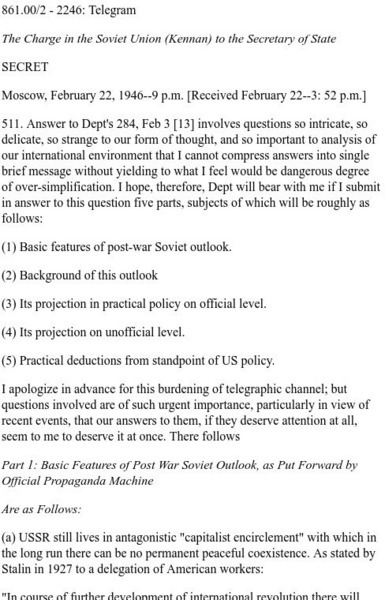
National Security Archive: George Kennan's "Long Telegram"
Find the entire contents of George Kennan's "Long Telegram" in which he expressed outlook on post-war Soviet Union. It was not flattering.
Independence Hall Association
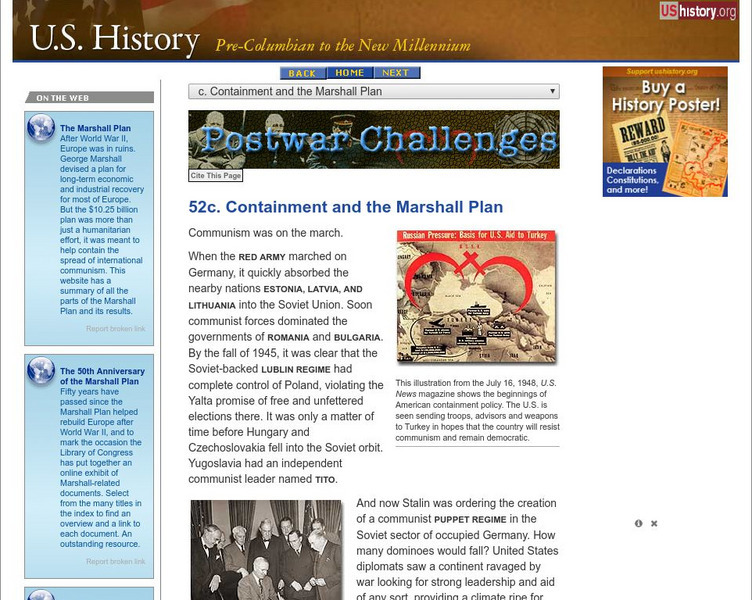
U.s. History: Containment and the Marshall Plan
Read about President Truman's two-pronged foreign policy for Europe. Find out about his containment policy and the Truman Doctrine, which was manifested in the Marshall Plan.

Siteseen
Siteseen: American Historama: Containment
The purpose of the United States policy of Containment was to restrict the spread of communism abroad and was strongly associated with the Domino Theory.
Center for Educational Technologies
Nasa Classroom of the Future: Korean Enigma: The Korean War
The key events of the Korean War are briefly described here, including the role of UN troops and China's participation. Featured information includes casualty statistics and photos of military actions. There is also a QuickTime video...
PBS
Pbs News Hour: Essays and Dialogues: George Kennan
Transcript of a NewsHour interview with George F. Kennan (1904-2005), the man credited with articulating the policy of containment that shaped U.S. foreign policy toward communism at the start of the cold war.
Digital History
Digital History: Years of Decision [Pdf]
This site is from a unit that covers the period from the Second World War up to the Cold War. It looks at relations between the United States and the Soviet Union and the thinking of their leaders. Students are asked to consider five...
Harry S. Truman Library and Museum
Truman Library: Telegram, George Kennan to George Marshall [Pdf]
See the "long telegram" sent by George Kennan to Secretary of State George Marshall in which he expressed his unflattering view of the USSR.