Hi, what do you want to do?






Anglophone School District
Fluids: Force in Fluids
Discuss Archimedes' Principle and fluid forces with your young scientists as they describe the relationship between mass, volume, and density during a series of engaging activities. They use the Participle Theory of Matter to explore the...

Smithsonian Institution
Water/Ways: The Poetry of Science
Water is the source of life. It appears in poetry in both peaceful and torrential descriptions; it appears in earth science in its liquid, gaseous, and solid states. Combine these interpretations of our planet's most precious and...

Curated OER
Density - To Float or Not to Float? That is the Question!
Students investigate how to find the density of fluids and solids using math. Students also learn how to find the density of regular and irregular shaped objects.

Columbus City Schools
Planet X
How did the earth become the mass that it is now? Your young scientists explore this question through the concept of density. Their inquiries consider the impact of gravity on the formation of planets. The culminating activity of the...
TeachEngineering
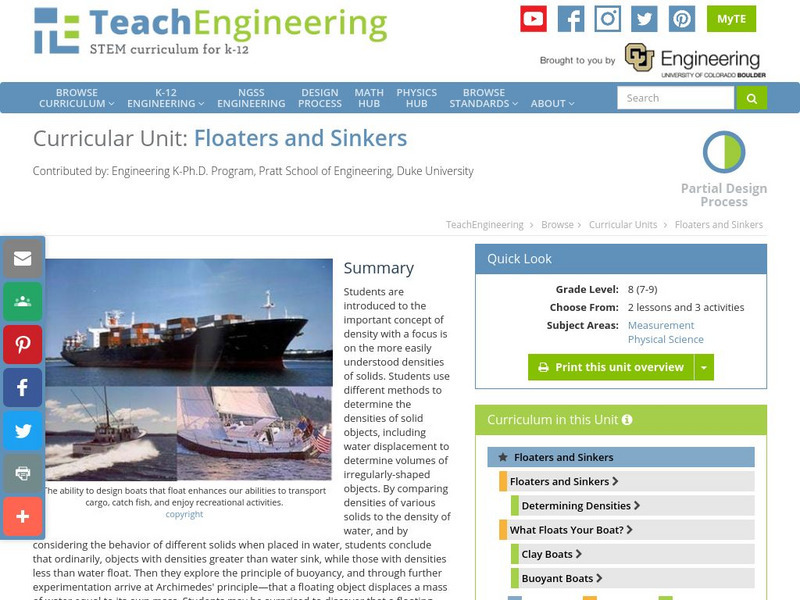
Teach Engineering: Floaters and Sinkers
Through this curricular unit, students are introduced to the important concept of density. The focus is on the more easily understood densities of solids, but students may also explore the densities of liquids and gases. Students devise...
Sophia Learning
Sophia: Kinetic Energy and States of Matter: Lesson 1
This lesson will compare the relative kinetic energy possessed by molecules in different states. It is 1 of 2 in the series titled "Kinetic Energy and States of Matter."

BBC
Bbc: Gcse Bitesize: Why Do Scientists Think That Light and Sound Are Waves?
Light travels as transverse waves and can travel through a vacuum. Sound travels as longitudinal waves and needs to travel through a solid, liquid or gas. Read about the properties of light and of sound, and learn the differences between...