Hi, what do you want to do?






Illustrative Mathematics
What’s Missing?
Now you see them, now you don't! This fun peek-a-boo activity engages young mathematicians in developing their ability to compose and decompose numbers. After being presented with a series of counters, children close their eyes while the...

Illustrative Mathematics
Overlapping Rectangle
Challenge young mathematicians' ability to compose and decompose shapes with this fun geometry puzzle. The goal is simple, locate all of the rectangles shown in a picture of three overlapping rectangles. Perform this activity as a whole...

Illustrative Mathematics
Shake and Spill
Entertaining as well as educational, this math activity about decomposing numbers is bound to capture the engagement of young learners. Given a cup and five two-color counters, young mathematicians simply shake and spill the cup,...

Illustrative Mathematics
Pick Two
Learning to break apart numbers into smaller pairs is a critical step young mathematicians take as they develop their number sense. To practice this skill, children are provided with sets of three numbers and are asked to pick the two...

Illustrative Mathematics
Make Your Own Puzzle
Puzzling over what geometry instructional activity to teach next? Look no further. This simple activity teaches young mathematicians how shapes can be decomposed into smaller figures, and how smaller figures can be assembled into larger...

Illustrative Mathematics
Counting Squares
Challenge young mathematicians' understanding of squares with this geometry puzzle. The task is simple, identify as many squares as possible in a 3x3 array. Allow learners to work independently or in pairs as they search for squares,...

Teach Engineering
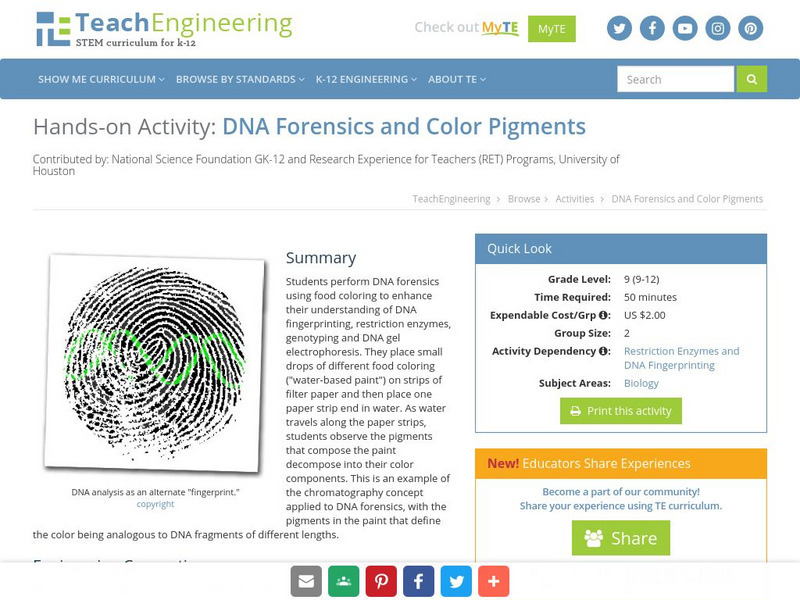
DNA Forensics and Color Pigments
Use food coloring in electrophoresis. The last segment in a four-part series mimics DNA fingerprinting by using chromatography. Teams conduct chromatography on food coloring to find colors that use similar pigmentation in their makeup.

It's About Time
Elements and Compounds
Young scientists use electrolysis to separate water into its elements before experimenting with fire to learn about their properties. A helpful resource provides a reading passage and analysis questions.

Curated OER
Finding the Area of Polygons
Third graders are exposed to finding the area of polygons by decomposing figures and recomposing them into rectangles. This strategy allows children to expand on their prior knowledge of constructing shapes by rearranging parts into...

Illustrative Mathematics
Finding Areas of Polygons, Variation 1
An exercise in finding the area of polygons by decomposing into triangles and composing into rectangles is the focus of this resource. Make several copies of the worksheet for each participant. Ask learners to use colored pencils to...
![K 5 Math Teaching Resources: Decompose a Factor [Pdf] Activity](https://statictemp.lp.lexp.cloud/images/attachment_defaults/resource/large/FPO-knovation.png "K 5 Math Teaching Resources: Decompose a Factor [Pdf] Activity")
K-5 Math Teaching Resources
K 5 Math Teaching Resources: Decompose a Factor [Pdf]
Students will learn how to determine the product by decomposing the factors.
TeachEngineering
Teach Engineering: Dna Forensics and Color Pigments
Students perform DNA forensics using food coloring to enhance their understanding of DNA fingerprinting, restriction enzymes, genotyping and DNA gel electrophoresis. They place small drops of different food coloring ("water-based paint")...
NumberNut
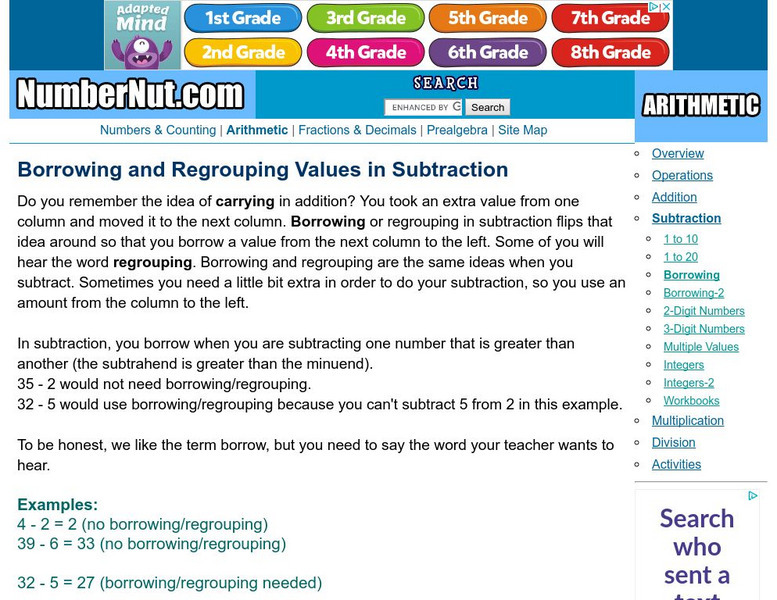
Number Nut: Subtraction: Borrowing
Explains the concept of 'borrowing' in subtraction, also known as regrouping or decomposing numbers.

NumberNut
Number Nut: Addition: Carrying
Explains how to carry when regrouping in addition, with related activities for skill practice.