Hi, what do you want to do?






Common Sense Media
Common Sense Media: Education: Lesson: Device Free Moments
[Free Registration/Login Required] In this lesson, 2nd graders learn when it's appropriate to use technology and when it's not, and practice making family rules for device-free time at home. Includes lesson plan, slideshow, student...
Other
The Canadian Science and Engineering Hall of Fame Resource for Teachers
An interesting collection of science and engineering lesson plans and activities for students. Covers a wide range of grades.
ReadWriteThink
Read Write Think: Paying Attention to Technology Reviewing a Technology
Contains plans for five lessons that ask young scholars to write reviews of pieces of technology (cell phones, webcams, ink pens, satellite dishes, etc.) like they would write reviews of books. In addition to objectives and standards,...
ReadWriteThink
Read Write Think: Corduroy Lesson Plan
This ReadWriteThink instructional activity features an opportunity for students to respond to literature through writing journals about "Corduroy," by Don Freeman. This idea could be used with other books as well.
TES Global
Blendspace: At Resources
This eleven-part learning module provides assorted assistive technology references. This blendspace provides reading and writing video, print, and audio resources that will help special needs students with their reading and writing.
Common Sense Media
Common Sense Media: Education: Lesson: Putting a Stop to Online Meanness
[Free Registration/Login Required] The internet is filled with all kinds of interesting people, but sometimes, some of them can be mean to each other. With this role play, help your students understand why it's often easier to be mean...
Canada Science and Technology Museum
Canada Science and Technology Museum: Background Information for Magnets
What makes a magnet? Learn all about magnets in this Q&A section. Educator resource materials are linked to this site.
Canada Science and Technology Museum
Canada Science and Technology Museum: Background Information for Light
Light! How do we see? What makes light? Find out everything you need to know through the Q&As on this site.
PBS
Pbs News Hour Extra: Romare Bearden (Lesson Plan)
This 4-day lesson plan asks students to explore artistic points of view, explore the elements and principals that contribute to mood, and discuss social themes that were prevalent during the Harlem Renaissance. The 4-day process involves...
Other
Learning for Justice: Part of a Community Online
This lesson focuses on helping young children learn to participate in different kinds of digital communities. Students will solidify and work on what they know about being part of any community.
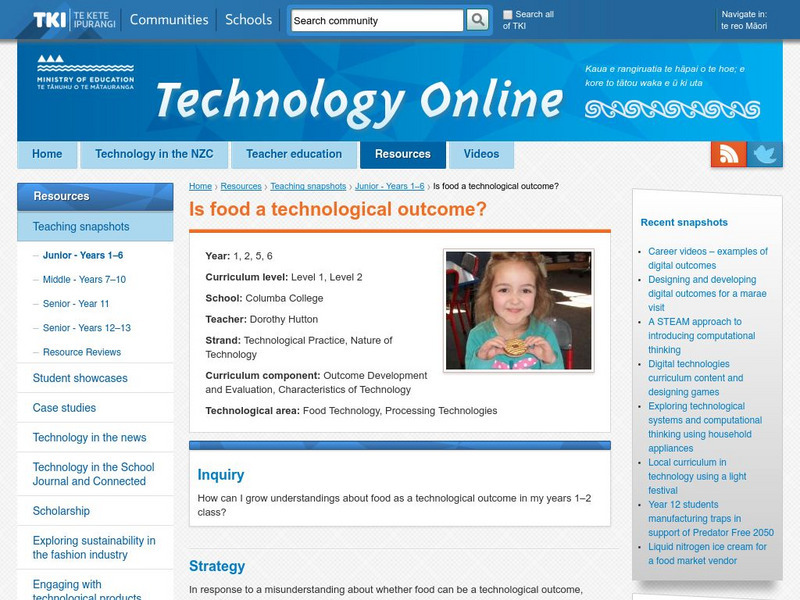
New Zealand Ministry of Education
New Zealand Government: Te Kete Ipurangi: Is Food a Technological Outcome?
In response to a misunderstanding about whether food can be a technological outcome, students were given an exploratory lesson in food technology. They discussed biscuits as technological products and the testing and trialing involved in...

Alabama Learning Exchange
Alex: The Early Americas Civilizations Power Point
This lesson plan is for cooperative learning groups. This lesson plan will take place in the classroom and the computer lab. Students will create PowerPoints on the early Americas civilizations of the Hohokam, Anasazi, Mississippians,...
ReadWriteThink
Read Write Think: Background for the Graphic Novel Persepolis: A Web Quest on Iran
This lesson focuses on students researching and learning about Iran's culture, society, and leadership before and after the 1979 Revolution in preparation for reading the graphic novel Persepolis. Students work in small groups to...
ReadWriteThink
Read Write Think: Choose Your Own Adventure: A Hypertext Writing Experience
This series of lessons involves student collaboration, writing and analytical skills, technology and imagination. While the lesson suggests use of FrontPage, it would also be possible to use a number of other authoring tools.
CK-12 Foundation
Ck 12: Algebra: Graphs of Exponential Functions
[Free Registration/Login may be required to access all resource tools.] Graphing functions with the input variable in the exponent (exponential functions) using transformations and technology. Students examine guided notes, review guided...
Cengage Learning
Mission to Mars: Project Based Learning
Students will plan a human expedition to the planet Mars. Through this project-based activity, they can choose to learn about the surface of Mars, the trip route, the analogical features between Mars and Earth, nutrition and exercise, or...