Hi, what do you want to do?






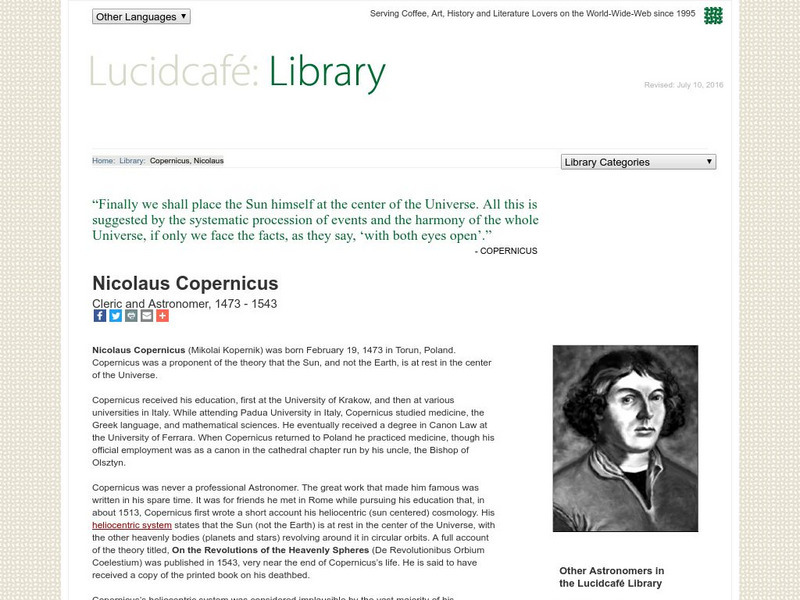
Robin Chew
Lucid Cafe: Polish Cleric and Astronomer
This site from the Lucid Cafe contains a short bibliography of Nicholas Copernicus. The information, though it is brief, is very factual and worth checking out with great links throughout for additional information on related subjects.
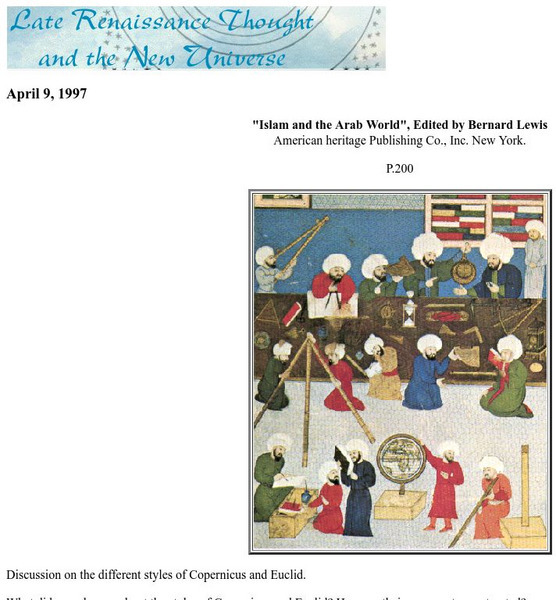
Dartmouth College
Dartmouth College: The Different Styles of Euclid and Copernicus
A history of the differences between Euclid's and Copernicus's methods of proving geometric ideas.
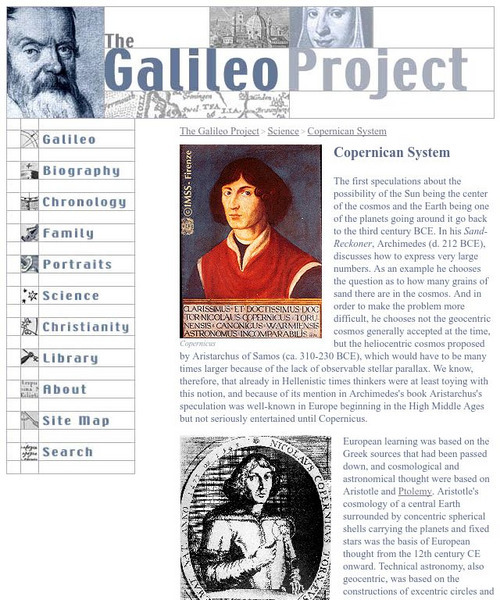
Rice University
Galileo Project: The Copernican System
This site from The Galileo Project of Rice University contains information relating to Copernicus's sun-centered solar system theory. Pictures are provided throughout this article along with links to additional information.
Curated OER
The Different Styles of Euclid and Copernicus
A history of the differences in Euclid and Copernicus--their methods of proving geometric ideas.
Curated OER
Educational Technology Clearinghouse: Clip Art Etc: Nicolaus Copernicus
(1473-1543) First astronomer of the Renaissance.

American Association of Physics Teachers
Com Padre Digital Library: Open Source Physics: Earth Orbit Model
Nicolaus Copernicus developed the theory of Earth's orbit around the sun demonstrated in this science simulation.
Georgia Department of Education
Ga Virtual Learning: A Brief History of Astronomy
In this interactive module students will explore what different ancient cultures believe was an explanation of the stars and planets. They will look at how the work of Nicolas Copernicus revolutionize the world of astronomy and learn how...
Steven Kreis, PhD
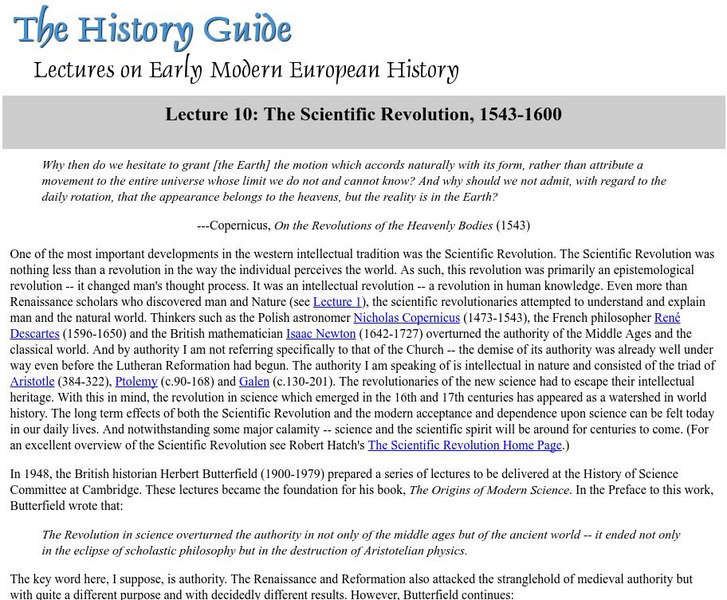
The History Guide: The Scientific Revolution, 1543 1600
A look at how Copernicus, Descartes, and Newton change the thought process of man! Explore how these men contributed to the scientific revolution and how the revolution changed human knowledge. A biography of these scientists is linked...
Society for Science and the Public
Science News for Students: Heaviest Named Element Is Official
Describes the discovery and naming of copernicum, the heaviest element on the Periodic Table, named after the 16th century scientist Nicolaus Copernicus.
PBS
Pbs Learning Media: Galileo: Sun Centered System
In the early 1600s, most people believed that the Sun revolved around a stationary Earth. This video segment adapted from NOVA tells how Galileo proved that the Sun, not Earth, is at the center of our universe.

University of St. Andrews (UK)
University of St. Andrews: Francois Viete
The University of St. Andrews offers this iography of Francois Viete. Many links are provided for more information.

NASA
Nasa Star Child: Star Child
StarChild from NASA defines and describes the Solar System in a simple and easy-to-understand manner. The website is broken down into two versions for the student, grade school and junior high.
Science Struck
Science Struck: Famous Scientists Who Believed in God
It is sometimes assumed that scientists do not believe in God but these famous scientists actually did. Read details about their lives and beliefs, and some quotes attributed to them.
Other
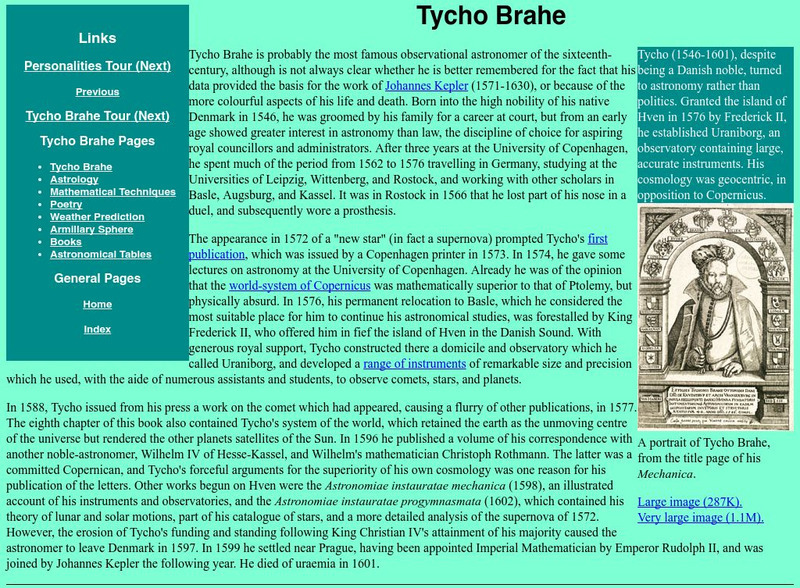
University of Cambridge: Tycho Brahe
The Department of History and Philosophy of Science at Cambridge University provides biographical information on Tycho Brahe, the most famous obervational astronomer of the sixteenth century.

Ducksters
Ducksters: History: Renaissance Astronomy for Kids
Kids learn about the science of astronomy during the Renaissance. Discoveries by Copernicus, Galileo, and Kepler.
Ministerio de Educación (Spain)
Ministerio De Educacion: Astronomia Visible
This site has maps of the nearest stars and constellations. Earth and star daily rotation, proper motion of the stars and many other topics about the solar system are also shown.Read phonetically
Nine Planets
The Nine Planets: Venus
In-depth information site on Venus, complete with a thorough glossary, links to a wide array of related sites, thumbnail picture files linked to larger images, and even a short audio file from a classic symphony.
Children's Museum
Children's Museum: Field Guide to the Universe: Astronomers
Read brief biographies of astronomers who are grouped by time period.
My Hero Project
My Hero: Galileo
"First to use a telescope to overserve the starts and planets," Galileo Galilei secretly published his work, which contradicted the Catholic Church's teachings. Use this site to learn about how Galileo's independence and courage made him...

Wikimedia
Wikipedia: Timeline of Solar System Astronomy
This site from the encyclopedia Wikipedia provides an in-depth timeline of important events in astronomy relating to the solar system are presented here. Links are also provided for additional information on related subjects.
Sonoma State University
Sonoma State University: The Copernican Revolution
This site has a time line featuring discoveries, and publications which sprang from Copernicus's publication of De Revolutionibus in 1543, and the people active in the field of physics between 1543 and Newton's death in 1727.
Curated OER
Rice University: The Copernican System
This site from The Galileo Project of Rice University contains information relating to Copernicus's sun-centered solar system theory. Pictures are provided throughout this article along with links to additional information.
Other popular searches
- Copernicus Inventions
- Ptolemy and Copernicus
- Copernicus Nicolaus
- Nicholas Copernicus
- Copernicus and Kepler
- Copernicus Nickolaus
- Copernicus Ptolemaic
- Uss Copernicus
- Copernicus Ptolemic
- Nicolas Copernicus
- Investigating Copernicus
- Kepler Copernicus Brahe