
Curated OER
Sound Search (Elementary, Reading/Writing)
Students learn initial sound recognition by walking through the school and its grounds looking for items that begin with the same sound as their first name.

Curated OER
Shout Out Loud
Young scholars explore the /ow/ sound using the 'ou' digraph. They recite an /ow/ tongue twister and participate in a letterbox lesson to gain understanding of the ou = /ow/ concept. They read 'The Napping House' to practice reading with...

Curated OER
Don't Wake the Baby - Phonics
Students explore beginning reading through the use of phonics. They practice making the /sh/ sound and create a list of /sh/ words. Students practice saying tongue twisters containing /sh/ sounds. They model writing the s and h...

Curated OER
Initial Consonant Cluster
In this grammar worksheet, students read and identify squ- words and then, recognize that sq (and q) are always followed by u. They also read a story and highlight all the words that begin with squ. Finally, students complete a crossword...

Curated OER
Animal Habitats
Learners explore animal lifestyles by researching their characteristics. In this animal habitat lesson, students read the story Over in the Jungle and analyze the animal illustrations in the book. Learners create clay animal characters...

Curated OER
Reading in Preschool
Students read along with their parents to promote their own reading and fluency. In this reading lesson plan, students look at picture books and follow along with their finger.

Curated OER
Picture Match
Students match pictures with words that have specific phonics connotations. In this picture matching lesson plan, students have groups of words with the same phonics sayings.

Pennsylvania Department of Education
Writing With Environmental Print
Students develop literacy skills by exploring street signs, cereal boxes, and billboards. For this writing with environmental print lesson, students build word recognition in every day print. Students decode words and discover new words.

Curated OER
Letter Recognition Flash Games for Kids
Students explore the alphabet by completing an on-line letter identification activity. In this phonetics lesson, students utilize the website www.literarycenter.net and listen to word sounds as they identify the spelling of the...

Curated OER
Color Recognition Game
Students study color words. In this math lesson plan, students complete a variety of activities on the computer in which they identify colors and color words.

Curated OER
Web-Based Practice
Students explore technology by participating in a word structure activity. In this grammar lesson plan, students utilize the Writing Center computer software to practice keyboarding while identifying word formations in class. Students...

Curated OER
Using Syllables to Help With Spelling
For this spelling worksheet, 3rd graders learn how each syllable in a word has at least one vowel sound. After giving an example of each type of syllable, students write their own examples of open and closed syllables and words with...

Curated OER
Abra-kadabra-kazam /a//a//a/, POOF!
First graders discover that each letter of the alphabet has a sound then detect the /a/ sound represented by the letter a. They pretend to be magicians and say, "Abra-kadabra-kazam! POOF!" emphasizing the /a/ sound and then repeat an /a/...

Curated OER
Tim the Turtle Takes Two Turns Today
First graders examine the way their mouths move when making the /t/ sound at the beginning and middle of a word. Next, they recite a tongue twister and write the letter. They listen to "A Cat Nap," discuss the story, and write a message...

Curated OER
Spelling Challenge Sheets
In this spelling worksheet, students are challenged to spell different words that use the graphic organizer as a theme for the type of words.

Curated OER
Feeding Red
Students increase their reading fluency through the use of various strategies. After reviewing chunking, decoding, rereading and reading with expression, students complete an initial read of a novel text. Working with the instructor,...

Curated OER
A Seal Who Loves Peaches and Cream
Students decode correspondence in order to become better, fluent readers. When the letters e and a are put together they make the E sound. They become more fluent readers through listening for a correspondence in speech, in text, and...

Curated OER
"Tick, Tock," Says the Clock!
Students explore the letter 't' and the /t/ sound. Through instruction and modeling they practice writing uppercase and lowercase T's. They say 't' tongue twisters. They identify 't' words on a worksheet and as they are read aloud from a...

Curated OER
Poor Crying Baby
Students examine the letter 'a'. Through instruction and modeling and a variety of practice activities, they explore the sound the letter makes and how the letter is written. They recite tongue twisters and read stories and pick out...
Auburn University
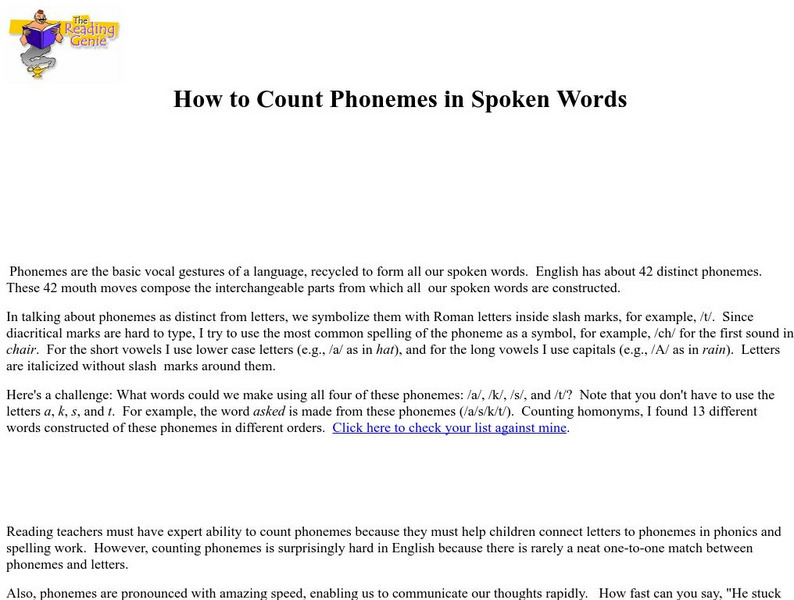
Auburn University: How to Count Phonemes in Spoken Words
How do you count phonemes in spoken words? Check out this site to discover more about how to approach dealing with question in the classroom. This site offers exercises dealing with counting phonemes.

Florida Center for Reading Research
Florida Center for Reading Research: Phoneme Segmenting: Say and Slide Phonemes
A lesson plan in which students work with a partner to count phonemes in picture cards. All materials are included.
Free Reading
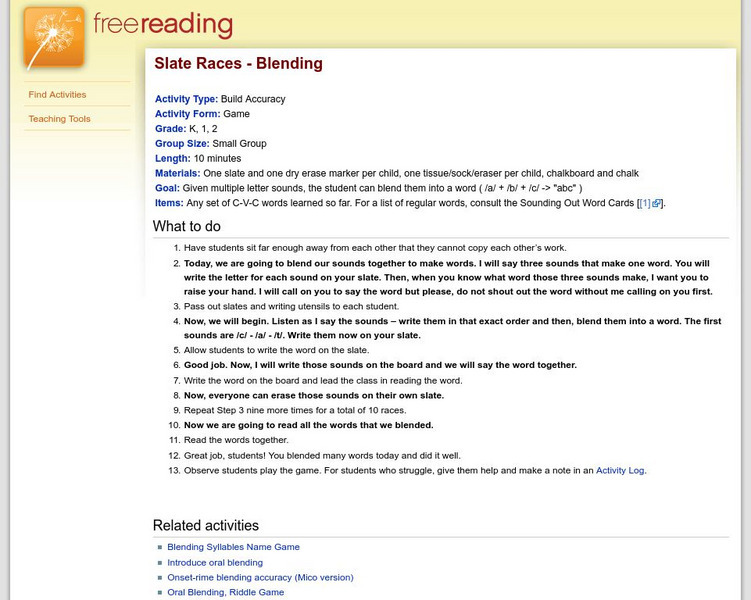
Free Reading: Slate Races: A Phoneme Blending Game
A classroom or small group game to build accuracy of students' abilities to blend phonemes. Students write the sounds that the teacher gives them on their own slate/dry erase board and then blend the sounds together to form words.
Free Reading
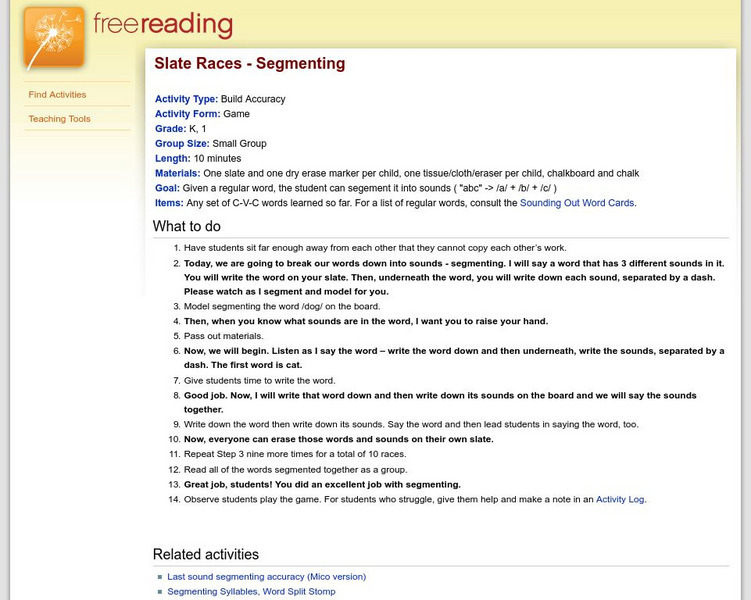
Free Reading: Slate Races: A Phoneme Segmenting Game
A classroom or small group game to build accuracy of students' abilities to blend phonemes. Students write the word that the teacher gives them on their own slate/dry erase board and then underneath the word, writes down each sound in...
Auburn University
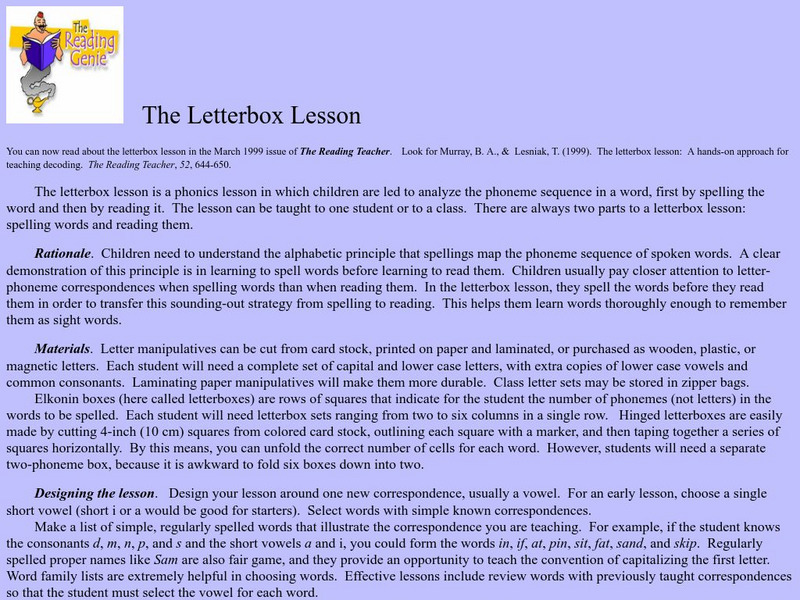
Auburn University: The Letterbox Lesson
What is the rationale behind the "Letterbox Lesson?" This site reveals how learners must understand the phoneme sequence in words in order to decode them. Come and learn more.