Hi, what do you want to do?






Alabama Learning Exchange
Alex: How Sweet It Is
As part of the study of Matter, the learners will determine the density of standard percent sugar solutions through hands on experimentation. In laboratory groups, students will graph a standardized curve of the experimental data. The...
Science Education Resource Center at Carleton College
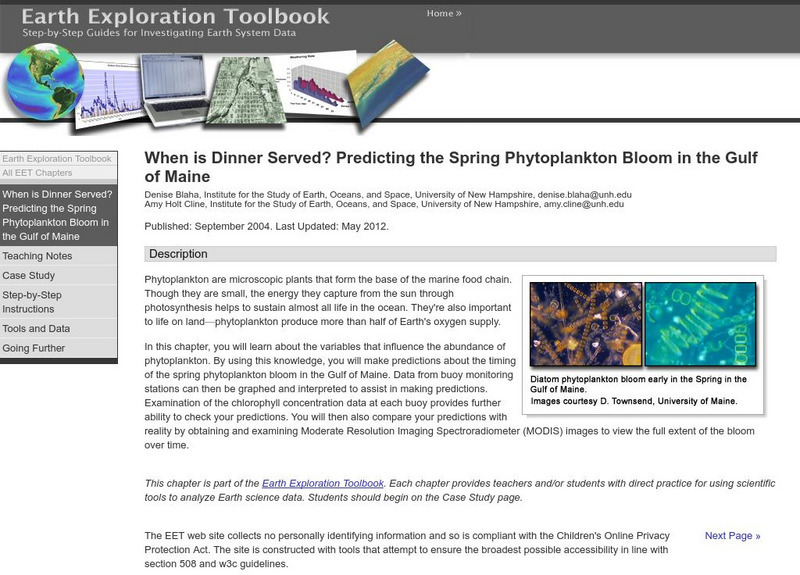
Serc: Predicting the Spring Phytoplankton Bloom in the Gulf of Maine
This lesson helps students understand the variables that influence the abundance of phytoplankton. Students will make predictions about the timing of the spring phytoplankton bloom in the Gulf of Maine. Furthermore, data from buoy...

Alabama Learning Exchange
Alex: Volume
Students will learn the concept of volume by determining the amount of sand that is needed to fill the long-jump pit at their school (or any rectangular- or square-shaped container). This lesson plan will explain the importance of...
TeachEngineering
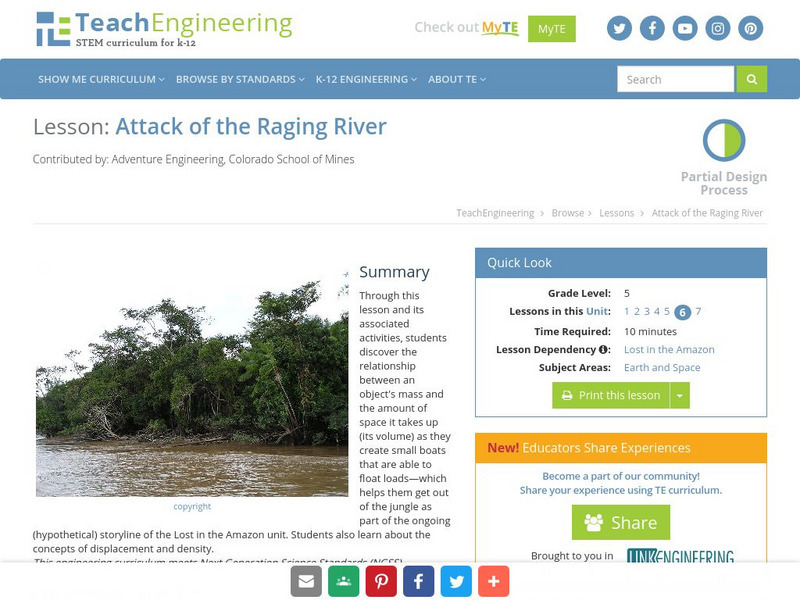
Teach Engineering: Attack of the Raging River
In this lesson, the students will discover the relationship between an object's mass and the amount of space it takes up (its volume). The students will also learn about the concepts of displacement and density.
TeachEngineering
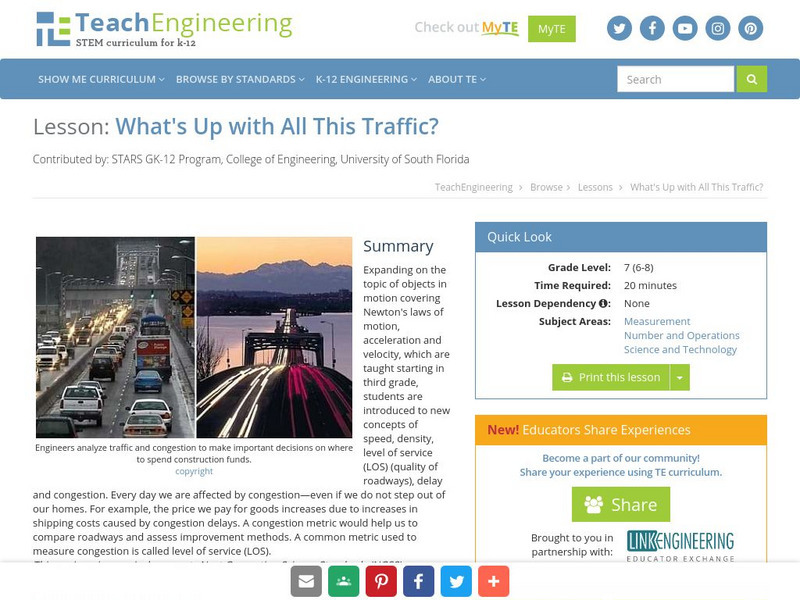
Teach Engineering: What's Up With All This Traffic?
Expanding on the topic of objects in motion covering Newton's laws of motion, acceleration and velocity, which are taught starting in third grade, middle schoolers are introduced to new concepts of speed, density, level of service (LOS)...

TeachEngineering
Teach Engineering: Latex and Hybrids: What's the Connection?
An engineering challenge where young scholars create small-scale models from which their testing results could be generalized to large-scale latex tubing for a hydraulic accumulator. They brainstorm ideas about how latex can be used in a...

McREL International
Mc Rel: Whelmer #64 Learning Activity: Liquid Rainbow
An easy to do activity that investigates density and solubility. The activity is presented in lesson plan format that meets NSES standards.

TeachEngineering
Teach Engineering: What Floats Your Boat?
Young scholars use modeling clay, a material that is denser than water and thus ordinarily sinks in water, to discover the principle of buoyancy. They begin by designing and building boats out of clay that will float in water, and then...
University Corporation for Atmospheric Research
Ucar: Cycles of the Earth System: Make Convection Currents!
In this lesson, students will understand that temperature changes can cause density changes in water and in air.
Utah STEM Foundation
Utah Stem Action Center: What's Up With Our Air?
Students will use modeling to understand inversions. Their models will evolve as they gather more information.