Hi, what do you want to do?






Curated OER
2D Shapes
This engaging presentation would be helpful for your young learners of geometry. Pupils are given clues as to what a shape may be, then they have to use those clues to guess what shape is being described. Shapes used are the circle,...

CPALMS
2D Rotations of Triangles
Where does the line of rotation need to be to get a cone? Pupils respond to three questions involving rotating a right triangle about different lines. The scholars describe the solid created along with providing details about its...

Curated OER
Third Grade Geometry
Third graders describe 2D and 3D shapes. For this geometry lesson, 3rd graders watch a PowerPoint presentation showing the terms used when analyzing shapes: vertex, edge, angle, side, and face. They compare shapes to see what they have...

Curated OER
Applied Science - Science and Math Lab
Create three dimensional objects in an applied science lesson plan. The goal is for your class to recognize, compare, and model shapes. Using cookie cutters and clay or play dough, they create models for three-dimensional shapes.

Mathematics Assessment Project
Designing a 3d Product in 2d: a Sports Bag
Sew up pupil interest with an engaging, hands-on instructional activity. Learners first design a sports bag given constraints on the dimensions of fabric. They then evaluate provided sample responses to identify strengths and weaknesses...

Curated OER
What a View!
Students examine two- and three-dimensional shapes and figures. Individually, they practice identifying the shape from various viewpoints. By completing this activity, they develop a spatial sense about how figures and shapes are...

Alabama Learning Exchange
Twisted Tangrams
Primary geometers create a picture using tangrams. In this geometry lesson plan, students read Grandfather Tang: A Tale Told with Tangrams, cut out their own tangrams, and choose a character from the story to make using their tangram...

Cornell University
Constructing and Visualizing Topographic Profiles
Militaries throughout history have used topography information to plan strategies, yet many pupils today don't understand it. Scholars use Legos and a contour gauge to understand how to construct and visualize topographic profiles. This...

Curated OER
Praire Biome Models
Fifth graders, in groups, list the physical characteristics of a biome and think of ways in which animals might have to adapt to live there and make a biome mobile ball that show the different types of habitats that shape the praire biome.

Mary Pope Osborne, Classroom Adventures Program
Mummies in the Morning Egyptian pyramids, hieroglyphics
Visit the Magic Treehouse and take your class on a trip through time with a reading of the children's book Mummies in the Morning. Using the story to spark an investigation into Egyptian culture, this literature unit engages...

Curated OER
Powerful Polygons
Students scan the classroom to find different common shapes. They listen as the teacher defines polygon and regular polygon. The teacher demonstrates regular polygons via the Internet and the "Math is Fun" web site. Students go outside...

Library of Virginia
Antebellum Freedom
From indentured servitude to involuntary race-based servitude, slavery has taken many forms in American history. Class members examine three manumission petitions that reveal how the rights of African Americans and African American...

Curated OER
Two Rivers Ran Through It
Sixth graders discover the problems that early Mesototamian farmers faced while developing agriculture in the land between the Tigris and Euphrates Rivers. They design a working model that solves those unique challenges.
![Inside Mathematics: Which Shape [Pdf] Lesson Plan](https://static.lp.lexp.cloud/images/attachment_defaults/resource/large/FPO-knovation.png "Inside Mathematics: Which Shape [Pdf] Lesson Plan")
University of Texas
Inside Mathematics: Which Shape [Pdf]
This task challenges a student to use knowledge of geometrical attributes to identify and describe shapes.

Math Is Fun
Math Is Fun: Regular 2 D Shapes
This tutorial provides illustrations for regular 2-D shapes as well as a definition for polygons and for regular polygons.
CK-12 Foundation
Ck 12: Elem Math: Counting Different 2 D Shapes Within Simple Composite Figures
[Free Registration/Login may be required to access all resource tools.] The video describes how to determine what shapes are used to create a given composite shape. The video is followed by practice problems.
CK-12 Foundation
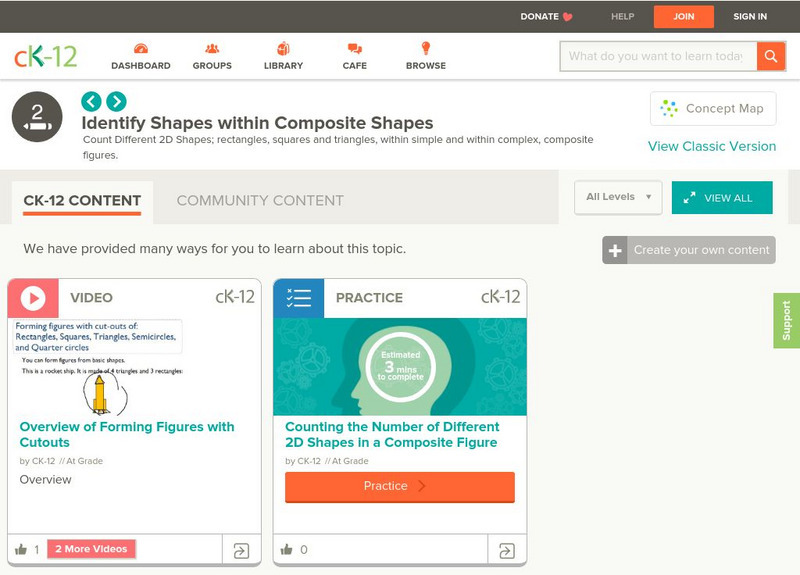
Ck 12: Elem Math: Count the Number of Different 2 D Shapes in a Composite Figure
[Free Registration/Login may be required to access all resource tools.] The video defines a composite figure and describes how to determine how many triangles are within the given composite shape. The video is followed by practice problems.
CK-12 Foundation
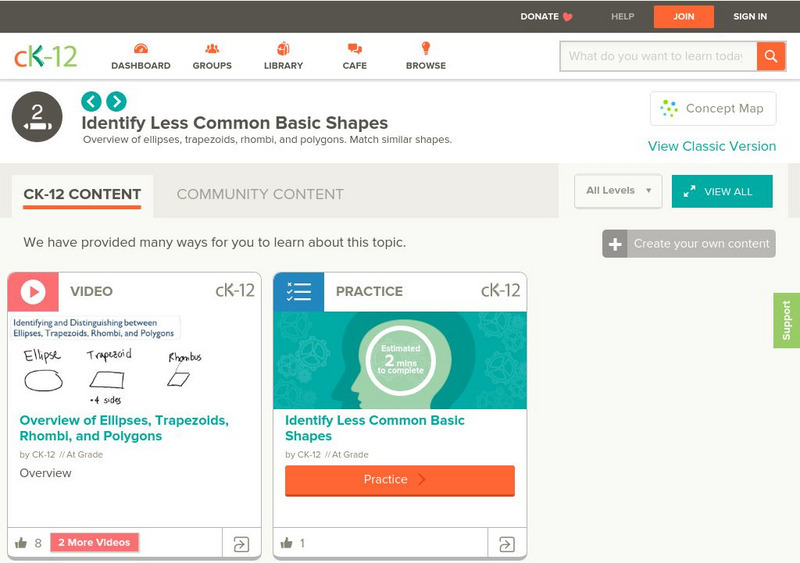
Ck 12: Elem Math: Matching Equivalent 2 D Shapes
[Free Registration/Login may be required to access all resource tools.] The video describes how to determine which shapes are similar by looking at the attributes of the given shapes. The video is followed by a series of practice...
CK-12 Foundation
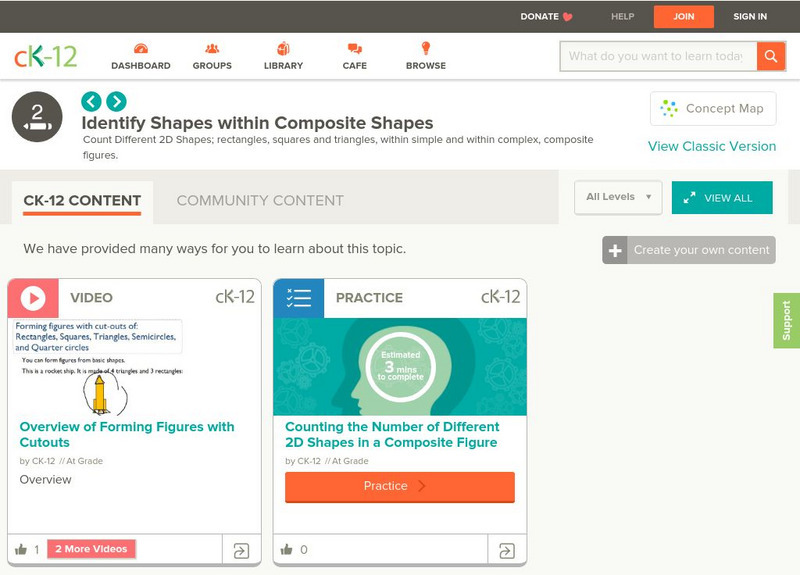
Ck 12: Elem Math: Counting Different 2 D Shapes Within Complex Composite Figures
[Free Registration/Login may be required to access all resource tools.] The video describes how to determine how many triangles are needed to create the complex composite shape.

CK-12 Foundation
Ck 12: Elem Math: Classifying Real Life Objects as Basic 2 D Shapes
[Free Registration/Login may be required to access all resource tools.] The video describes how to classify a real-world object as a circle, triangle, square or rectangle. The video is followed by additional practice problems.

National Council of Teachers of Mathematics
Nctm: Illuminations: Cutting Corners
Students will use their knowledge of plane figure attributes to create and view shapes by cutting and rotating shapes to stimulate discussions on names and attributes of various shapes they do not regularly encounter.
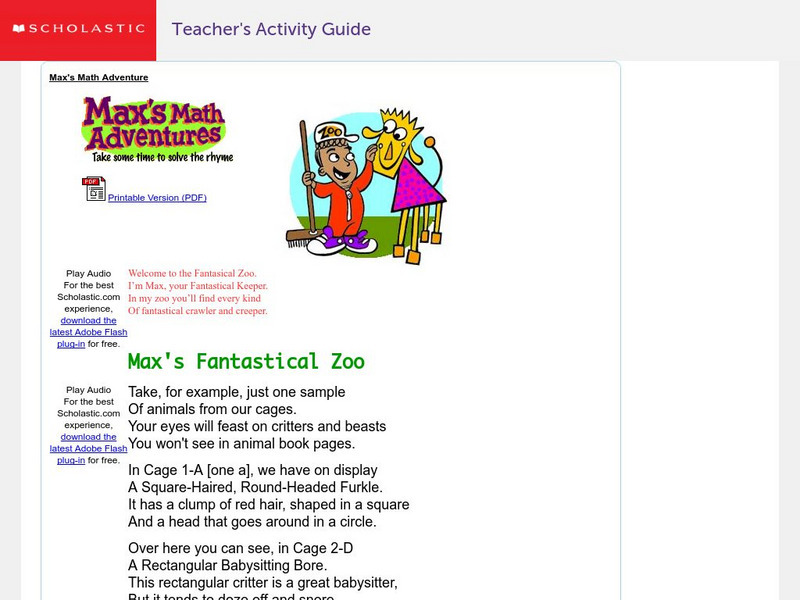
Scholastic
Scholastic: Max's Math Adventures: Max's Fantastical Zoo
Use this rhyming description of Max's Fantastical Zoo to make some amazing animals from geometric shapes. There is a teacher's guide for easy lesson planning.

Other
Kinderweb: Educational Children's Games
Use this site to practice identifying shapes, colors, and animals with these interactive games.
Illustrative Mathematics
Illustrative Mathematics: G Gmd, G Mg Tennis Balls in a Can
For this task, learners investigate the volume of tennis balls and their cylindrical container, the empty space around the balls, different ways of slicing them, and what their visualizations will look like. Aligns with G-GMD.B.4 and...