Hi, what do you want to do?






Curated OER
Identifying Pennsylvania Watersheds
Ninth graders study and identify the six major drainage systems in Pennsylvania. In this watershed activity students read an article, complete an activity and take a quiz on what they learned.

Curated OER
Landscapes
Learners explore landforms and landscapes. They demonstrate an appreciation for and examine how to recognize the attributes of landforms and landscapes. Students create a landscape and reflect on their painting.

Curated OER
Taking Risks: Drug and Alcohol Abuse
Students discuss a video about drug and alcohol abuse and their connection to risk-taking. They answer questions on a risk factor sheet about the use of tobacco, drugs, and alcohol. They discuss long and short term goals and how not...

Curated OER
Thar She Blows!
Students identify the advantages and disadvantages of wind farms and turbines. They examine how weather conditions can affect their effectiveness and how engineers are trying to solve the problem. They discover how engineers use this...

Curated OER
Mining Reclamation and Cookies
Ninth graders are introduced to the process of mining. In groups, they use the internet to research the effect of mining on the environment. They work together to create their own make believe mining company and discover the process of...

Curated OER
Bird Stories: Fact or Fiction
Students evaluate/distinguish scientific fact from fiction. They discuss similarities and differences in the life cycles of various birds. Student use the Internet as a research tool.

Curated OER
Sketch Up
Young scholars estimate and measure exact. In this geometry lesson, students create different object in three-dimensional pattern. They use SketchUp to create their shape and perform measurements on their shapes.

Curated OER
Tree Identification
Students list four ways to identify trees. For this tree identification instructional activity, students use tree identification techniques such as leafs, bark, wood grain, soil type, and climate to create tables and graphs.

Curated OER
Science: Plate Tectonics, Faults, and Volcanoes
Eighth graders conduct Internet research on plate tectonics, faluts, and volcanoes. In groups, they compile information related to teacher-provided questions. Students write papers detailing their findings and make oral presentations...
TeachEngineering
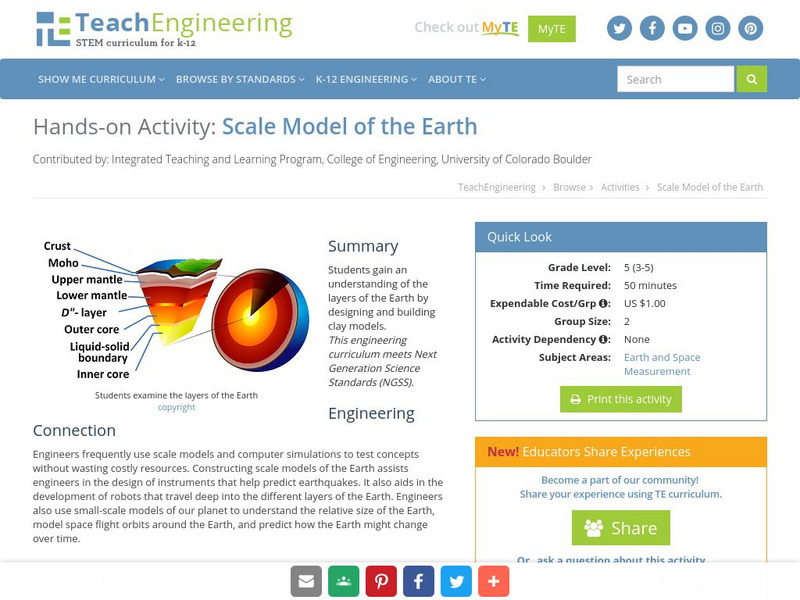
Teach Engineering: Scale Model of the Earth
In this activity, students gain an understanding of the layers of the Earth by designing and building a clay model.
TeachEngineering
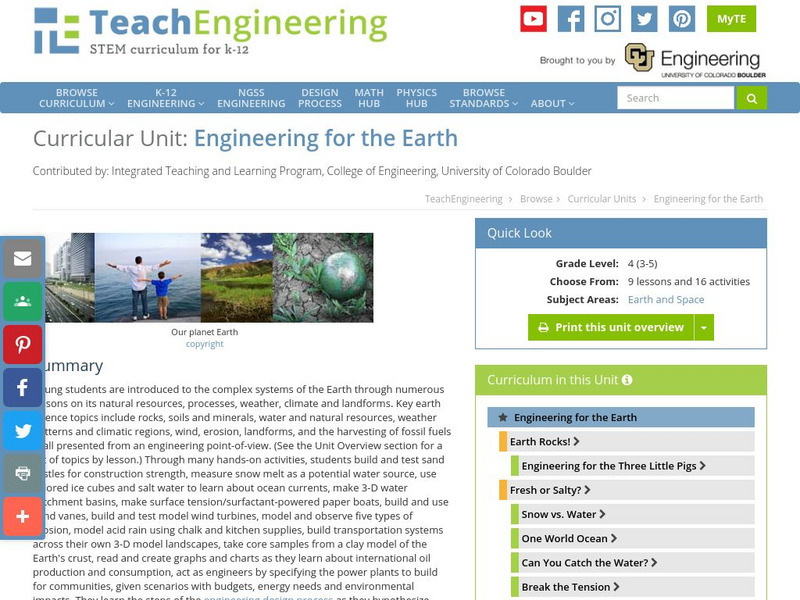
Teach Engineering: Engineering for the Earth
Young students are introduced to the complex systems of the Earth through numerous lessons on its natural resources, processes, weather, climate and landforms. Key earth science topics include rocks, soils and minerals, water and natural...
University of Hawai'i
University of Hawai'i: Exploring Our Fluid Earth: Activity: Design a Ship
In this activity, students apply their knowledge of buoyancy and ship stability to design a model ship. They test, evaluate, and refine the design of the model to optimize performance. Background information and other activities are...

Alabama Learning Exchange
Alex: Learning the Three Layers
This lesson will help students visualize the Earth's crust (lithosphere), mantle, and core. The students will work in groups to research and design a model of the Earth's layers. Some of the types of models include: computer, fruits such...
TeachEngineering
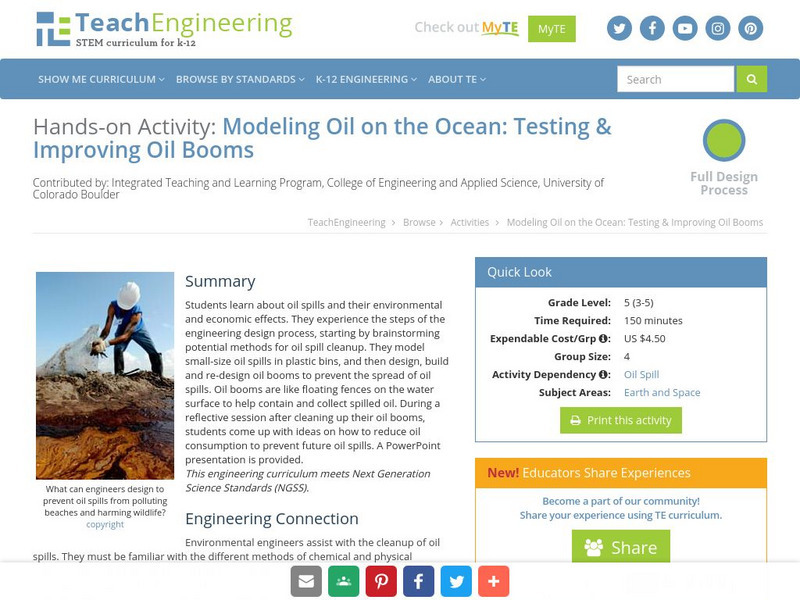
Teach Engineering: Oil on the Ocean
Students learn about oil spills and their environmental and economic effects. They experience the steps of the engineering design process as they brainstorm potential methods for oil spill clean-up, and then design, build, and re-design...
National Association of Geoscience Teachers
Nagt: Bringing the Geologic Time Scale Down to Earth in the Students' Backyard
This activity is specifically designed for a field trip to Drayton Hall, which is a historic plantation near Charleston, South Carolina. It does provide a model of how a similar activity could be designed for a local area, and there are...
TeachEngineering
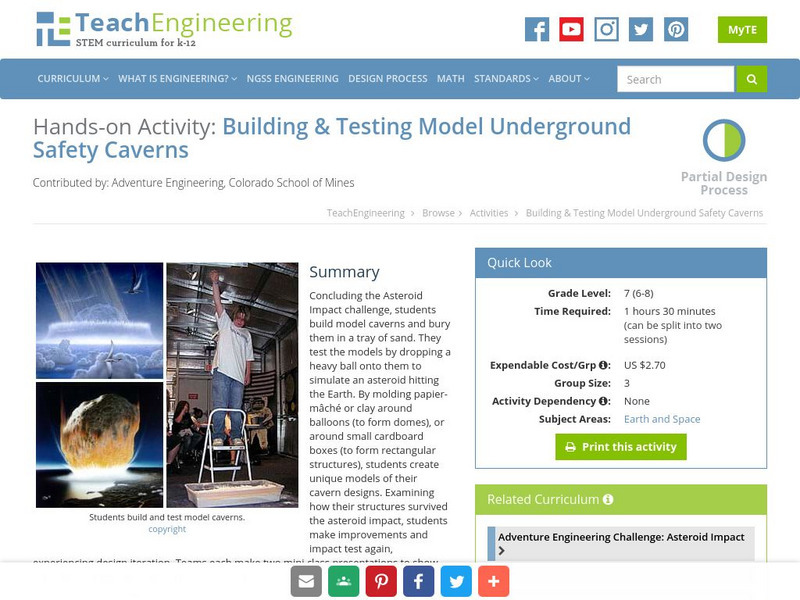
Teach Engineering: Testing the Caverns
Students build model caverns and bury them in a tray of sand. They test the models by dropping balls onto them to simulate an asteroid hitting the Earth. By molding papier-mache or clay around balloons (to form domes), or around small...
TeachEngineering
Teach Engineering: Natural Disasters
Students are introduced to our planet's structure and its dynamic system of natural forces through an examination of the natural hazards of earthquakes, volcanoes, landslides, tsunamis, floods and tornados, as well as avalanches, fires,...
TeachEngineering
Teach Engineering: Rock Cycle
Through five lessons, students are introduced to all facets of the rock cycle. Topics include rock and mineral types, material stresses and weathering, geologic time and fossil formation, the Earth's crust and tectonic plates, and soil...
Illustrative Mathematics
Illustrative Mathematics: G Mg Satellite
This task models a satellite orbiting the Earth in communication with two control stations located miles apart on Earth's surface. Students determine distances between various locations and, given a rate of travel, they determine the...
TeachEngineering
Teach Engineering: Planting Thoughts
Students gain an understanding of the parts of a plant, plant types and how they produce their own food from sunlight through photosynthesis. They also learn about transpiration, the process by which plants release moisture to the...
TeachEngineering
Teach Engineering: Air Pollution
Students are introduced to the concept of air quality by investigating the composition, properties, atmospheric layers and everyday importance of air. They explore the sources and effects of visible and invisible air pollution. By...
TeachEngineering
Teach Engineering: Dams
Through eight lessons, students are introduced to many facets of dams, including their basic components, the common types (all designed to resist strong forces), their primary benefits (electricity generation, water supply, flood...
TeachEngineering
Teach Engineering: Tunnel Through!
Students apply their knowledge about mountains and rocks to transportation engineering, with the task of developing a model mountain tunnel that simulates the principles behind real-life engineering design. Student teams design and...

TeachEngineering
Teach Engineering: Survive That Tsunami!
Students use a table-top-sized tsunami generator to observe the formation and devastation of a tsunami. They see how a tsunami moves across the ocean and what happens when it reaches the continental shelf. Students make villages of model...