Lesson Planet
Search educational resources
  • Sign In Try It Free
  • AI Teacher Tools
    • Discover Resources Search reviewed educational resources by keyword, subject, grade, type, and more
    • Curriculum Manager (My Content) Manage saved and uploaded resources and folders To Access the Curriculum Manager Sign In or Join Now
    • Browse Resource Directory Browse educational resources by subject and topic
    • Curriculum Calendar Explore curriculum resources by date
    • Lesson Planning Articles Timely and inspiring teaching ideas that you can apply in your classroom
    • Our Story
    • Frequently Asked Questions
    • Testimonials
    • Contact Us
  • Pricing
  • School Access
    • Your school or district can sign up for Lesson Planet — with no cost to teachers
      Learn More
  • Sign In
  • Try It Free

Hi, what do you want to do?

Create a lesson plan
Generate resources with 80+ AI teacher tools
Search 200,000 instructional videos
Find a teaching resource
Teach Engineering: Dams Unit PlanTeach Engineering: Dams Unit Plan
Publisher
TeachEngineering
Curator Rating
Educator Rating
Not yet Rated
Unit Plan

Teach Engineering: Dams

Curated by ACT

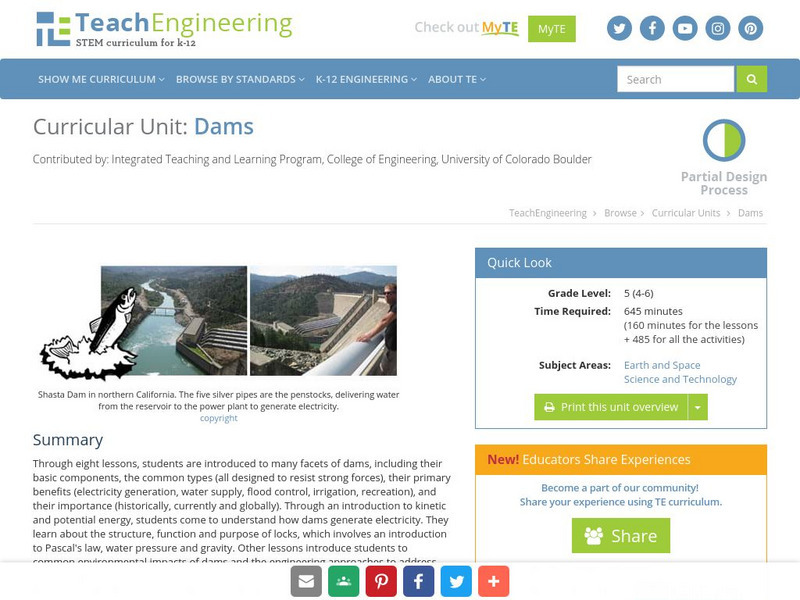
Through eight lessons, students are introduced to many facets of dams, including their basic components, the common types (all designed to resist strong forces), their primary benefits (electricity generation, water supply, flood control, irrigation, recreation), and their importance (historically, currently and globally). Through an introduction to kinetic and potential energy, students come to understand how dams generate electricity. They learn about the structure, function and purpose of locks, which involves an introduction to Pascal's law, water pressure and gravity. Other lessons introduce students to common environmental impacts of dams and the engineering approaches to address them. They learn about the life cycle of salmon and the many engineered dam structures that aid in their river passage, as they think of their own methods and devices that could help fish migrate past dams. Students learn how dams and reservoirs become part of the Earth's hydrologic cycle, focusing on the role of evaporation. To conclude, students learn that dams do not last forever; they require ongoing maintenance, occasionally fail or succumb to "old age," or are no longer needed, and are sometimes removed. Through associated hands-on activities, students track their personal water usage; use clay and plastic containers to model and test four types of dam structures; use paper cups and water to learn about water pressure and Pascal's Law; explore kinetic energy by creating their own experimental waterwheel from two-liter plastic bottles; collect and count a stream's insects to gauge its health; play an animated PowerPoint game to quiz their understanding of the salmon life cycle and fish ladders; run a weeklong experiment to measure water evaporation and graph their data; and research eight dams to find out and compare their original purposes, current status, reservoir capacity and lifespan. Woven throughout the unit is a continuing hypothetical scenario in which students act as consulting engineers with a Splash Engineering firm, assisting Thirsty County in designing a dam for Birdseye River.

3 Views 2 Downloads
Concepts

civil engineering, water, stem, dams

Additional Tags

integrated teaching and learning program and laboratory, teachengineering, teachengineering: dams, dam, water supply
Show More Show Less

Resource Details

Grade
4th - 6th
Subjects
Science
2 more...
Resource Type
Unit Plans
Audiences
For Administrator Use
1 more...
Lexile Measures
0L

See similar resources:

Activity

Teach Engineering: Dam Forces

TeachEngineering
Students learn how the force of water helps determine the size and shape of dams. They use clay to build models of four types of dams, and observe the force of the water against each type. They conclude by deciding which type of dam...
4th - 6th Science
Activity

Teach Engineering: Dam Pass or Fail

TeachEngineering
Students conduct Internet research to investigate the purpose and current functioning status of some of the largest dams throughout the world. They investigate the success or failure of eight dams and complete a worksheet. While...
4th - 6th STEM
Lesson Plan

Teach Engineering: Why Do We Build Dams?

TeachEngineering
Students are introduced to the concept of a dam and its potential benefits, which include water supply, electricity generation, flood control, recreation and irrigation. This lesson begins an ongoing classroom scenario in which student...
4th - 6th Science
Lesson Plan

Teach Engineering: Dam Impacts

TeachEngineering
While the creation of a dam provides many benefits, it can have negative impacts on local ecosystems. Students learn about the major environmental impacts of dams and the engineering solutions used to address them.
4th - 6th Science
Lesson Plan

Teach Engineering: Water and Dams in Today's World

TeachEngineering
Students learn about the importance of dams by watching a video that presents historical and current information on dams, as well as descriptions of global water resources and the hydrologic cycle. Students also learn about different...
4th - 6th Science
Lesson Plan

Teach Engineering: Swim to and From the Sea!

TeachEngineering
Students are introduced to the basic biology behind Pacific salmon migration and the many engineered Columbia River dam structures that aid in their passage through the river's hydroelectric dams. Students apply what they learn about the...
3rd - 5th Science
Lesson Plan

Teach Engineering: Locks and Dams

TeachEngineering
Students are introduced to the structure, function and purpose of locks and dams, which involves an introduction to Pascal's law, water pressure and gravity.
5th - 7th Science
Activity

Teach Engineering: Falling Water

TeachEngineering
Students drop water from different heights to demonstrate the conversion of water's potential energy to kinetic energy. They see how varying the height from which water is dropped affects the splash size. They follow good experiment...
3rd - 5th Science
Activity

Teach Engineering: How Much Water Do You Use?

TeachEngineering
Students keep track of their own water usage for one week, gaining an understanding of how much water is used for various everyday activities. They relate their own water usages to the average residents of imaginary Thirsty County, and...
5th - 7th Science
Lesson Plan

Teach Engineering: Are Dams Forever?

TeachEngineering
Students learn that dams do not last forever. Similar to other human-made structures, such as roads and bridges, dams require regular maintenance and have a finite lifespan. Many dams built during the 1930-70s, an era of intensive dam...
4th - 6th STEM
Try It Free
© 1999-2026 Learning Explorer, Inc.
Teacher Lesson Plans, Worksheets and Resources

Sign up for the Lesson Planet Monthly Newsletter

Open Educational Resources (OER)

  • Health
  • Language Arts
  • Languages
  • Math
  • Physical Education
  • Science
  • Social Studies
  • Special Education
  • Visual and Performing Arts
View All Lesson Plans

Discover Resources

  • Our Review Process
  • How it Works
  • How to Search
  • Create a Collection

Manage Curriculum

  • Edit a Collection
  • Assign to Students
  • Manage My Content
Contact Us Site Map Privacy Policy Terms of Use