Hi, what do you want to do?






5280 Math
Multiplication Table Algebra
Patterns, patterns, everywhere! Young scholars examine the multiplication table to identify patterns. Their exploration leads to an understanding of the difference of squares and sum of cubes by the completion of the algebra project.

Exploratorium
Oil Spot Photometer
Are these two light sources the same? Groups use a white card and a little cooking oil to create a photometer that allows for the comparison of two lights. The Inverse Square Law provides a way to calculate the actual difference in...

Curated OER
Hoot: Concept/Vocabulary Analysis
Augment your unit on Carl Hiaasen's Hoot with a series of activities about the environment, civil disobedience, making an impact in the world, and growing up. A list of literary concepts and themes helps you to write your lessons to...

Cru High School
Games / Icebreakers
Twenty-three, fun-filled activities make up a list of icebreakers designed to familiarize class members with one another, and add a sense of community to the classroom.

Illustrative Mathematics
Computations with Complex Numbers
This quick set of problems provides a brief refresher on the arithmetic of complex numbers. Learners need to multiply, add and subtract, and remember features of i when raised to a power. Included solutions are clear enough that...

5280 Math
Polygon Polynomials
Patterns in polygons lead to patterns in polynomials. Presented with a series of polygons, individuals create polynomial expressions to represent their patterns. The algebra project consists of nine problems that incorporate polynomial...

Curated OER
Shapes and Their Insides
Learners follow a series of instructions for drawing and coloring different shapes in order to learn the difference between the perimeter and area of a polygon. Then they are asked to find the perimeter and area of a 3x4 rectangular...

Illustrative Mathematics
Shape Hunt Part 2
Shapes are everywhere in the world around us, from rectangular doors to the circular wheels of a car. The second lesson in this series opens the eyes of young mathematicians to this wonderful world of shapes as they search the classroom,...

Computer Science Unplugged
Ice Roads–Steiner Trees
As an introduction to Steiner Trees, class members are challenged to find the shortest paths to connect multiple points. The teacher introduces the problem by showing how to connect three points. Groups then go outside and construct a...

Serendip
Should States Repeal Their Laws Banning First Cousin Marriage?
Around half of the states in the US ban first cousin marriage, but does science support that ban? Scholars work through genetic analysis of the risks to understand if more states should ban the practice—or if some should remove it. They...

Science Matters
Plot Study
Small groups investigate plots of land to discover how abiotic and biotic factors interact. After recording their findings, scholars share observations with peers and self-reflect on the learning process.

Illustrative Mathematics
Toilet Roll
Potty humor is always a big hit with the school-age crowd, and potty algebra takes this topic to a whole new level. Here the class develops a model that connects the dimensions (radii, paper thickness, and length of paper) of a...

Howard Hughes Medical Institute
Stickleback Evolution Virtual Lab
How quickly do animals evolve? Can comparing different samples of the same fossil answer timeline questions? Scholars use virtual labs to examine fossils and learn about stickleback evolution. They compare pelvic morphology in lakes...

Texas State Energy Conservation Office
Investigation: Gas Laws in Action - Propane
Using helium as an example of propane, physical science middle schoolers experiment with and graph the relationship between temperature and volume in gases. In a whole-class demonstration, they show how molecules behave under different...

Illustrative Mathematics
Rational or Irrational?
Is 4 plus the square root of 2 rational or irrational? After your class has gained a basic grasp of rational and irrational numbers, use this worksheet to push them a little further in their understanding. Learners must identify sums and...

Illustrative Mathematics
Identifying Rational Numbers
Eight different numbers are listed for mathematics masters to analyze. They simply tell if each number is rational or irrational. They can also explain their reasoning. A simple and straightforward learning exercise that is a handy tool...

Curated OER
Coffee and Crime
Is there a correlation between the number of coffee shops and the amount of crime in a given area? In this quick exercise, your class will examine the data, interpret the results, and discuss their conclusion. Concepts covered include...

Illustrative Mathematics
The Physics Professor
Help mathematicians see that a formula found in a physics book has an algebraic structure. Though the formula given in the resource looks complicated, learners are to break down the expressions and interpret each part separately....

Illustrative Mathematics
Comparing Rational and Irrational Number
Algebra learners must know how to use rational numbers to approximate irrationals. This resource asks participants to decide which number is larger without using a calculator. It makes a great exercise to use as a five-minute transition...

Curated OER
Trina's Triangles
Practice evaluating polynomial expressions at the same time you find Pythagorean Triples. Look for patterns and find examples when the "formula" does and doesn't work. Finally, verify the formula by proving the identity true.

Varsity Tutors
Varsity Tutors: Hotmath: Algebra Review: Difference of Squares
Find a quick, concise explanation of how to find the difference of squares. An example is given and clearly explained.
Interactive Mathematics
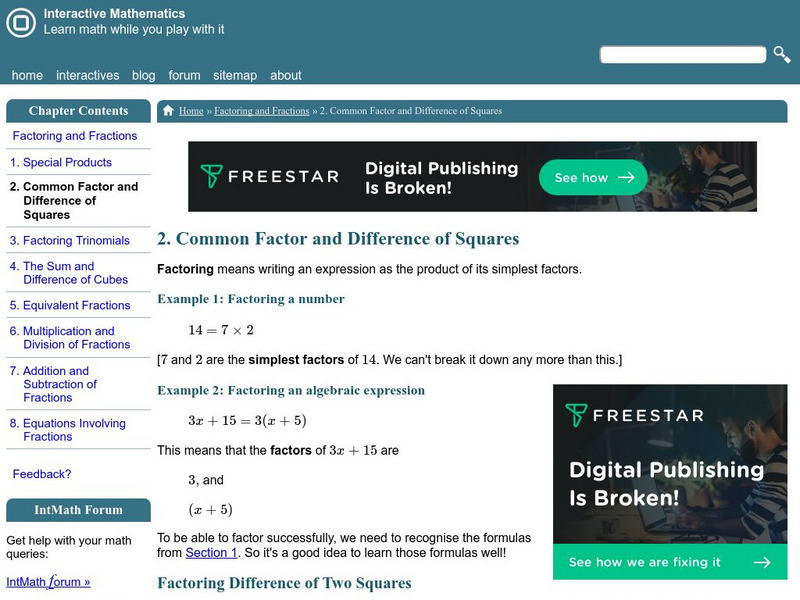
Interactive Mathematics: Common Factor & Difference of Squares
These easy to follow examples demonstrate how to factor algebraic expression using GCF and difference of squares.
University of Saskatchewan (Canada)
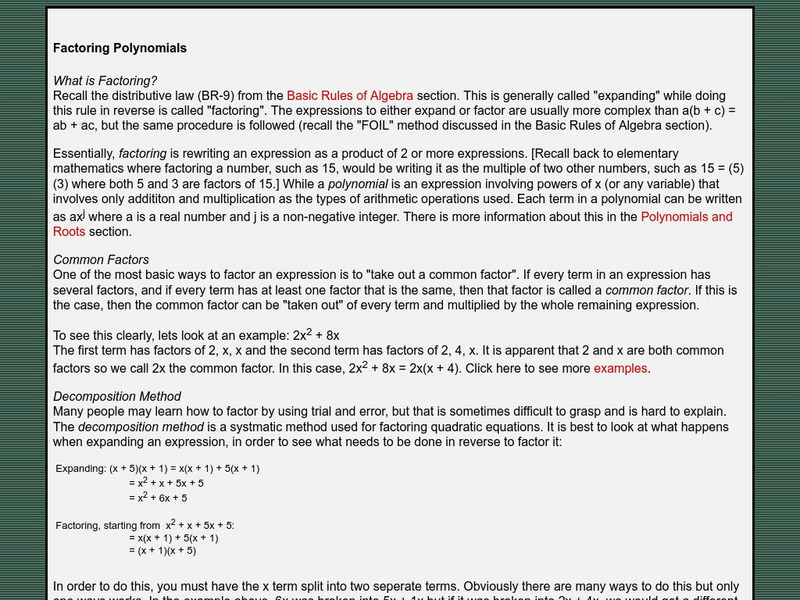
University of Saskatchewan: Factoring Polynomials
This site from the University of Saskatchewan provides an explanation of factoring by grouping, greatest common factor, perfect squares, and difference of squares. Higher degree polynomials factored as well. Some examples provided along...
Cool Math
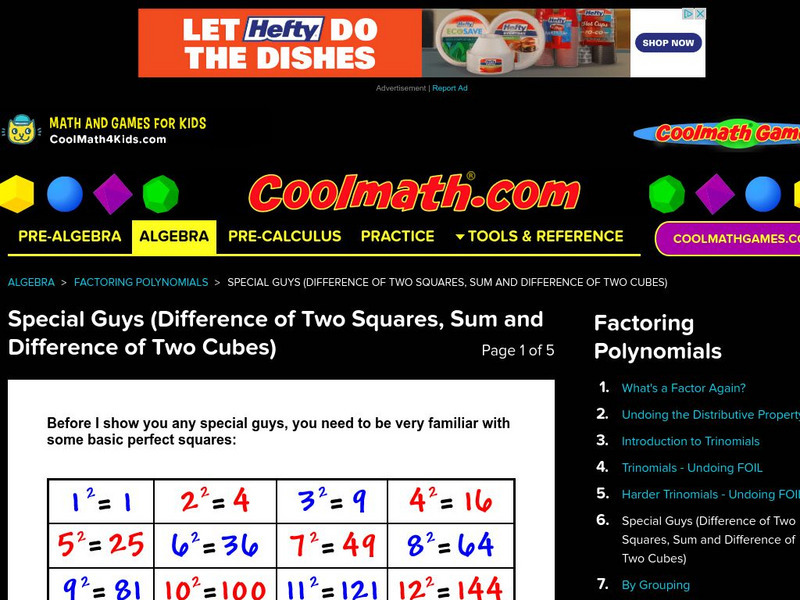
Coolmath: Difference of Two Squares, Sum and Difference of Two Cubes
This algebra lesson explains how to factor the difference of two squares and the sum and difference of two cubes.