Hi, what do you want to do?






Curated OER
WATER CHEMISTRY
Students list reasons why water is important and investigate and graph the freezing points of different solutions.

Curated OER
Activity One -- Fundamentally Speaking
In this science worksheet, students examine how the universe is bound with the atomic particles and focus upon the findings of two historical scientists.

Curated OER
The Water Cycle and Global Warming
Students study the flow of water in the environment. In this water cycle lesson students evaluate the consequences of changes in the water cycle using data.

Curated OER
A Phylogenetic Perspective for the Cladistically Challenged
Students use M&Ms to simulate radioactive decay of elements.

Curated OER
Causal Patterns in Density Phenomena
Students consider the causes of density at a microscopic level. They then discover that one cause of density has to do with how many protons and neutrons the material contains.

Curated OER
Physical and Chemical Changes
Eighth graders view a PowerPoint presentation that assist them in distinguishing between physical and chemical changes. They compare their observations of demonstrations to a list of clues recognizing types of changes.

Curated OER
Reading Labels For Fat Types
Students analyze a variety of cooking oils to determine the amount and types of fats included in each.

Curated OER
Energy Dispersive Spectroscopy
Students calculate the values of electron binding energies. In this physics lesson, students solve for different wavelength characteristics of X-rays. They present their findings to the class.

Curated OER
Static Cling
Students work together to discover the concept of static electricity. They participate in an experiment in which they test different objects charge. They make observations and record them for later use.

Curated OER
Atomic Time Lines
Learners understand the evolution of the atomic model from Ancient Greece to the present. They then choose one of the options as a project using class time to do research and to be creative.

Curated OER
Lesson- Radial Solution, Hydroggen Wavefunction
Student uses Schrodinger's equation applied to a single electron Hydrogen atom. They use angular and radial portions equation to answer questions. Student use a model to answer equation questions.

Curated OER
A Chemist in My Class?
First graders in kindergarten science class discuss matter. They make predictions and then identify mystery items in brown paper bags as either solid, liquid, or gas by using their senses. They discuss that a chemist is a scientist that...

Curated OER
Breaking it Down
High schoolers will identify the factors that contribute to erosion and weathering. They will start by differentiating between chemical and mechanical weathering. They then apply what they learned by playing the online jeopardy game. Key...

Curated OER
Typical Numeric Questions for Physics I - Atomic Spectra
Seven practice problems are presented to physics pros in this assignment. Given the wavelengths, they perform computations for emission spectra. This brief activity makes an appropriate pop quiz.

Curated OER
Advanced Paragraph Correction #8
In this paragraph correction worksheet, students read an 8 line passage. Then students respond to 8 multiple choice questions regarding grammar, punctuation, and spelling errors within the paragraph.
Science Education Resource Center at Carleton College
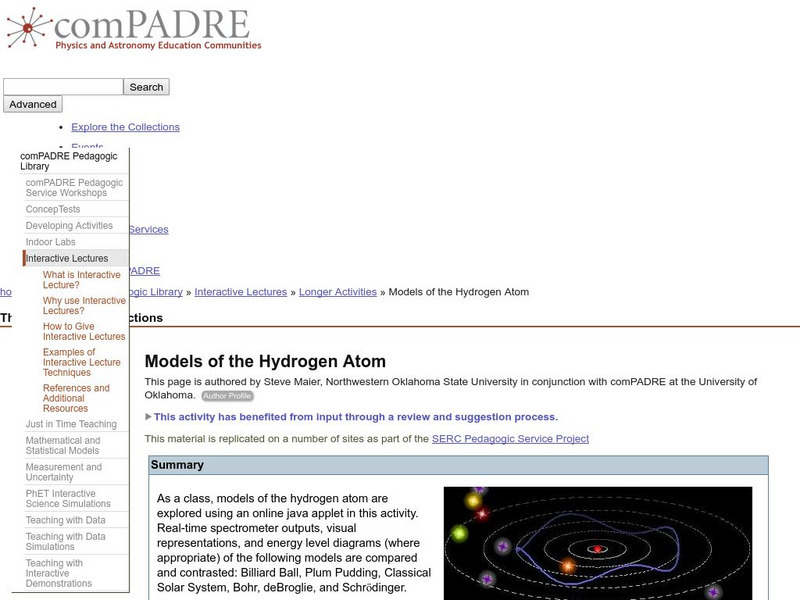
Serc: Models of the Hydrogen Atom
In this activity, students will explore several different models of the hydrogen atom and compare and contrast them using an online java applet.

Alabama Learning Exchange
Alex: Atoms and Models of Atoms
This lesson introduces learners to scientific models. The students will learn how models of the atom have changed as new evidence is gathered. The learners will also learn about the current model of the atom. Each student will make a...
University of Colorado
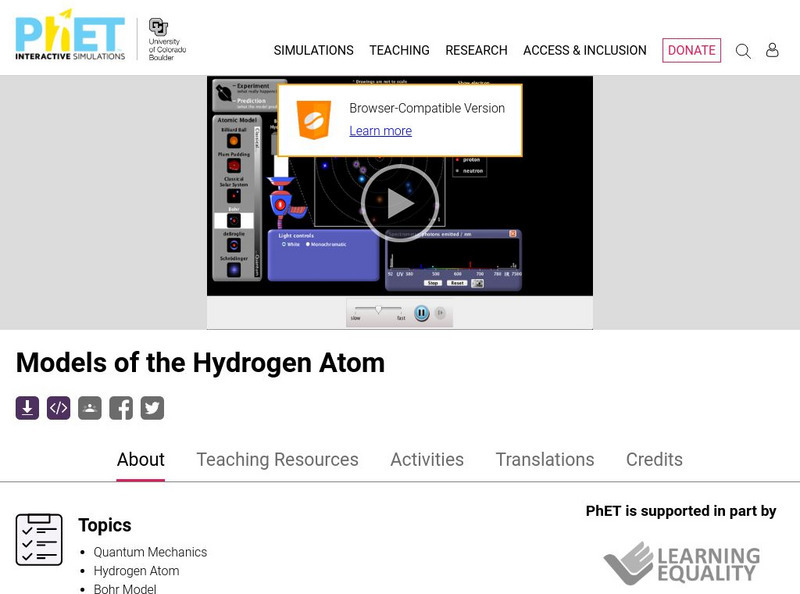
University of Colorado: Ph Et Interactive Simulations: Models of the Hydrogen Atom
How did scientists figure out the structure of atoms without looking at them? Try out different models by shooting light at the atom. Check how the prediction of the model matches the experimental results.
Tom Richey
Slide Share: Atomic Models: Everything You Need to Know
A detailed slideshow for Grade 8 students that looks at the history of our understanding of atoms. Looks at the ideas presented by Democritus, John Dalton, J.J. Thomson, Ernest Rutherford, and Niels Bohr, and the modern-day wave model. A...
TeachEngineering
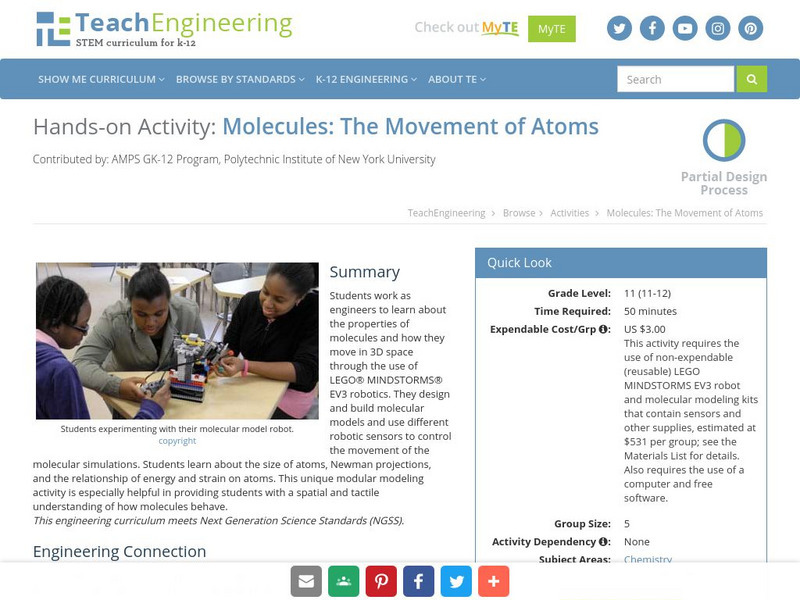
Teach Engineering: Molecules: The Movement of Atoms
Students work as engineers to learn about the properties of molecules and how they move in 3D space through the use of LEGO MINDSTORMS NXT robotics. They design and build molecular models and use different robotic sensors to control the...
Science Education Resource Center at Carleton College
Serc: Electron Energy Levels of Atoms and Ions
In this lab, students investigate basic electron structure by making a model using pennies and different sized filter papers.

CK-12 Foundation
Ck 12: Plix: Bohr's Atomic Model
[Free Registration/Login Required] Shown here are representations of three different models of the atom. Move the name labels to correctly title each of the models with the scientist who created them.

University of Colorado
University of Colorado: Physics 2000: Bohr's Atom
An outstanding site that can best be described as student friendly. It describes the main differences between the classical and quantum models of the atom. Clear and well illustrated.
University of Colorado
University of Colorado: Ph Et Interactive Simulations: Molecule Shapes
Explore molecule shapes by building molecules in 3D. How does molecule shape change with different numbers of bonds and electron pairs? Find out by adding single, double or triple bonds and lone pairs to the central atom. Then, compare...