Hi, what do you want to do?






Curated OER
Prime Numbers and Factors
Students determine factors of numbers to 100 and identify prime factors; students differentiate prime and composite numbers by the factors of the numbers.

Curated OER
Symmetrical Design: Pennsylvania Barn Signs
Second graders explain and apply the visual arts elements and the design principle of symmetry and apply media, techniques, and processes. In addition, they describe how different materials, techniques, and processes cause different...

Curated OER
Solving Problems
Second graders become familiar with need strategies for computation of money problems and estimating sums. In this computation lesson plan, 2nd graders solve real life problems to understand estimation and money problems.

Pennsylvania Department of Education
Equal Groups
Students explore statistics by completing a graphing activity. In this data analysis lesson plan, students define a list of mathematical vocabulary terms before unpacking a box of raisins. Students utilize the raisins to plot data on a...

Ohio Department of Education
Actions with Fractions: Adding and Subtracting Fractions with Common Denominators
Fourth graders develop a conceptual understanding of fractions and begin to add and subtract fractions with like denominators. Included is a worksheet to assess readiness and a teacher's checklist showing class understanding at a...

Curated OER
Area Model of Multiplication
Fifth graders build area models to represent multi-digit multiplication. This lesson is not complete, but having pupils learn first through hands-on experiences builds a solid mathematical foundation.

Curated OER
Finding Addition Patterns
Students practice finding the sums of two-one digit numbers. In this addition lesson plan, students also record facts onto an addition chart.

Curated OER
Finding Sums to 6
Students explore the additive identity property where they add multiple numbers to get to the number 6. In this number 6 lesson plan, students also work on their addition charts.

Curated OER
Urban Safari: A Walk on the Wild Side
Students discover the urban ecosystem through a series of activities. They explore both the biotic and abiotic factors of the urban environment.

Curated OER
Matter
Students complete a unit of activities to learn about states of matter and how to measure matter. In this matter lesson, students complete 8 lessons to learn about matter, its states, and how to measure matter.

Curated OER
Devine Design
Students examine the functions of the different systems in the body. They discover how different systems must work together to make the body function correctly. They identify the needs of the body to help it survive.

PBS
Pbs: Modeling Fraction and Mixed Number Division Using Arrays
This video illustrates how to use an array as a visual model for solving a word problem involving the division of fractions and mixed numbers. The problem asks students to determine the width of a rectangular fennec fox den based on its...
PBS
Pbs: Modeling Fraction Division Using Arrays
This video illustrates a visual model for solving a word problem involving the division of fractions. The problem asks students to determine the width of a rectangular platypus burrow based on its length and area. In the accompanying...

Khan Academy
Khan Academy: Multiply With Arrays
Practice multiplying 1-digit numbers using arrays. Students receive immediate feedback and have the opportunity to try questions repeatedly, watch a video or receive hints.
Khan Academy
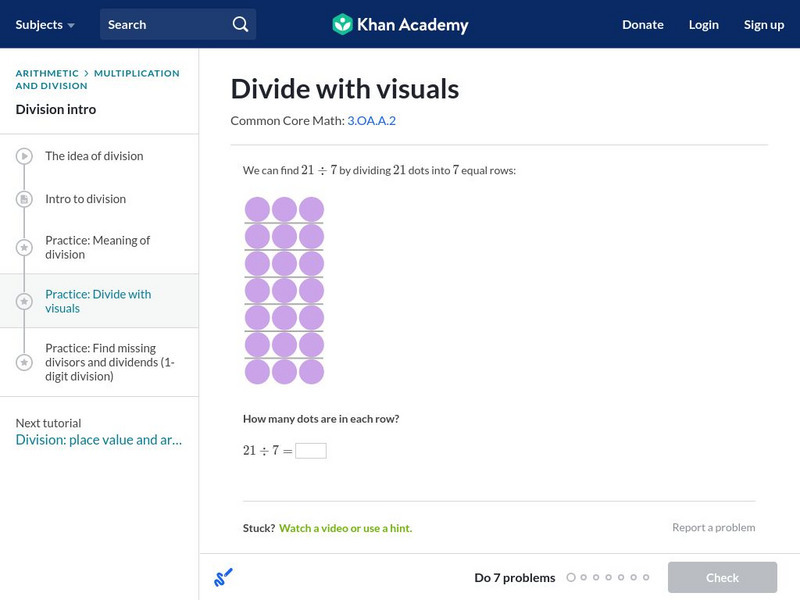
Khan Academy: Divide With Vsuals
Practice basic division using various visuals, such as arrays. Students receive immediate feedback and have the opportunity to try questions repeatedly, watch a video or receive hints.
Cool Math
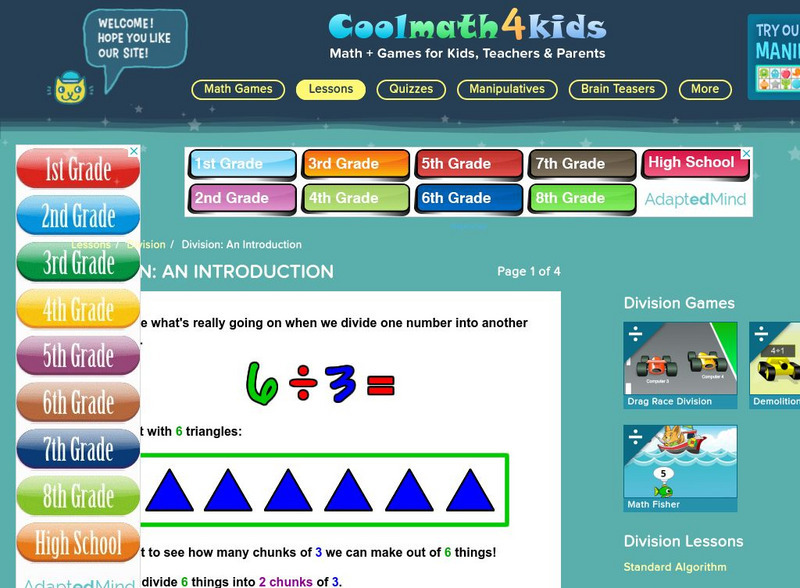
Coolmath: Coolmath4kids: Division: An Introduction
Uses visual models to explain what division is and includes sample problems to try. It also offers links to division games.
Better Lesson
Better Lesson: Multiplication Facts With Arrays
Third graders are expected to fluently multiply and divide within 100. This allows students to practice their math facts and then check their work using area models.

Khan Academy
Khan Academy: Divide With Visuals
Division practice using an array to determine the quotient. There are additional explanations and a video to support learning.
Khan Academy
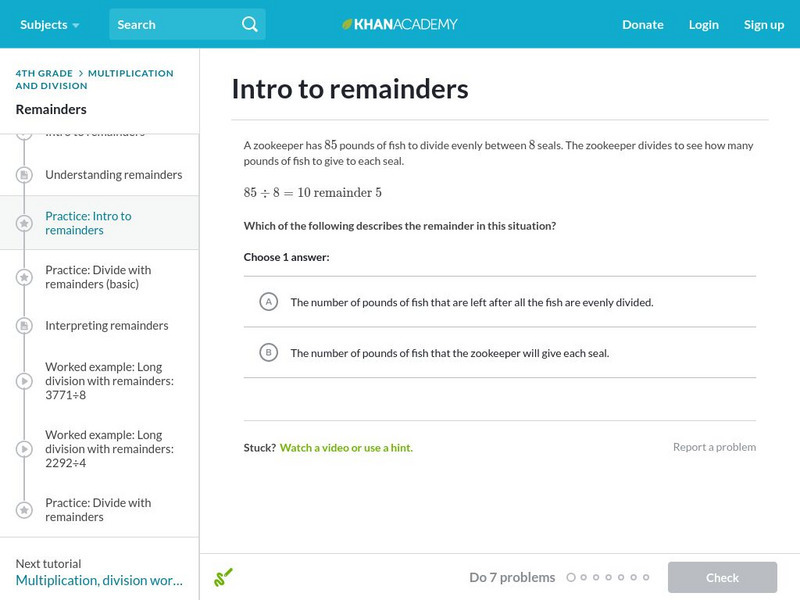
Khan Academy: Intro to Remainders
Use arrays, area models, and practice problems to understand remainders. Students receive immediate feedback and have the opportunity to try questions repeatedly, watch a video or receive hints.

Khan Academy
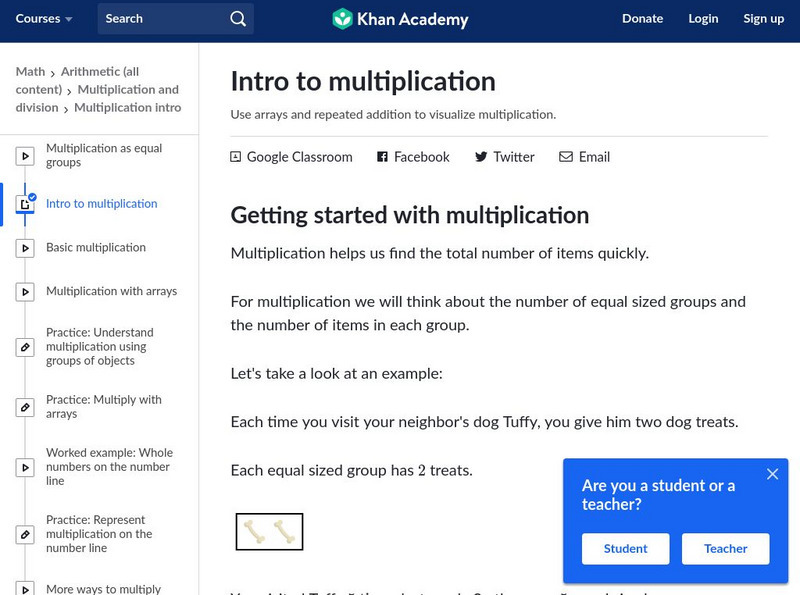
Khan Academy: Intro to Multiplication
Guided questions with explanations using equal groups, arrays, and repeated addition as an introduction to multiplication.
Khan Academy
Khan Academy: Intro to Multiplication
Explains what multiplication is and how to represent it using equal groups and arrays. Also looks at the strategies of repeated addition and skip counting and how they can be used to solve multiplication problems. Includes practice...
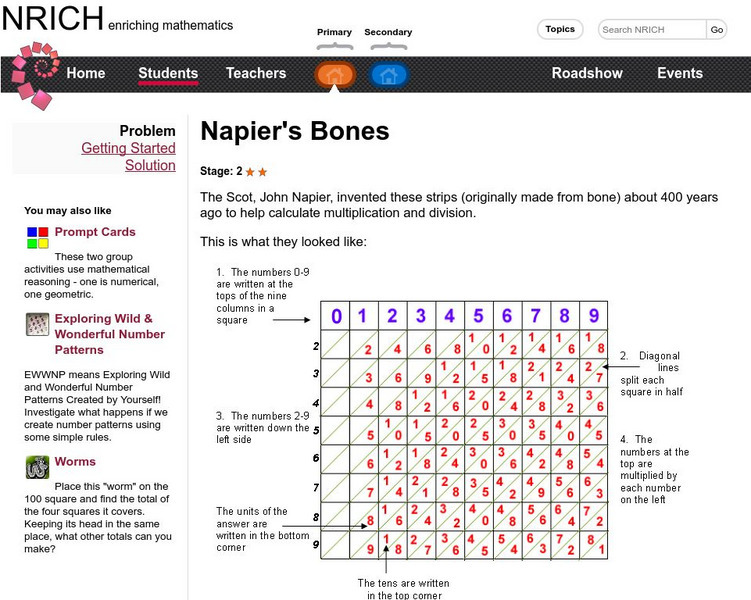
University of Cambridge
University of Cambridge: Nrich: Napier's Bones
Use this one page website to learn how to multiply and divide a "new" way. This method was invented over 400 years ago by John Napier. A detailed explanation is only a click away.