Hi, what do you want to do?






EngageNY
Divisibility Tests for 3 and 9
Who knew the sum of a number's digits gives such interesting information? The 18th installment of a 21-part module has scholars investigate division by three and nine. After looking at several examples, they develop divisibility tests...

Mathed Up!
Proof
Scholars learn how to write number theory proofs by viewing a video reviewing techniques for proofs on divisibility, parity, and consecutive integers. They then write proofs for a handful of conjectures on a worksheet.

Illustrative Mathematics
Zeroes and factorization of a quadratic polynomial I
This activity uses the division algorithm and the definition of a zero/root of a function to guide your class to see the relationship between zeros and factors of a general quadratic, which can later be generalized to the Remainder...

Concord Consortium
Leap Years and Calendars
How many birthdays do leap year babies have in a lifetime? Learners explore the question among others in a lesson focused on different calendar systems. Given explanations of the Julian, Gregorian, and Martian calendars, individuals use...

Illustrative Mathematics
Rational or Irrational?
Is 4 plus the square root of 2 rational or irrational? After your class has gained a basic grasp of rational and irrational numbers, use this learning exercise to push them a little further in their understanding. Learners must identify...

Curated OER
Visiting the Arcade
Second graders take a trip to the arcade in an activity that engages them in problem solving with money. Composed of three word problems, youngsters are instructed to determine various combinations to represent a given value by using...
Illustrative Mathematics
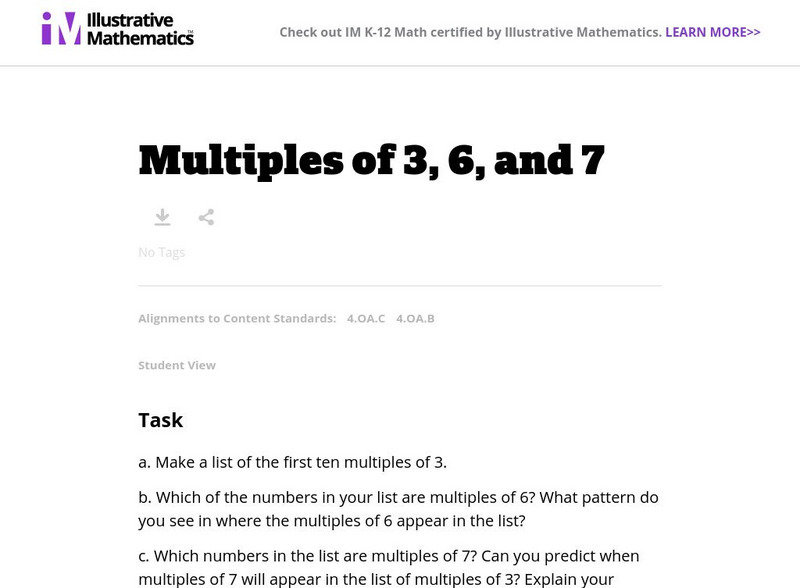
Illustrative Mathematics: 4.oa Multiples of 3, 6, and 7
This task investigates divisibility properties for the numbers 3, 6, and 7. Aligns with 4.OA.C.