Hi, what do you want to do?






Curated OER
How We See Things
Students investigate how mirrors reflect light. In this reflection lesson, students draw the path of the light reflected from a mirror. Students construct a list of objects that are light sources.

Curated OER
Mystery of the Senses-Vision
Students view six optical illusions and explain why the visual system might interpret them the way it does. They explore how illusions distort our sense of perspective, because they deceive us into seeing what we expect to see. ...

Curated OER
YOU CAN BE A WOMAN MOVIE MAKER
Students research and participate in activities to find out more information about women movie-makers.The use of reading a script and making storyboards are just a couple of examples.

Curated OER
Surface Area of a Leaf (Grades 7-9)
For this math and science worksheet, students read about the process of photosynthesis and plant growth. They determine how a plant's ability to create food is dependent on the surface area of its leaves using geometric calculations....

Curated OER
Halloween Carnival
Students review previously taught movements of kicking, striking, throwing and catching while involving a Halloween theme. They go to workstations with names such as "Floating Ghosts," "Shadow Shapes," "Spider Web," &quo

Curated OER
What a View!
Young scholars examine two- and three-dimensional shapes and figures. Individually, they practice identifying the shape from various viewpoints. By completing this activity, they develop a spatial sense about how figures and shapes are...

Curated OER
The Earth is Flat
Third graders experiment to gain understanding of the shape and rotation of the Earth. For this Sun and Moon science lesson, 3rd graders understand that the Earth rotates on its axis and how that explains the appearance of the moon and...

Curated OER
A Moon with a View
Third graders explore the rotation of Earth and the moon. For this solar system lesson, 3rd graders participate in an Earth and moon simulation in which part of the class "becomes" the sun, while other children represent the moon by...

Curated OER
Forces in Action
Students investigate different forces and draw arrows to signify specific directions of force. Students are then shown a brick and they are asked to draw a diagram which will include labels for the forces that are acting on the brick....

Curated OER
Changing circuits
Students identify that there are conventional symbols to represent the components in circuits. Students use these symbols to draw diagrams of circuits. They are reminded that electric circuits can be drawn in diagrams using symbols. ...

Curated OER
Language Arts: Chasing Vermeer - A DaVinci Code for Children
Students read the mystery novel, Chasing Vermeer, research the artist and his works. Through observation of his works, they create their own pencil sketches of selected paintings. Finally, students simulate Vermeer's interiors with...

Curated OER
Self Portraits
Students study themselves in a mirror paying close attention to every attribute on their face. In this self portrait lesson students create a self portrait the same way as Rembrandt has done many times. Students also ask themselves a...

Curated OER
Phases of the Moon
Pupils create a model of the phases of the Moon by giving students pictures of the phases of the Moon, a picture of the Earth, and a picture of the Sun. They then take a picture, and stand in correct place to make the phases of the Moon...

Curated OER
Haring Lampshades
Students enter a creative competition where they create a Keith Haring inspired lamp shade. In this lamp shade lesson plan, students discuss functional art.

Curated OER
Dark Nights-Nature Notebook
In this night time worksheet, students complete a graphic organizer about the night, drawing and filling in information about the night sky, the night ground, and the lights they may see.

Curated OER
Space Science: Phases of the Moon
Looking for a terrific lesson on the phases of the moon that has lots of good worksheets? With two excellent websites are embedded in the plan, the activity is sure to spark some interest in your astronomy unit. Some common...

Curated OER
Paper Plate Observation
Students analyze transits from previous scientists. They identify simple objects that could have been used for documentation in the science world. They also practice scientific inquiry using methodology.
J. Paul Getty Trust
J. Paul Getty Museum: Drawings by Rembrandt and His Pupils
Compare and contrast drawings by Rembrandt with those of his students to learn about his characteristic visual traits, especially his approach to line and his use of light and shadow to create the illusion of three dimensions.
Other
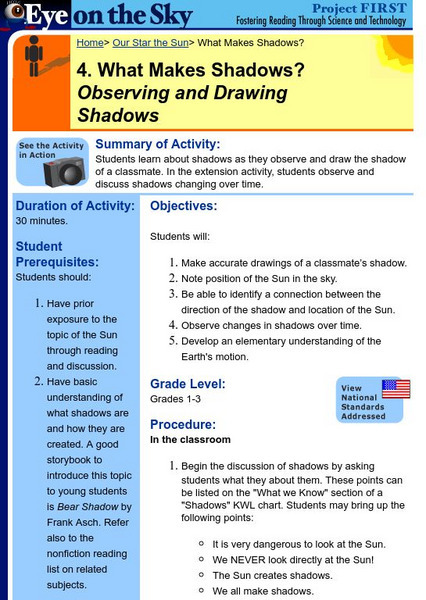
Center for Science Education: Eye on the Sky: What Makes Shadows?
Students will enjoy these activities where they draw shadows, and observe the sun's placement and how its position impacts on the size of a shadow.
Exploratorium
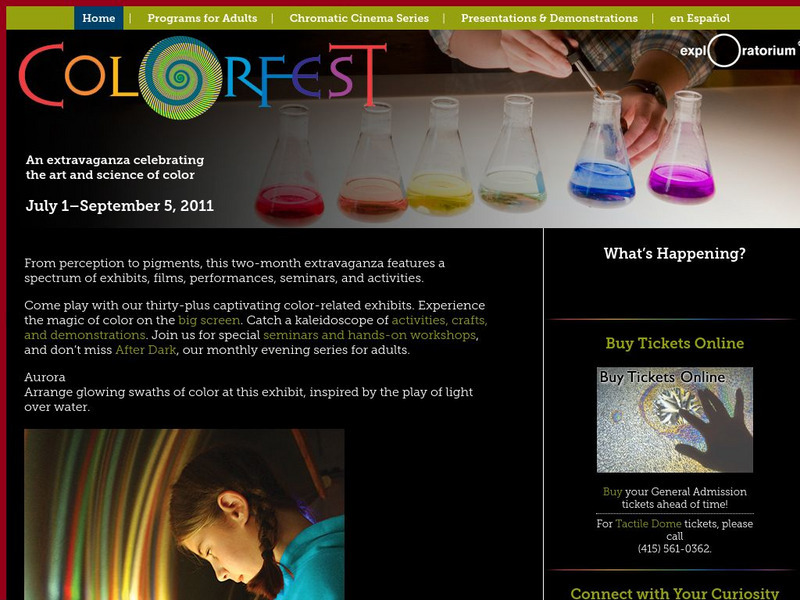
Exploratorium: The Art and Science of Color
This series of programs includes hand-tinted archival films, contemporary offerings by local artists, and films created by artists drawing and painting on the film surface itself. Featuring animated, documentary, and homemade works.

Other
Ohio Resource Center: Shadows
This applet helps students visualize the shapes of shadows cast by a cube with a light coming from different angles. This helps students visualize shapes from different angles and to identify, sketch and classify the cross-sections of...
Encyclopedia Britannica
Encyclopedia Britannica: Kara Walker
Biographical information on Kara walker, an American installation artist who used intricate cut-paper silhouettes, together with collage, drawing, painting, performance, film, video, shadow puppetry, light projection, and animation, to...