Hi, what do you want to do?






Columbus City Schools
Moon Phase Mania
Now you see it, now you don't. Our moon seems to pull a disappearing act from time to time—but why? Take your seventh grade scientists above and beyond to discover the truth about the moon and the role it plays in Earth's little...

Columbus City Schools
Totally Tides
Surf's up, big kahunas! How do surfers know when the big waves will appear? They use science! Over the course of five days, dive in to the inner workings of tidal waves and learn to predict sea levels with the moon as your guide.

Columbus City Schools
Experiencing Eclipses
Don't be caught in the dark! Young scientists investigate the causes of both solar and lunar eclipses using an interactive to help them understand the development of an eclipse over time. They then research facts and characteristics...

Curated OER
Spinning into Space
Students, through hands-on activities, teacher demonstrations, pictures, and informational books, complete a unit on the Earth and its place in the Universe. They make mobiles of the Milky Way and watch demonstrations of lunar and solar...

Curated OER
Astronomy
Students complete a unit of lessons on our solar system, its stars, and astronomers. They record information in a space journal, design constellations, define key vocabulary, observe the phases of the moon, and create a group planet...

Curated OER
Our Solar System
Students study the Earth and Solar System through a variety of activities. They compile a coloring book show the characteristics of the Sun and nine planets.

NASA
Collecting Electromagnetic Radiation
Astronomy is literally over your head, but this lesson will explain how we study it. Young scientists make telescopes, calculate and compare the light gathering power of lenses, and simulate detection of infared radiation....

Curated OER
Our Universe: Always Moving, Always Changing
Students explore the main concepts of astronomy through the eleven lessons of this unit. The past, present, and future methods of studying the science are examined in this unit.

Curated OER
The Motions of the Oceans
Students examine the topics of ocean waves, currents, and tides. They locate and label ocean currents on a world map, conduct experiments, analyze key vocabulary, view demonstrations and record the data, and complete handouts.
E-learning for Kids
E Learning for Kids: Egypt: How Do the Sun, Moon and Earth Revolve Around Each Other?
Omar helps his parents sell things at the market. Join him while he learns about the relationship of the Sun, Moon, and Earth.
E-learning for Kids
E Learning for Kids: Science: Center of the Ocean: The Sun, the Earth, and the Moon
Nita lives on Coco Island in the Indian Ocean, and is learning more about the Sun, the Earth, and the Moon. Join her and learn about day and night.

CK-12 Foundation
Ck 12: Earth Science: Tides
[Free Registration/Login may be required to access all resource tools.] Reveals tidal patterns and that tides are caused by the gravitational attraction of the Sun and Moon to Earth.

CK-12 Foundation
Ck 12: Fifth Grade Science: Earth Science: The Sun Earth Moon System
[Free Registration/Login may be required to access all resource tools.] Discusses solar and lunar eclipses, the phases of the Moon, and why the phases occur.
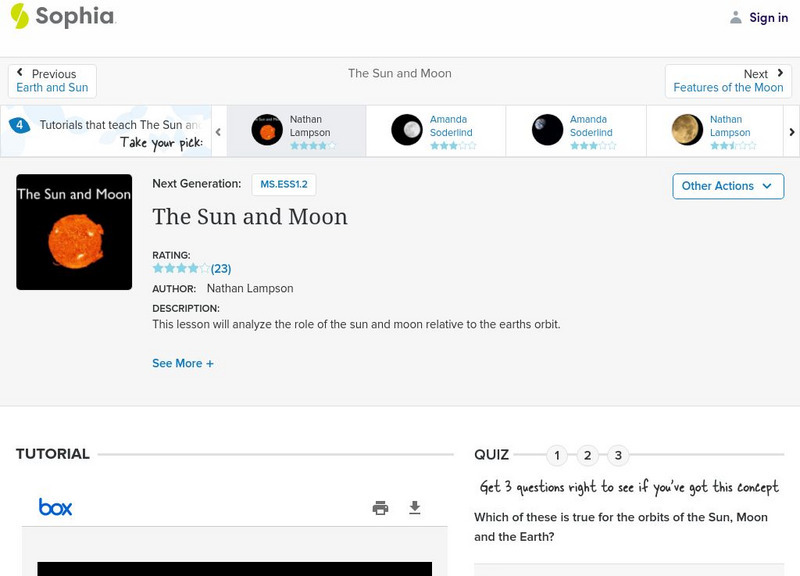
Sophia Learning
Sophia: The Sun and Moon
An expertly illustrated presentation which highlights the sun and moon, and their relationship to the Earth.
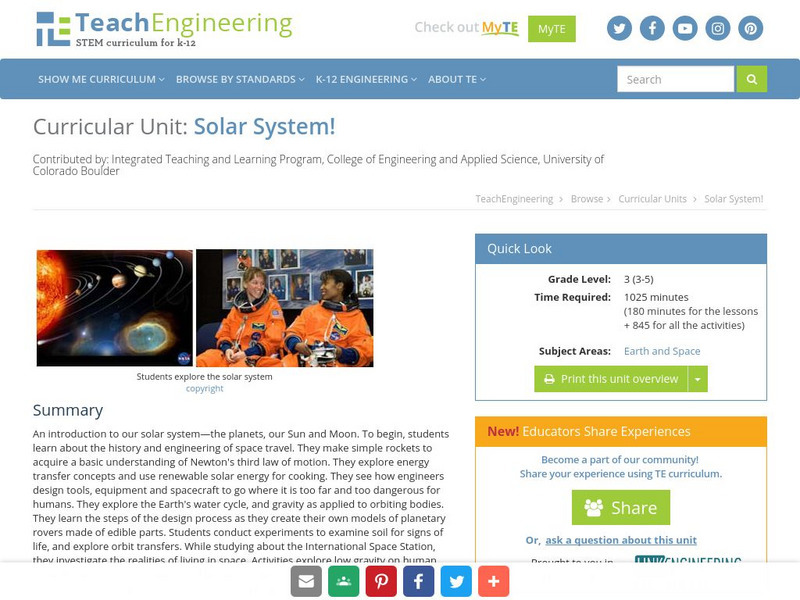
TeachEngineering
Teach Engineering: Solar System!
An introduction to our solar system: the planets, our Sun and our Moon. Students begin by learning the history and engineering of space travel. They make simple rockets to acquire a basic understanding Newton's third law of motion. They...
TED Talks
Ted: Ted Ed: A Rare, Spectacular Total Eclipse of the Sun
Andy Cohen details the extraordinary celestial phenomenon of a total solar eclipse, and when it will next occur. [3:47]
Sophia Learning
Sophia: The Sun and Moon: Lesson 3
This lesson will analyze the role of the sun and moon relative to the earth's orbit. It is 3 of 4 in the series titled "The Sun and Moon."
Sophia Learning
Sophia: The Sun and Moon: Lesson 4
This lesson will analyze the role of the sun and moon relative to the earth's orbit. It is 4 of 4 in the series titled "The Sun and Moon."
Ministerio de Educación (Spain)
Observaciones Y Modelos en Astronomia
How does the length of the day change? How does the height of the sun change? Do we always see the same star? The answer to these questions and different observations about the sun, the moon and the stars that we can do from earth can be...
NASA
Nasa: Solar System Exploration
Enter our solar system to interact with the planets, moons, asteroids, meteors, and more. Investigate with NASA scientists and explore missions related to space exploration. Read facts, compare statistics, look through resources, and...
NASA
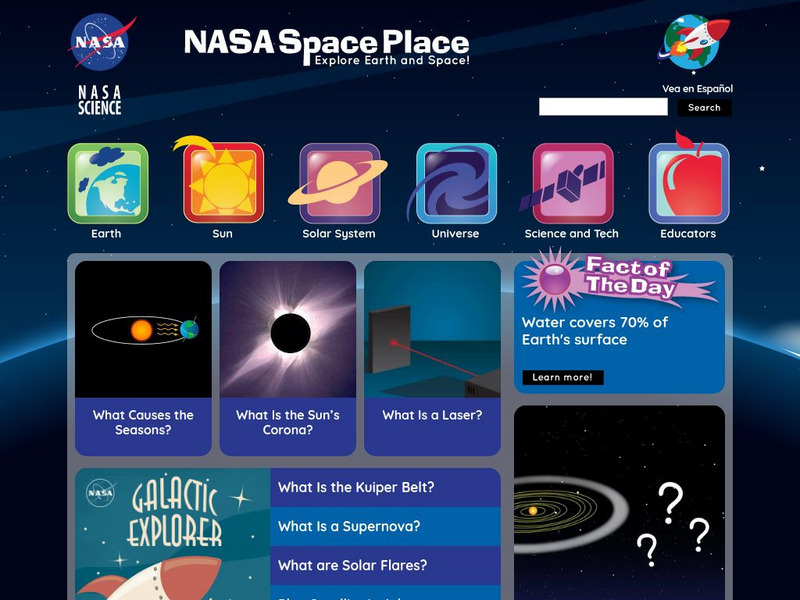
Nasa: The Space Place
This site from NASA's Space Place is geared towards early elementary learners. It offers detailed instructions for crafts and activities related to space, games and a teacher resource area. Students can also ask an expert at this site.
NC State University
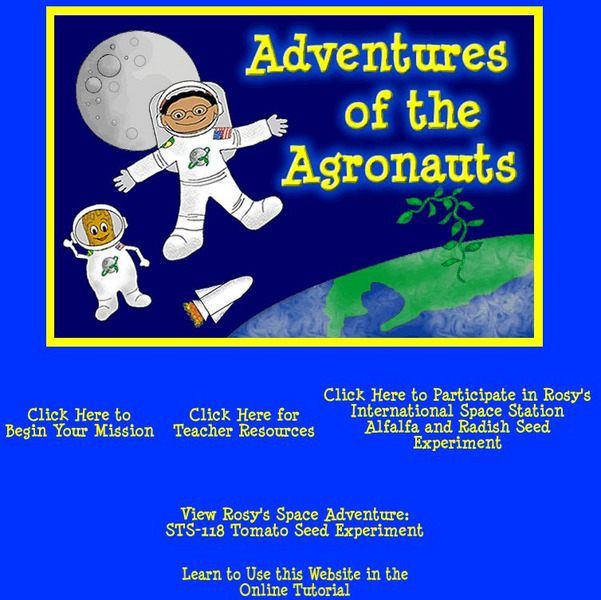
Ncsu.edu: Adventures of the Agronauts
This site is an online science curriculum on how to grow plants on the Moon. There are six lessons that have a glossary also included. There are movies that demonstrate concepts, and teacher resources. The sites topics cover, the Earth,...
CK-12 Foundation
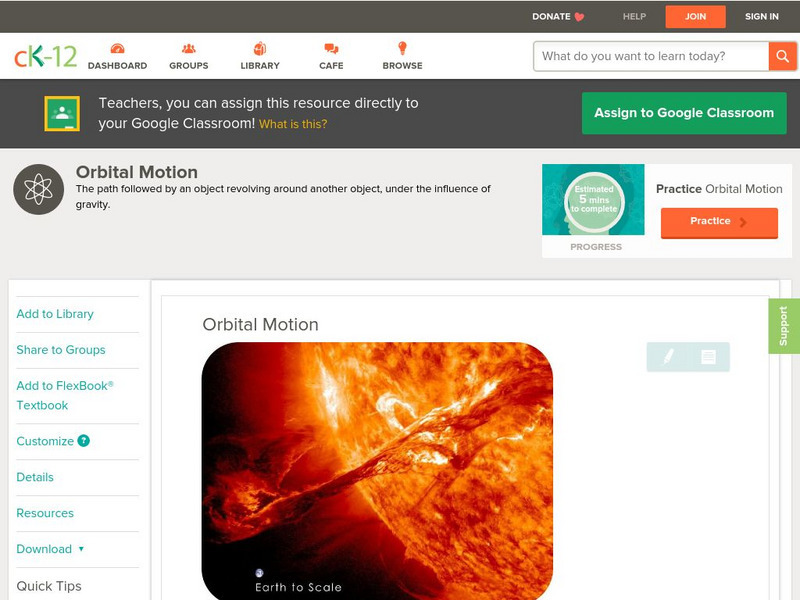
Ck 12: Physical Science: Orbital Motion
[Free Registration/Login may be required to access all resource tools.] Orbital motion and why it occurs, and the orbits of the Earth around the sun and the moon around the Earth.
Ministerio de Educación (Spain)
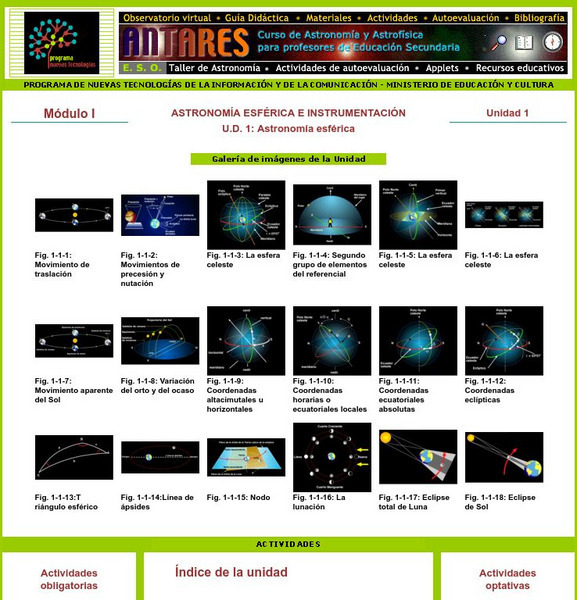
Ministerio De Educacion: Atronomia Esferica Modulo I Unidad 1
Recognize the major constellations and learn about the sky during the different seasons of the year. You will also be able to measure the height of the mountains of the moon.
Other popular searches
- Earth Sun and Moon
- Earth, Sun and Moon
- Sun, Earth and Moon
- Moon Earth and Sun Rotations
- Moon, Sun and Earth
- Earth, Sun, and Moon