Hi, what do you want to do?






McGraw Hill
Orbital Velocity Interactive
Why does it take Pluto 90,000 days to orbit the sun, but it only takes Mercury 88 days? An interactive lesson helps pupils find a connection between the speed of orbit and distance a planet is from the sun. The simulation allows for...

PHET
Gravity And Orbits
Have you ever wanted to turn off gravity? This simulation allows learners to do just that in addition to altering other variables. Scholars can move the sun, Earth, moon, and space station to see how distance affects gravitational pull....

Laboratory for Atmospheric and Space Physics
Orbit Simulator
Researchers think they have evidence of a new planet deep in our solar system that is the size of Neptune and orbits the sun far beyond Pluto. The orbit simulator shows the orbits of our well-known planets, as well as Pluto and the comet...

Scholastic
Study Jams! Seasons
Use this during the season of teaching about the seasons! As Earth revolves around the sun, its tilt causes the weather to change. The graphics in this presentation show how Earth's position in space has an effect on the angle of...

CK-12 Foundation
Revolutions of Earth: Planet Cube
Does assessing Earth Science vocabulary making your head spin? Test scholars' knowledge of revolving and rotating using an interactive tool. The movement of a new planet and its moon is in their hands, allowing them to explore...

Scholastic
Study Jams! A Day on Earth
It's good thing that it isn't up to RJ to spin the earth on its axis; he can't even keep a basketball spinning! In this video animation, he and viewers learn about Earth's movements in space. One thing to consider before you use this...

American Museum of Natural History
What Do You Know About the Universe?
The universe is full of a mystic matter people cannot see. Pupils respond to 10 questions about the stuff in the universe. Most of the questions involve the big bang theory and dark matter. Learners find out how astronomers have found...

PBS
Why Do We Have Seasons?
Explore the reason for the seasons! An interactive lesson allows learners to explore the earth's rotation from the viewpoint of four cities at different latitudes. It provides descriptive information at eight points during the orbit...

PBS
Why Isn't There an Eclipse Every Month?
Searching for an eclipse activity that sends scholars over the moon? Try an interesting interactive to get their minds active! The resource, part of an extensive Space series from PBS Learning Media, uses modeling and data analysis to...

American Museum of Natural History
What is Astronomy?
Go study the universe. Pupils learn seven aspects about astronomy and astronomers. They begin to learn about constellations; distance and motion between objects; gravity; the electromagnetic spectrum; dark matter and energy; and teams of...

Curated OER
Student Exploration: Phases of the Moon
In this moon phase worksheet, learners complete 2 prior knowledge questions, then use the "Phase of the Moon Gizmo" to complete several activities, answering short answer questions when finished.

Curated OER
Student Exploration: Summer and Winter
In this recognizing the seasons online/interactive worksheet, students explore the Earth's positions and determine the summer and winter season. Students answer 21 short answer questions

Curated OER
Scientific Revolution
In this online interactive world history worksheet, high schoolers answer 20 matching questions regarding the Scientific Revolution. Students may submit their answers to be scored.

My Schoolhouse
Global Warming or Climate Change?
In this online interactive global warming and climate change worksheet, students respond to 10 multiple choice questions regarding the information included in the provided paragraphs.

Curated OER
Global Warming or Climate Change?
In this online interactive global warming and climate change worksheet, students respond to 10 multiple choice questions regarding the information included in the provided paragraphs.

Curated OER
A Mission-To-Mars Quiz
In this space exploration worksheet, students complete a 6 question multiple choice on-line interactive exercise about the exploration of Mars.

Curated OER
Student Exploration: 2D Eclipse
In this earthquake exploration worksheet, students complete 2 prior knowledge questions, then use "2D Eclipse Gizmo" to conduct several activities, completing short answer questions when finished.

Curated OER
Explorit's Astronomy 2. Quiz
In this astronomy worksheet, students complete a five question multiple choice on-line interactive quiz about astronomy. Prior knowledge is assumed.

Curated OER
Ocean Currents Quiz
In this ocean worksheet, students complete a 13 question multiple choice on-line interactive quiz about ocean currents. Prior knowledge is assumed.
University of Colorado
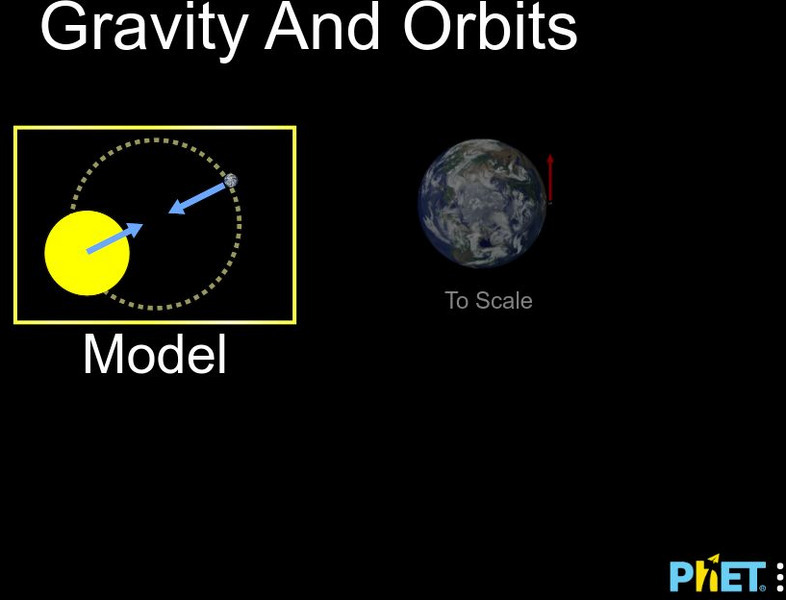
University of Colorado: Ph Et Interactive Simulations: Gravity and Orbits
Move the sun, earth, moon, and space station to see how it affects their gravitational forces and orbital paths. Visualize the sizes and distances between different heavenly bodies, and turn off gravity to see what would happen without it.

BBC
Bbc Schools: Ks2 Bitesize: Science: Physical Processes: Earth, Sun, and Moon
Help Sarah Jane and her team put the solar system's planets back in order. Following the activity, read more about the sun, the Earth, and its moon, and then take a quick quiz to check for understanding.

PBS
Pbs Learning Media: Earth in Motion: Seasons
This interactive activity from the Adler Planetarium explains the "reasons for the seasons." Featured is a game in which Earth must be properly placed in its orbit in order to send Max, the host, to different parts of the world during...
American Association of Physics Teachers
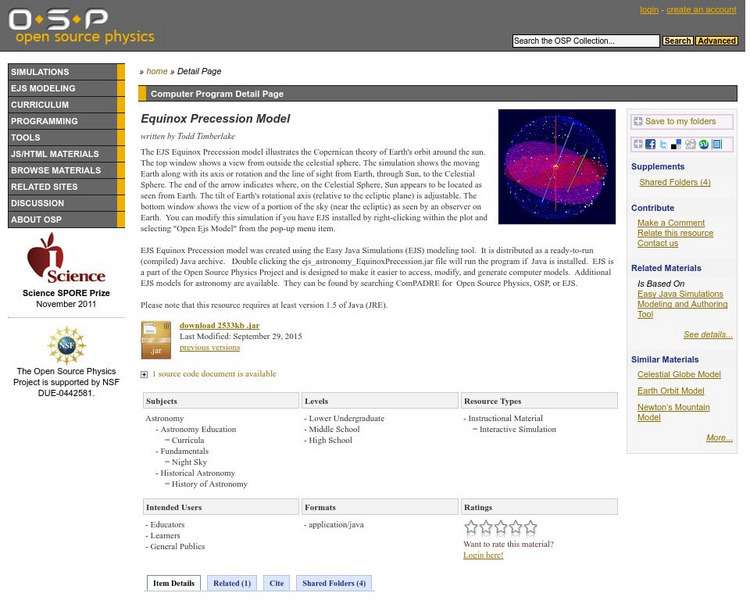
Com Padre Digital Library: Open Source Physics: Equinox Precession Model
Experience a science simulation illustrating the Copernican theory of Earth's orbit around the sun.
Harvard University
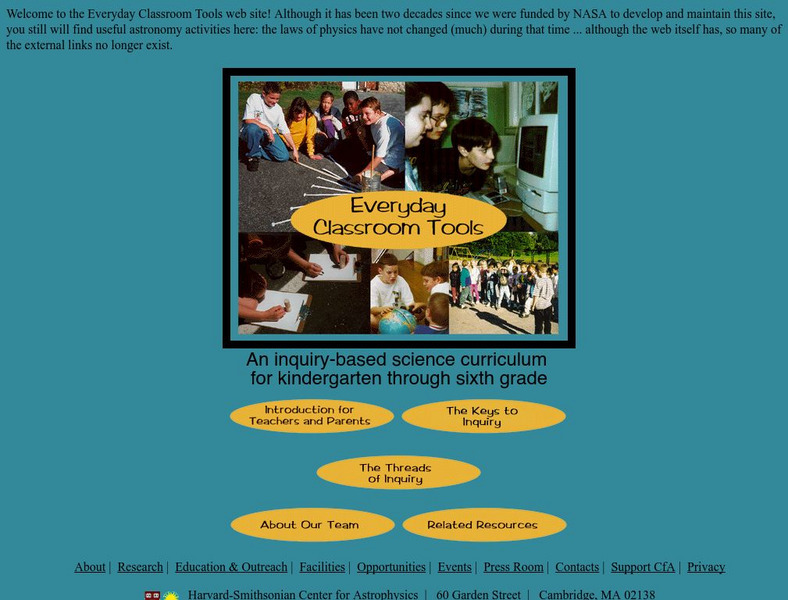
Harvard Smithsonian: Everyday Classroom Tools
The focus of this series of lessons is to engage students in an exploration of the world around them. The emphasis is on inquiry as students learn about the earth, sun, light, shapes and more.