Hi, what do you want to do?






Curated OER
Motion Through the Ages
Eighth graders conduct internet research to produce a timeline of man's growth in understanding of concepts of motion and planetary motion through history.

Curated OER
Conceived in Light
Students write a piece of free-verse poetry that incorporates or focuses on an idea about light. They brainstorm twenty phrases about light as a pre-writing activity.

Curated OER
The Nobel Prize
Students investigate the Nobel Prize winners for 2001. They complete a Webquest, explore various websites, watch a video, answer discussion questions, and identify and read newspaper articles about Nobel Prize categories.

Curated OER
WWII and the Atomic Bomb
Young scholars explore three decisions about the atomic bomb faced by the U.S. during WWII, take a position on each of the decisions, and defend their position. Should a bomb have been built, dropped, and was the right decision made?

Curated OER
Quantum Mechanics and Atomic Physics
Students will discuss the de Brogile Hypothesis and state the circumstances under which the wave nature of matter is observed. They will also calculate the wavelengths of matter waves.

Curated OER
Shakespeare
High schoolers read specific acts of Shakepeare's King Lear. Using the text, they identify the beginning stages of Lear's insanity and the causes of his instability. They examine the relationship between King Lear and Poor Tom and...

Curated OER
Scientific Images & Animations
Students view a variety of scientific images and animations. They explore the world of science and visual art. Students enrich their knowledge through animation examinations of thoughts and feelings and awesome color rainbows of...

Curated OER
Boundaries
Pupils identify and analyze the boundaries which exist between urban and rural, wildness and country and among rural areas, country, town, and city. Students actively participate in planning, obtaining materials, setting goals and...

Curated OER
Ideas and Commodities Cross Cultural Regions
Students compare and contrast how commodities native to certain countries have impacted the economies of other nations. After gathering information regarding how commodities are grown and traded, students use their information to...

Curated OER
Photosynthetically Available Radiation (PAR) Measurements Part 1: Calculating the Solar Constant using a TI-8
Twelfth graders are introduced to the term Photosynthetically Available Radiation. In groups, they participate in an experiment to determine how ecosystems survive the conditions in the Arctic. They calculate the amount of solar energy...

Curated OER
Hyperbolas
Students analyze given hyperbolas and write the equation for an hyperbola given certain information. They also identify and define hyperbolas and complete an activity using the hyperbola paper included in the lesson which will help them...

Curated OER
Interest Survey
In this science and social studies worksheet, students complete a survey about their interests. Students check each subject that they are interested in, such as killer whales, Thomas Edison, and magnets.

Curated OER
Creative Activities for the Sciences
Young scholars expand their creative outlets. For this science lesson, three ideas, including videos, are presented to help get students motivated to think creatively and express themselves.

Curated OER
Black Holes: The Ultimate Abyss
Students compare and contrast the characteristics of the three different types of black holes. In this space science lesson plan, students research black hole's lifetime, location and evidence of existence. They present their findings to...

Curated OER
Study of Gravity Scientists
Eighth graders research scientists that have made major contributions to the study of gravity and create a timeline of these scientists and events.

PBS
Pbs Learning Media: Think Like Einstein
This interactive activity from the NOVA Web site challenges you to think like Einstein and understand how time travel might be possible.
Other
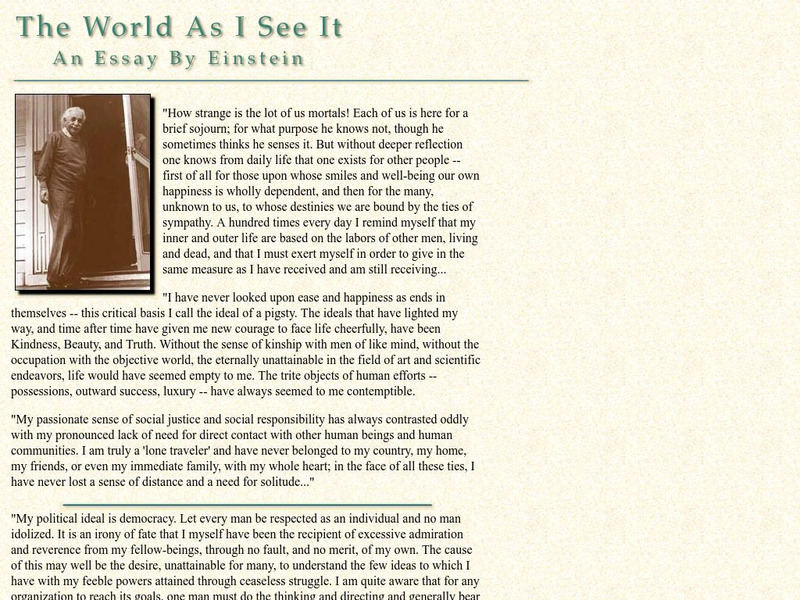
Image and Impact: An Essay by Einstein: The World as I See It
Einstein's ideals are presented in his own words. Presents a philosophical essay about his core values.
PBS
Pbs Learning Media: Einstein: A Timeline of His Life
This illustrated timeline from the NOVA Web site follows Albert Einstein's life, including 1905, his "Miracle Year," during which he developed his Special Theory of Relativity and the equation, E=mc2.
Other
Aip: Einstein Image and Impact
A major exhibition that presents nine sections of in-depth information on aspects of Einstein's life.
PBS
Pbs Learning Media: Einstein: How Smart Was He?
This essay from the NOVA Web site explores the impact Einstein made on physics and most everything we know about the cosmos.
American Museum of Natural History
American Museum of Natural History: Einstein
This resource is a companion site of a retrospective exhibition held at the American Museum of Natural History in 2002-03, Einstein covers the life and scientific theories of this revolutionary scientist. Includes numerous primary source...
Other
Einstein Archives Online
This database holds thousands of Einstein's manuscripts, writings and personal correspondence. Many of these are original copies, others are reproduced English or German versions.
American Museum of Natural History
American Museum of Natural History: O Logy: Way to Go, Einstein!
The Way to Go, Enstein, OLogy site is a place for learning about Einstein--his career, his ideas, how he thought about problems, and his contributions to science. Explore, ask questions, find information, and meet American Museum of...
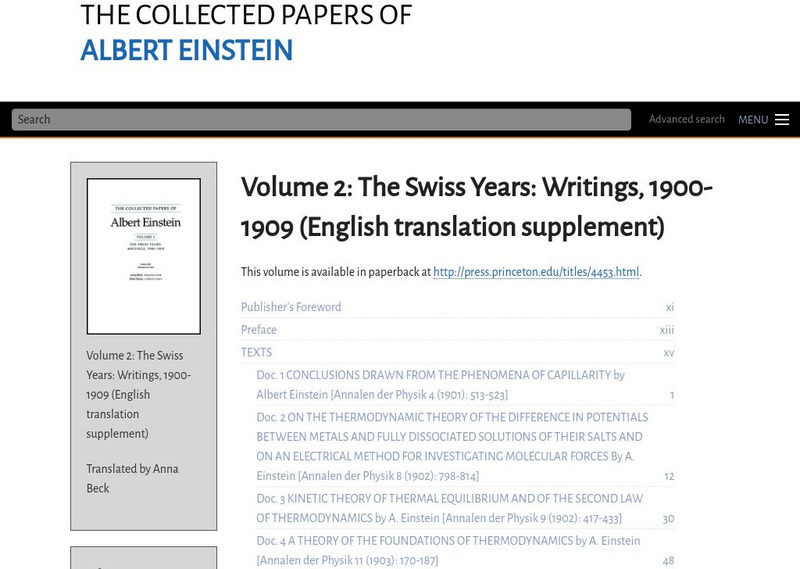
Princeton University
The Collected Papers of Einstein: Volume 2: Swiss Years: Writings, 1900 1909 Eng
A publication of Albert Einstein's written legacy presented in the English language translation. This translation volume focuses on his life and work in Switzerland.
Other popular searches
- Einstein, Albert
- Albert Einstein
- Einstein Relativity
- Einstein Science
- Einstein Speed of Light
- Einstein Space Time
- Newton Einstein
- The Next Einstein
- Math Lesson Albert Einstein
- Einstein, Albert Inspiration
- Einstein Thought Experiments
- Albert Einstein Facts