Hi, what do you want to do?






Bozeman Science
Mass and Energy
In this video Paul Andersen explains how mass can be converted to energy and energy can be converted to mass. The equation E=mc2 can be used to determine the amount of energy released from nuclear processes.
Professor Dave Explains
Special Relativity Part 4: Mass-Energy Equivalence or E = mc^2
Everyone and their mom knows about E = mc^2, it's the most famous equation in science, and there are plenty of posters you can buy for your dorm room with Einstein's face and this equation floating mysteriously around his head. But what...
FuseSchool
Nuclear Fission
Nuclear Fission In a nuclear reactor the controlled slow release of energy is used to heat up a closed loop of coolant which passes to heat exchangers which then boil water to provide steam to turn electrical generators. The output of...
Curated Video
How Nuclear Bombs Work: Atomic vs. Hydrogen Bombs Explained
Hydrogen bomb how does it work? The bomb on Hiroshima released the energy equivalent of 15,000 tons of TNT. The first hydrogen bomb released the energy equivalent of 10,000,000 tons of TNT.
While...
While...
Curated Video
Quantum Chromodynamics (QCD): Visualizing the Strongest Force
QCD: Quantum Chromodynamics. How can positive protons be so close together in the nucleus, if they repel each other? Japanese physicist and Nobel laureate Hideki Yukawa sought to answer this question. He proposed...
MinutePhysics
The Unreasonable Efficiency of Black Holes
This video is about how efficient various reactions are at converting mass to energy (as we know from the Einstein mass-energy equivalence of E=mc^2). Antimatter is very efficient but it is not...
Curated Video
5 Math Equations that Could End Human Civilization
Certain mathematical equations contain unnerving dangers, Arguably, E=mc^2 is the most famous equation in science. C is a very large number. But in Einstein’s, equation it is squared. This means that mass contains an insane...

Clarendon Learning
Albert Einstein for Kids | Lean all about Einsteins life and his major discoveries
In this video about Albert Einstein for Kids we learn about one of the most famous scientists in history. Albert Einstein contributed to many scientific areas but one of his most important contribution to the world of physics and science...
Curated Video
String Theory Simplified: Could It Explain Our Existence?
What is string theory? When string theory is simplified - it can answer the question "Why do we exist?" First you must accept that there are two worlds we live in - the world of the large, the world we can see, which...
Curated Video
Exploring the Role of Light in the Universe
What is the purpose of light? How does light work? Why does Light exist? There had been a controversy about whether light was particles or waves. Albert Einstein showed that light must come in discrete packets of...
Curated Video
How Fundamental Constants Define the Limits of Physics: The Planck Scale
How the Planck scale is derived from the most important fundamental constants in physics. This is where our physics ends. If you wanted to simulate the universe in a computer, you would need to enter...
Curated Video
Is a Final Theory of Everything Possible? Exploring Scientific Progress
Is a theory of everything really possible? What makes us think it even exists? If we look at historical precedent, we can see that we have united seemingly completely unrelated forces and particles to a...

Veritasium
The Invention of Nuclear Weapons
Neutrons have approximately the same mass as a proton, but contain no charge. Something so seemingly insignificant changed the world thanks to nuclear weapons, nuclear energy, and nuclear radiation. Viewers learn more about the invention...

Crash Course
Nuclear Physics: Crash Course Physics #45
E=mc^2 is an important equation in the physics world. Help your classes understand its significance with a helpful video lesson. An episode of the Crash Course physics series offers an overview of nuclear physics and an explanation of...

Veritasium
Where Does The Sun Get Its Energy?
How does the sun give us light and heat? Discover what's really going on inside the centerpiece of our solar system in a brief video. The content includes common misconceptions about the sun's source of energy, how the simple elements...
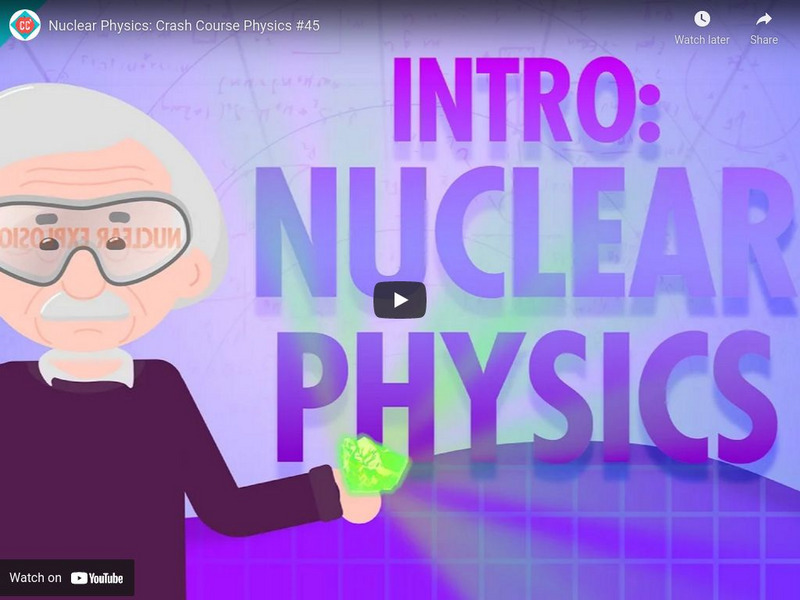
Crash Course
Crash Course Physics #45: Nuclear Physics
It's time for our second to final Physics episode. So, let's talk Einstein and Nuclear Physics. What does E=MC2 actually mean? Why is it so useful to us as physicists and humans? In this video episode of Crash Course Physics, Shini sits...

Other
Rhyme Learn: E=mc2 Rap
Have you ever wanted to learn more about Einstein's E=MC2? This rap song explains it all! [3:52]