Hi, what do you want to do?





National High Magnetic Field Laboratory
Magnet Academy: Sin Itiro Tomonaga
Japanese theoretical physicist Sin-Itiro Tomonaga resolved key problems with the theory of quantum electrodynamics (QED) developed by Paul Dirac in the late 1920s through the use of a mathematical technique he referred to as...

National High Magnetic Field Laboratory
Magnet Academy: Jean Charles Athanase Peltier (1785 1845)
Although he didn't start studying physics until he retired from the clock-making business at age 30, French native Jean Peltier made immense contributions to science that still reverberate today. Even with the primitive tools available...
National High Magnetic Field Laboratory
Magnet Academy: Charles Augustin De Coulomb
Charles-Augustin de Coulomb invented a device, dubbed the torsion balance, that allowed him to measure very small charges and experimentally estimate the force of attraction or repulsion between two charged bodies. The data he obtained...
National High Magnetic Field Laboratory
Magnet Academy: Faraday's Ice Pail
Out of a humble ice pail the great experimentalist Michael Faraday created a device to demonstrate key principles of attraction, repulsion and electrostatic induction. (Java tutorial)
National High Magnetic Field Laboratory
Magnet Academy: Oscillator
Oscillators are a type of circuit found in many types of electronic equipment, including clocks, radios and computers. (Java tutorial)
National High Magnetic Field Laboratory
Magnet Academy: Torsion Balance
Experiment with the torsion balance and see what happens first by giving the rod a charge, and then by moving the charged rod closer to the outer metal sphere of the instrument. Observe what happens to the needle as the charge increases.
National High Magnetic Field Laboratory
Magnet Academy: Oil Drop
It may look like a simple black blob, but an oil drop is in fact a phenomenally complex mix of immense molecules called hydrocarbons. Using a type of mass spectrometry called FT-ICR, scientists can analyze oil and other macromolecules...
National High Magnetic Field Laboratory
Magnet Academy: Steam Condensing Engine 1769
Few inventions have affected human history as much as the steam engine. Without it, there would have been no locomotives, no steamers and no Industrial Revolution.
National High Magnetic Field Laboratory
Magnet Academy: Paul Dirac
Paul Adrien Maurice Dirac was an outstanding twentieth century theoretical physicist whose work was fundamental to the development of quantum mechanics and quantum electrodynamics. He was awarded the Nobel Prize for Physics jointly with...
National High Magnetic Field Laboratory
Magnet Academy: Lee De Forest
American inventor Lee De Forest was a pioneer of radio and motion pictures. He received more than 300 patents over the course of his lifetime, the most important of which was for a three-electrode vacuum tube, or triode, that he called...
National High Magnetic Field Laboratory
Magnet Academy: Leon Cooper
Leon Cooper shared the 1972 Nobel Prize in Physics with John Bardeen and Robert Schrieffer, with whom he developed the first widely accepted theory of superconductivity. Termed the BCS theory, it is heavily based on a phenomenon known as...
National High Magnetic Field Laboratory
Magnet Academy: James Clerk Maxwell
James Clerk Maxwell was one of the most influential scientists of the nineteenth century. His theoretical work on electromagnetism and light largely determined the direction that physics would take in the early twentieth century. Indeed,...
National High Magnetic Field Laboratory
Magnet Academy: Theodore Maiman
Theodore Maiman built the world's first operable laser. Ironically, Maiman's first paper announcing this momentous achievement, which many other scientists had been racing to complete themselves, was rejected. Since then, however, lasers...
National High Magnetic Field Laboratory
Magnet Academy: Heinrich Rohrer
Swiss physicist Heinrich Rohrer co-invented the scanning tunneling microscope (STM), a non-optical instrument that allows the observation of individual atoms in three dimensions, with Gerd Binnig. The achievement garnered the pair half...
National High Magnetic Field Laboratory
Magnet Academy: Eric Cornell
Born in Palo Alto, California, and raised in Cambridge, Massachusetts - homes to Stanford and the Massachusetts Institute of Technology, respectively - you could say Eric Cornell was destined to become a renowned scientist. And while he...
National High Magnetic Field Laboratory
Magnet Academy: Heinrich Hertz
The discovery of radio waves, which was widely seen as confirmation of James Clerk Maxwell's electromagnetic theory and paved the way for numerous advances in communication technology, was made by German physicist Heinrich Hertz. In the...
National High Magnetic Field Laboratory
Magnet Academy: John Ambrose Fleming
John Ambrose Fleming was an electronics pioneer who invented the oscillation valve, or vacuum tube, a device that would help make radios, televisions, telephones and even early electronic computers possible. A brilliant innovator,...
National High Magnetic Field Laboratory
Magnet Academy: Enrico Fermi
Enrico Fermi was a titan of twentieth-century physics. He outlined the statistical laws that govern the behavior of particles that abide by the Pauli exclusion principle and developed a theoretical model of the atom in his mid-twenties....
National High Magnetic Field Laboratory
Magnet Academy: Siegmund Loewe
Siegmund Loewe was a German engineer and businessman that developed vacuum tube forerunners of the modern integrated circuit. He pioneered both radio and television broadcasting, and the company he established with his brother, David...
Massachusetts Institute of Technology
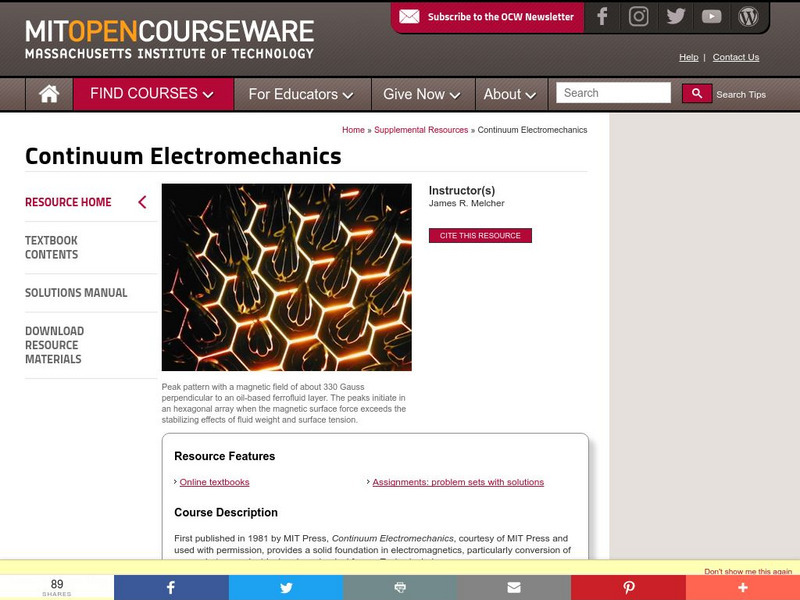
Mit: Open Course Ware: Supplemental Resources: Continuum Electromechanics
College-level electrical engineering and computer science textbook highlighting the applications of continuum electromechanics.
National High Magnetic Field Laboratory
Magnet Academy: Crookes Tube 1870
English chemist Sir William Crookes (1832 - 1919) invented the Crookes tube to study gases, which fascinated him. His work also paved the way for the revolutionary discovery of the electron and the invention of X-ray machines.
National High Magnetic Field Laboratory
Magnet Academy: John Daniel Kraus
For a man whose career involved the entire known universe, John Kraus had a remarkably insular upbringing. He was born and raised in Ann Arbor, Michigan, and earned his bachelor's, master's and doctoral degrees in physics, all at the...

National High Magnetic Field Laboratory
Magnet Academy: Inductive Reactance
Like resistance, reactance slows an electrical current down. Explained by Lenz's Law, this phenomenon occurs only in AC circuits. (Java tutorial)
National High Magnetic Field Laboratory
Magnet Academy: John Bardeen
John Bardeen was one of a handful of individuals awarded the Nobel Prize twice and the first scientist to win dual awards in physics. Both times, he shared the prize with others. The first time his co-recipients were Walter Brattain and...