Hi, what do you want to do?






Tennessee Valley Authority
Renewable Energy Sources
Not all energy sources are renewable, as learners investigate in this unit. Made up of six lessons that span a few weeks of instruction, the unit has learners examining US energy reserves and consumption, using data to draw conclusions...

University of Minnesota
C. elegans and the Search for Extraterrestrial Life
Introduce the topic of astrobiology in a unit that's out of this world. Biology scholars examine the search for extraterrestrial life by culturing roundworms, a species that has been key in helping researchers understand the...

Columbus City Schools
Photosynthesis and Respiration
Thirty percent of the world's oxygen is produced by rainforests found throughout the world. Seventh grade learners explore the processes of photosynthesis and respiration through 10 days of labs, manipulatives, and discussions. They...

NASA
The Electromagnetic Spectrum
Did you realize the visible light spectrum is less than three percent of the electromagnetic spectrum? A hands-onlesson includes five activities and experiments for scholars to explore and discover many advanced science concepts. They...
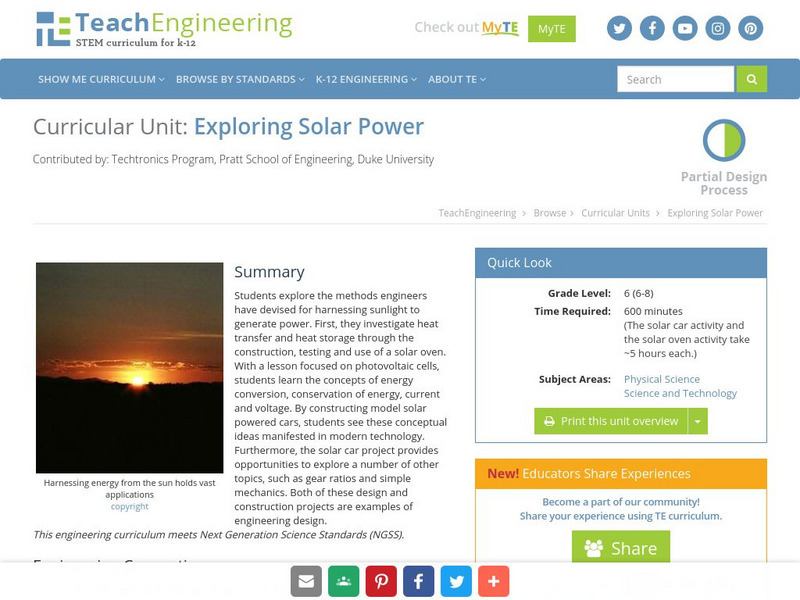
TeachEngineering
Teach Engineering: Exploring Solar Power
This unit provides students the opportunity to explore methods engineers have devised for harnessing sunlight to generate power. Students will initially explore heat transfer and heat storage through the construction, testing, and...

CPALMS
Florida State University Cpalms: Florida Students: Energy and Carbon in Photosynthesis and Cellular Respiration
A tutorial that looks at the connection between photosynthesis and cellular respiration.
CK-12 Foundation
Ck 12: Life Science: Producers
[Free Registration/Login may be required to access all resource tools.] Energy is the ability to do work. In organisms, this can be physical work, like walking or jumping, or it can be the work used to carry out the chemical processes in...
BBC
Bbc: Gcse Bitesize: What Happens During Cellular Respiration? Ocr 21 C
This lesson focuses on what happens during cellular respiration including how energy is released as APT and why organisms need energy in that form. A link to a test is provided.

CPALMS
Cpalms: Energy and Cellular Respiration
Learn how food is broken down to produce energy for cells in the in the form of ATP in this interactive tutorial.

Open Ed
Open Ed Sci: 8.1 Contact Forces
In this unit, students explore a variety of phenomena to figure out, "Why do things sometimes get damaged when they hit each other?" Student questions about the factors that result in a shattered cell phone screen lead them to...

TED Talks
Ted: Ted Ed: Oxygen's Surprisingly Complex Journey Through Your Body
In the body, oxygen forms a vital role in the production of energy in most cells. Enda Butler tracks the surprisingly complex journey of oxygen through your body.
PBS
Pbs: How Do Solar Panels Work?
We've seen them for years on rooftops, atop highway warning signs, and elsewhere, but how many of us know how solar panels actually work? How do the photovoltaic cells that lie at the heart of them turn sunlight ("photo") into...
CK-12 Foundation
Ck 12: Earth Science: Effect of Atmospheric Circulation on Climate
[Free Registration/Login may be required to access all resource tools.] Looks at how atmospheric circulation cells affect the climate of regions.
CK-12 Foundation
Ck 12: Physical Science: Biochemical Reaction Chemistry
[Free Registration/Login may be required to access all resource tools.] Definition of a biochemical reaction, the different types and the importance of enzymes in biochemical reactions.
Sophia Learning
Sophia: Passive Transport: Lesson 2
This lesson introduces the process of passive transport, explaining that it is a form of transport that does not require energy, and moves molecules down their concentration gradient. It is 2 of 4 in the series titled "Passive Transport."
Sophia Learning
Sophia: Passive Transport: Lesson 3
This lesson introduces the process of passive transport, explaining that it is a form of transport that does not require energy, and moves molecules down their concentration gradient. It is 3 of 4 in the series titled "Passive Transport."