Hi, what do you want to do?





University of Arizona
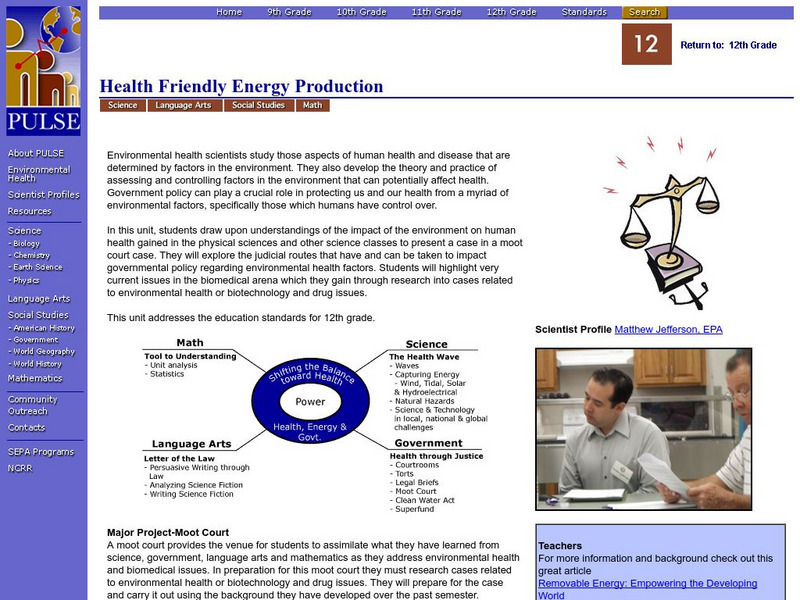
Pulse: Health Friendly Energy Production
A cross curricular project where students conduct a moot court to explore the role government policy plays in protecting our health. The focus of the unit is how our power effects our environmental health. Students use their knowledge of...

National Geographic
National Geographic: The Right Balance: Mixing Energy Resources
In this lesson, students look at profiles of energy production for different regions of the United States. They examine the conversion efficiency and the carbon dioxide emissions of each type of energy, and then the environmental impact...

US Department of Energy
Doe: Fossil Energy: Education Start Page
Overview of the fossil energy industry (oil, gas, coal) with detailed descriptions of the processes and the work of the people employed in the industry.
University of Michigan
University of Michigan: Global Change: The Flow of Energy: Higher Trophic Levels
This lesson addresses the following questions: What is the efficiency with which energy is converted from trophic level to trophic level? What are the differences between assimilation efficiency, net production efficiency, and ecological...
US Energy Information Administration
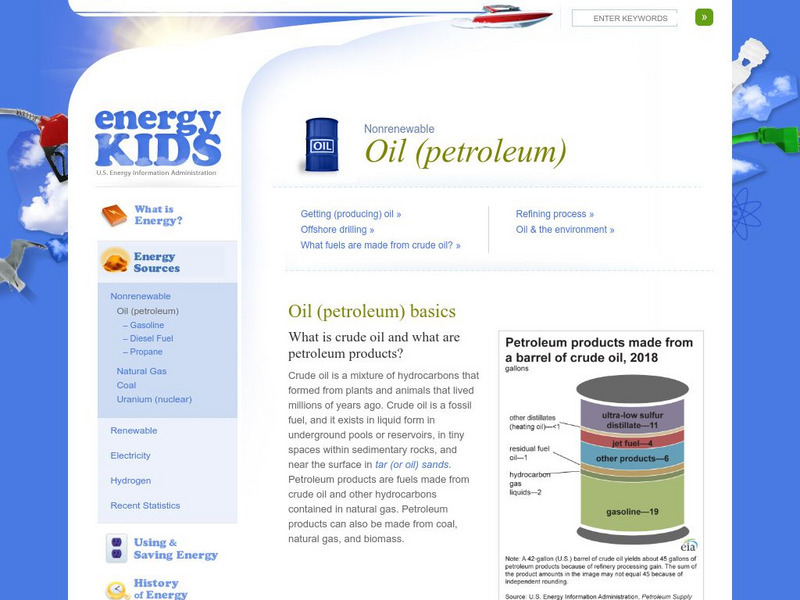
U.s. Eia Energy Kids: Nonrenewable Oil (Petroleum)
Provides good information about oil made from petroleum. Covers production, offshore drilling, fuel products made from crude oil, the refining process, and environmental issues. Includes helpful charts and maps.
Annenberg Foundation
Annenberg Learner: The Habitable Planet: Energy Challenges
With this resource, users join investigators in the exploration of humans' use of and dependence on the many energy resources. Learn about new technologies such as carbon capture and sequestration as an alternative to reduce our carbon...
PBS
Pbs Learning Media: Snapshot of u.s. Energy Use
This video segment adapted from NOVA/FRONTLINE looks at American energy consumption and the resulting production of greenhouse gases. [4:59]
Better Lesson
Better Lesson: Chillin' With Colored Paper
Students work with ice cubes and different colored paper to develop observations in order to prove energy can be transferred from one object to another. Resources include videos of the lesson in action, examples of student work, and...
National Academies of Sciences, Engineering, and Medicine
The National Academies: Our Energy Sources: Natural Gas
Energy production from natural gas is less destructive to the environment than energy produced from coal, but it is still produced from fossil fuels. While advances have been made in reducing its detrimental effects, our resources are...
Other
Biology Simulations: Cell Energy
This simulation can be used as a virtual lab for photosynthesis, cellular respiration, and primary productivity.
National Academies of Sciences, Engineering, and Medicine
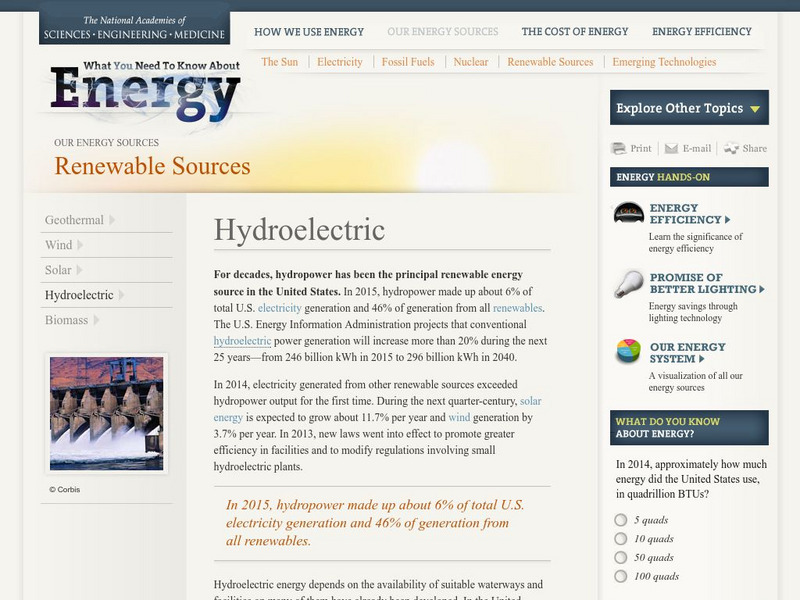
The National Academies: Renewable Sources: Hydroelectric
Hydroelectric power has been a major source of energy production in the United States. More recently, other alternative energy sources have taken some of its market share. Hydroelectricity has both advantages and disadvantages, briefly...
National Academies of Sciences, Engineering, and Medicine
The National Academies: Emerging Technologies: Hydrogen Fuel Cells
The advantages and disadvantages of hydrogen fuel cell technology as a source for energy production are outlined. There is still much to be done in research and development before this energy source can be marketed widely.
Arizona State University
Arizona State University: Why Study Photosynthesis?
Article discusses importance of Photosynthesis in terms of food, energy, and environment. Relates process to human needs.
Energy for Sustainable Development
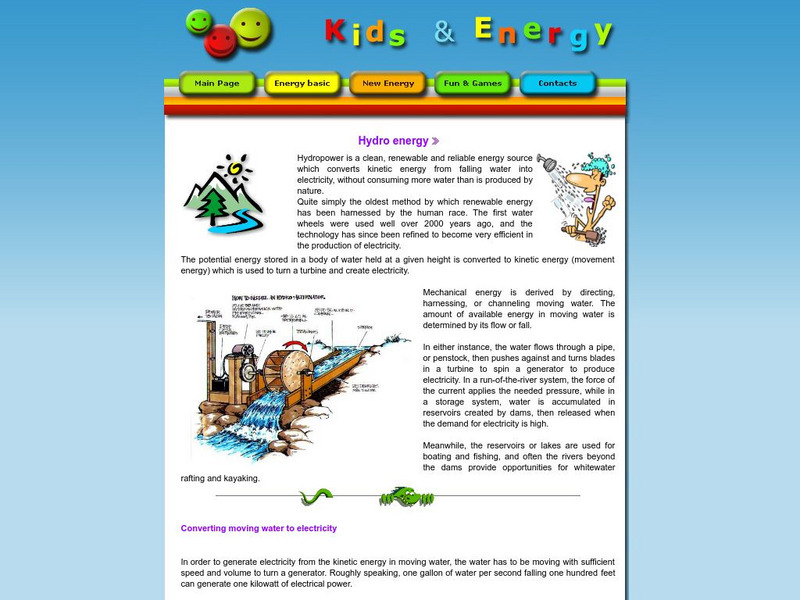
Kids and Energy: Hydro Energy
Hydropower is a clean, renewable and reliable energy source which converts kinetic energy from falling water into electricity, without consuming more water than is produced by nature. Quite simply the oldest method by which renewable...
PBS
Pbs Learning Media: Sci Girls | Industrial Engineering
Industrial engineers improve processes by eliminating any waste of time, money, energy, or other resources. They need to understand how every part can affect the entire process and figure out how to balance each part to design the most...
NC State University
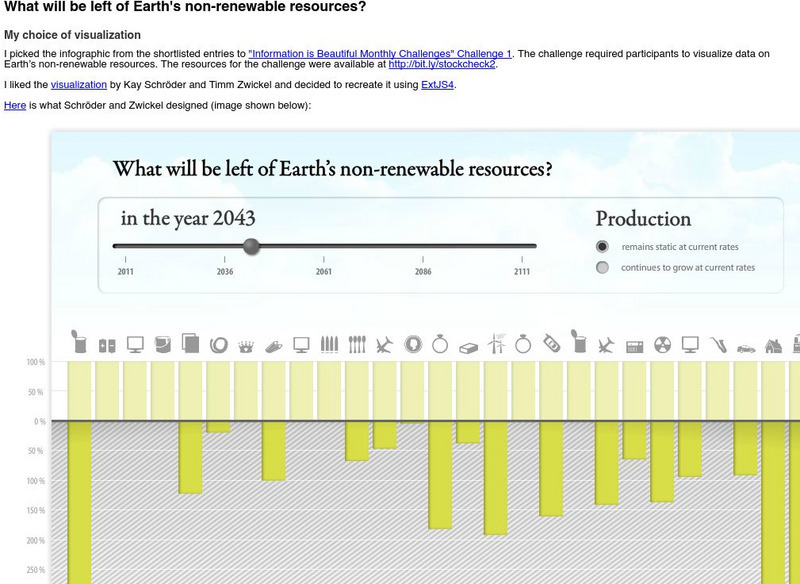
Ncsu: What Will Be Left of Earth's Non Renewable Resources?
An interactive graph that predicts how many years until more than two dozen natural resources (e.g., chromium, oil, tin, coal, etc.) are depleted, based on current production rates or production that grows each year. Use the slider at...
Other
Digital Library for Earth System Education: Teaching Box: Seasonal Upwelling
A suite of lessons focusing on the process of upwelling. Inquiry-based exploration of seasonal upwelling includes marine food webs, food production in the ocean, wind-driven ocean currents, and seasonal changes in biotic and abiotic...
National Academies of Sciences, Engineering, and Medicine
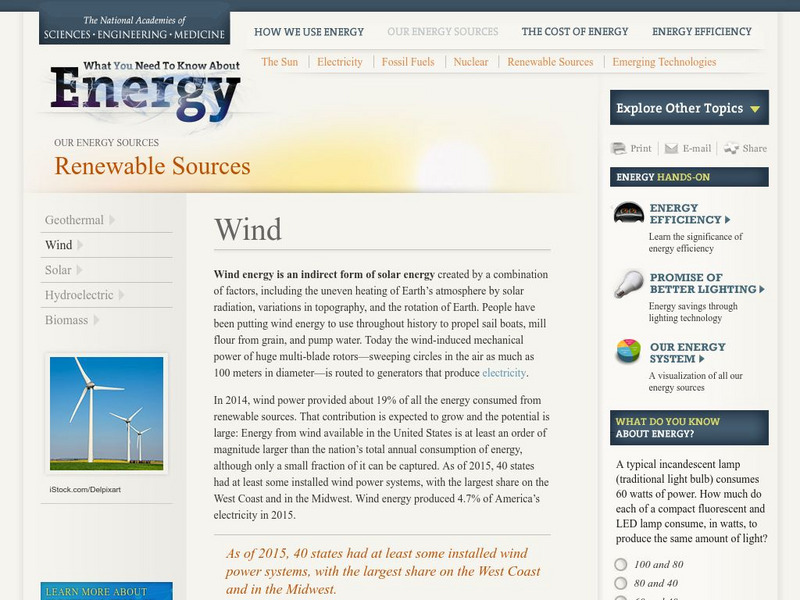
The National Academies: Renewable Sources: Wind
The status of wind energy production in the United States is described, with the advantages and disadvantages of this alternative energy source.
Energy4Me
Energy4me: Peak Oil Game
This activity aims to explore the production process and its advancing technologies to better extract petroleum for products and energy use. What happens to production as the amount of oil in the ground decreases?
National High Magnetic Field Laboratory
Magnet Academy: Fluorescent Lamp 1934
Compared to incandescent lamps, fluorescent lamps last longer, require less energy and produce less heat, advantages resulting from the different way in which they generate light.
National Academies of Sciences, Engineering, and Medicine
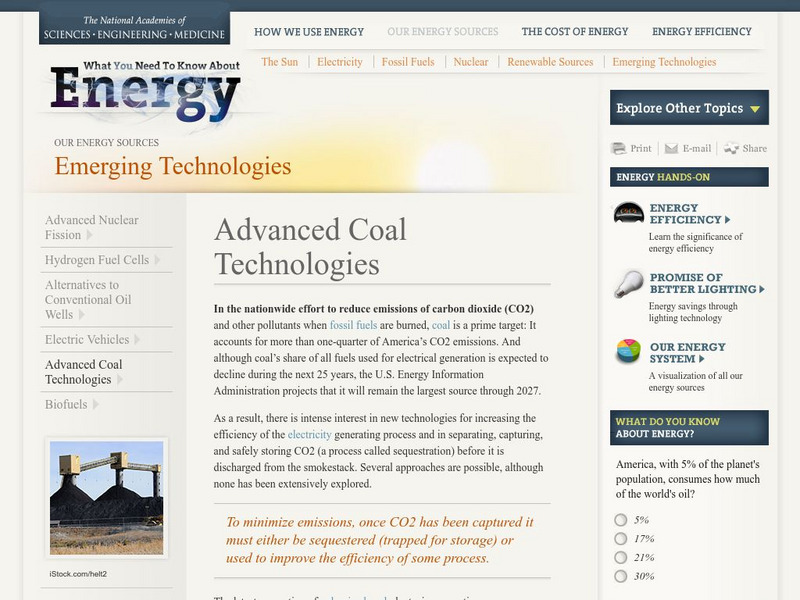
The National Academies: Emerging Technologies: Advanced Coal Technologies
Coal is still widely used in energy production but is responsible for a third of the carbon dioxide emissions in the United States. New technologies, described here, are being developed to reduce or eliminate these emissions.
TeachEngineering
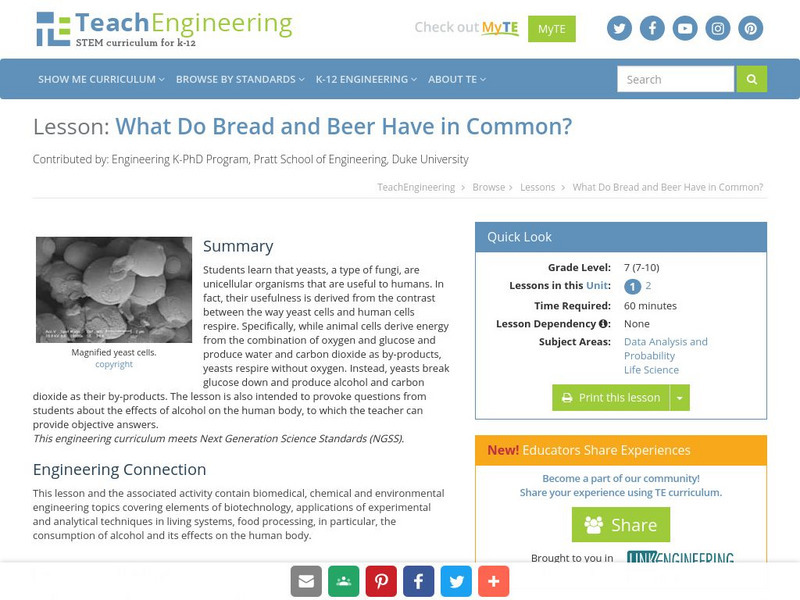
Teach Engineering: What Do Bread and Beer Have in Common?
Students are presented with information that will allow them to recognize that yeasts are unicellular organisms that are useful to humans. In fact, their usefulness is derived from the contrast between the way yeast cells and human cells...